
Climate taz
Golf in times of climate change: sporty firebreaks
Golf courses proved helpful in fighting the devastating forest fires in France. Where new plants should be built everywhere. more...
Deutsch (original) ·Auto-translated to English
T he literary supplement to the wochentaz from October 2nd was illustrated with two dramatic photos of golfers on a green course; Flames from a gigantic forest fire blazed in the background. Headline: “Apocalypse now”. The scene was undoubtedly apocalyptic.
The cynical taz caption for the archive images from 2017 by US photographer Kristy McCluer: “No need to worry: the grass is still green.” Message: Look, these narrow-minded golfers just continue to play unmoved while people are fighting for their belongings, maybe even for their lives. Even if we don't know the details of the Eagle Creek fire in Oregon, you really don't want to be particularly kind to these club swingers.
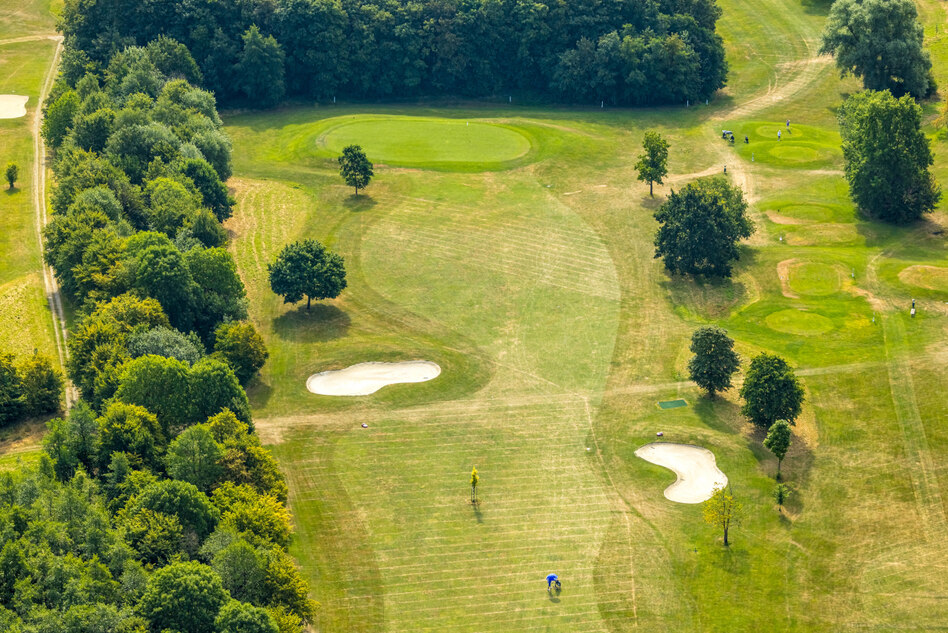
Since this blazing summer, the combination of forest fire and golf course has taken on a new meaning. Golf courses can slow down flames. If a fire breaks out, the fairways, which are usually 40 or 50 meters wide, with their short-mown lawns in a forest area are natural barriers. Ground fires lose power and sometimes go out completely. Elsewhere, forestry milling machines, harvesters or even small tanks have to quickly plow such paths into the forests.
There were a few examples in southwest France, where the worst fires of the past scorching summer raged near Bordeaux. Of course, unlike in Oregon, the courses were closed, whether the Golf International d'Arcachon, Golf de Pessac or Biscarrosse. The fire made it impossible for people to access, but the places were in the way of the fire.
The French website sportstrategies.com wrote: A golf course can represent “an infrastructure of resilience” and “play a strategic role”. Golf courses as “smart firefighting strongholds” because “vegetation is more fragmented due to golf.”
Fire departments have enough space on the green lanes to coordinate firefighting. Above all: Most golf courses have ponds or lakes. Extinguishing water is available directly on site, including irrigation systems with powerful pumps and extensive pipes. If there are still players around when there is a fire, they form an integrated reporting system, initially better than drones, if it suddenly becomes acutely threatening.
“A golf course,” says sportstrategies.com, “must become a multifunctional landscape capable of reconciling sporting use, water sobriety, biological diversity and risk prevention.” Golf courses are therefore integrative: as places for the most beautiful sport in the world and as cleverly used tools of forest architecture. Such multiple functions of these fire golf courses also serve to improve their image.
Forward-looking policy must therefore think big. Forests need aisles. The timber industry's plantations must be cut up piecemeal by golf courses, in the long term out of self-interest. Also in Germany: in the vast areas of the particularly hot southwest, including the Black Forest, also in the often dry Brandenburg or in national parks such as the Bavarian Forest.
It is also important to take precautions close to the city, for example in Berlin: In Grunewald, residents like Joschka Fischer and neighbors Golf could sleep more peacefully, thanks to. The zoo lends itself to a long, winding queue, 18 lanes from the Reichstag building to the zoo.
The causes of the climate catastrophe have not been eliminated. But you can imagine what golf courses could do. If you are shocked at the charred tree landscapes on the left and right of a narrow road in a French forest fire area these days, your immediate reflex is: Well, there was no golf course here.
Exaggerated? We must not forget: What was just trivialized as the fire of the century will soon be a normal quarterly fire.