
World · taz · · 2h
Refugees at the Latvian border: With greetings from Moscow
Deutsch (original) · Auto-translated to English
There are two graves just a few meters from Latvia's border with Belarus. The two people buried there have neither names nor their nationality is known. And the time of her death is also not clear. These are just two of the unknown people who have fallen victim to the tensions at the European Union's external border.
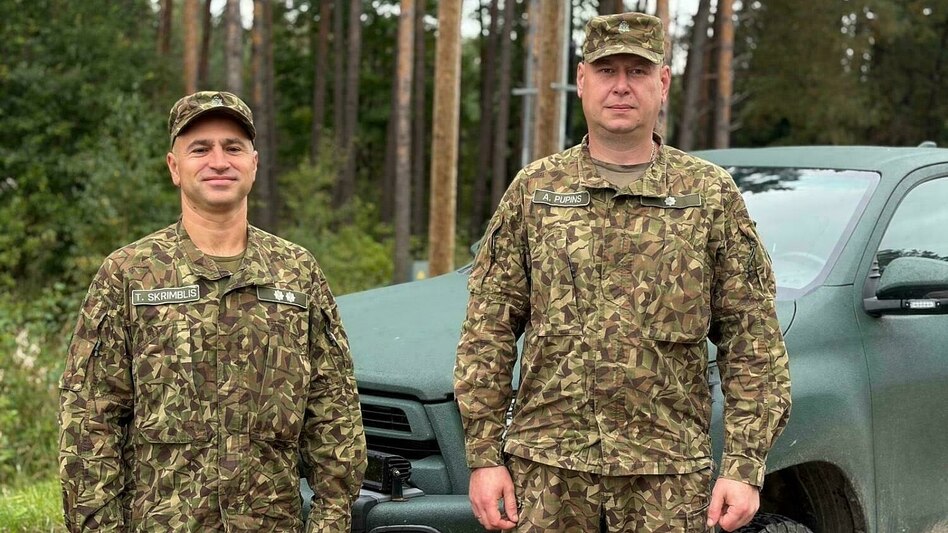
“Human trafficking is extremely well organized here,” says Lieutenant Colonel Tomass Skrimblis, deputy head of the border guard administration in Daugavpils. "It is organized by both sides and there are organizers abroad who coordinate the entire operation. Huge sums of money are involved." Like the commander of the Latvian state border guard, General Guntis Pujāts, Skrimblis also speaks of a “mafia” at work here on the Latvian-Belarusian border. What this means specifically is that Belarus and Russia are involved here. The governments of Latvia, Lithuania and Poland have mentioned this several times.
The border with Belarus is lined with dark and swampy forests, valleys and hills, lakes and rivers - and is very sparsely populated. Part of the border runs along Latvia's largest river, the Daugava. The refugees first get stranded in camps on the Belarusian side and then try to cross the border illegally in various ways: for example over the almost 4 meter high metal fence that separates the two countries, over the river - and recently also through underground, dug tunnels.
Latvia will elect a new parliament on October 3rd. This means that 100 MPs will be appointed for the 15th Saeima. So far, Prime Minister is Andris Kulbergs from the green-conservative alliance Apvienotais saraksts (AS). Kulbergs only ran the business for around 4 months because his predecessor Evika Silina lost confidence and resigned due to several drone incidents in Latvia.
Topics in the election campaign are the Russian war of aggression in Ukraine and Latvia's associated increased investments in defense and migration and asylum policy. Population decline, high inflation and the cost of living are also top issues. The central question is how much money the Latvian government wants to invest in defense. In current polls, Kulberg's alliance is currently ahead, followed by the populist right LPV - Latvia first. (taz)
Such a tunnel was discovered a few weeks ago not far from the Silene border post. The underground passage was probably only used once before it was discovered. Now it has been filled in again and, for safety reasons, barbed wire has been laid inside the tunnel. Another tunnel was also found near the Belarusian border in Kaplava. “This was a much more elaborate tunnel because it had both support beams and boards inside,” says Skrimblis. "It was also longer and you could see that they had prepared for the passage of a larger number of people. But we found this one too, even though it was well camouflaged and covered with moss."
This article was made possible through the financial support of the Forschungsfonds Ausland e. V. You can support the research fund through a donation or membership.
The border guards do not believe that all this would be possible without the support of Belarusian border guards or their willingness to turn a blind eye. Like its neighboring countries Lithuania and Estonia as well as Finland and Poland, the country has an external EU border. Since 2021, the number of people illegally crossing the border from Belarus to Latvia has increased steadily. The authorities speak of hybrid warfare.
"In Belarus, camps have even been set up where these people spend several days or weeks. They do not cross the border on their own initiative. They are taken there and told how to get to Latvia," reports Skrimblis. Holes would even be cut in the fence for them or ladders would be placed on the border walls so that people could cross the border. NGOs that work with refugees coming from these camps regularly tell similar stories.
Artūrs Pupins, head of the Silene border guard department, recalls a shocking event: "A body lay on the Belarusian side for more than three days. We reported that there was a body there, but they did not react. The person lay there, in a ditch, for three days and nights." Only when a letter was sent through official channels did things start to move. There is no exact data on how many people actually cross the border. But what is being recorded is how many people are turned away at the border and sent back to Belarus.
As of 2021, this has been more than 50,000 people. Between 30 and 100 people were turned away every day. Only a small part of them stay in Latvia, for example if there are health reasons. In 2023, 408 people were able to stay in Latvia for humanitarian reasons. However, over the past two years, the number of such cases has fallen sharply - 26 in 2024, 32 last year and 14 so far this year. "In the meantime, however, the profile of the migrants has changed. They are mostly men between the ages of 20 and 40. Young, strong, healthy men whose goal is to get to Germany," says Skrimblis. Previously there were many women and families with children.
People who are turned away at the border are not registered, so their exact origin remains unknown. Border Patrol officials estimate that the majority of those crossing the border illegally currently come from African countries. For a while, many came from Middle Eastern countries. Not only is the border heavily guarded, but also the surrounding area. Since Latvia's Prime Minister Andris Kulbergs launched Operation Vilkatis (English: "Werewolf") to deter migrants at the beginning of August this year, both the national armed forces and the police have provided greater support to border guards.
Latvia's government has increased staff at the border and is also using drones to find people who want to cross the border. Locals should also help, for example by reporting when they see refugees. The border guards say they are cooperating very well.
The closest, more populated area to the border is the village of Silene. Single-family houses, a school, the community center, a Catholic church. The streets are empty on this Monday afternoon. In some gardens you can see women pulling weeds in their flowerbeds or hanging out laundry. Suddenly an older woman comes down the street, she is 80 years old. Has she ever seen refugees here? "I don't. But I know that people say there are some. We just carry on as usual," says the woman in Silene, less than 10 kilometers from the Belarusian border.
For Anna Griķe, these people exist. She just came from the Orthodox cemetery. Two migrants are buried there, one next to the other. On the sandy hill there are two crosses on which the inscription “Unknown Person” can be read. Eleven people have died on the Latvian side in recent years, but so far only one has been identified.
Anna Griķe has made it her mission to look after the gravesites of the deceased and help relatives find migrants who disappeared along the way. She has been working with the non-governmental organization “I Want to Help Refugees” for several years. She first heard about the refugees at the border in 2021 when she moved to Krāslava with her family to work on her doctoral thesis. At that time, this topic was overshadowed by the Covid pandemic.
In 2022 she began monitoring the border together with other helpers. She counted those who were sent back and those who died trying to cross the border. She spoke to local residents and conducted interviews with them: “Only one of them said she had met migrants,” says Griķe. "Only once in those four years. Everyone else just knew someone who had met one at some point." Perhaps this refusal to believe is also due to the fact that in Latvia, aiding and abetting illegal border crossings is punished with high penalties: prison sentences of between two and ten years.
Griķe, like the border guards, also confirms that Latvia is only a transit country for migrants and that they choose the route because it is safer than crossing the Mediterranean. “That’s very sensible,” she says dryly. "If a boat sinks, there's a good chance everyone will drown. The only risk here is being stranded along the way." Of course, that is something of an understatement: the forests and swamps in the border area are dangerous.
Over the years, through conversations with refugees, among other things, she has gained a rough idea of the route the smugglers take. Asylum seekers from African countries or the Middle East are almost certainly first brought to Russia, where they are then transported either further to the border or to one of Latvia's larger cities, for example Daugavpils or Riga. “Then the next minibus comes, for example to Germany,” says Griķe. "And it's just like this: Just as we sometimes can't list all the countries in Africa, they don't know all the countries in Europe either. They usually have a specific target in mind - a specific person, perhaps a relative from a specific town or village."
Griķe also met migrants who were able to stay in Latvia for humanitarian reasons. She particularly remembers the story of a woman from Somalia. "She was about 38 years old, the same age as me. And she had lost both legs on the trip. They had been amputated due to frostbite. And she had left three children at home!" remembers Griķe. The woman was politically persecuted in Somalia. She reached Latvia seriously injured and without the opportunity to contact her children. Griķe and the aid organization got her a cell phone and a SIM card. A little help when no one else feels responsible.
Griķe believes that this may also be the reason why fewer and fewer women and families with children are coming to the border, but rather single men. According to their count, many of those crossing the border illegally in 2023 came from India, Bangladesh and Pakistan. But in the last two or three years there have been particularly high numbers of people from Somalia, Ethiopia and Eritrea. Many refugees also came from Afghanistan.
The border between Latvia and Belarus is 173 kilometers long. With 30 to 100 arrests per day, Griķe doesn't want to talk about a migration crisis. In a country with around 2 million inhabitants, border guards and authorities apparently see things differently.
The number of deaths at the border has not been recorded for years. Griķe fears that the number of people missing or dead is even higher than previously thought. People are fleeing from the border officials. Not everyone is caught and the forests around the border are dark and swampy. The remains of dead refugees are buried in Latvia - in cemeteries not far from where they were found.
Relatives of the missing are also in regular contact with Griķe and her organization, which in turn has contacts with other NGOs in the refugees' countries of origin. One of the most poignant stories about an identified deceased was that of a young girl from Somalia who died in the spring of 2024. She could have been easily identified based on the description of her relatives, says Griķe. But the police insisted on DNA tests, tried for a long time to convince the relatives, and when they finally succeeded after two weeks, the girl had already been buried. The tragic result: To this day, her relatives refuse to believe that their daughter was buried. “They don’t really want to accept what happened,” says Griķe.
Read the full story at the source
Source: taz