
Migration taz
Commemoration of deportations on Platform 17: The final transition from right to wrong
85 years ago, the first train carrying deported Jews left Berlin-Grunewald station. The commemoration of the Shoah is mixed with fear of a new anti-Semitism. more...
Deutsch (original) ·Auto-translated to English
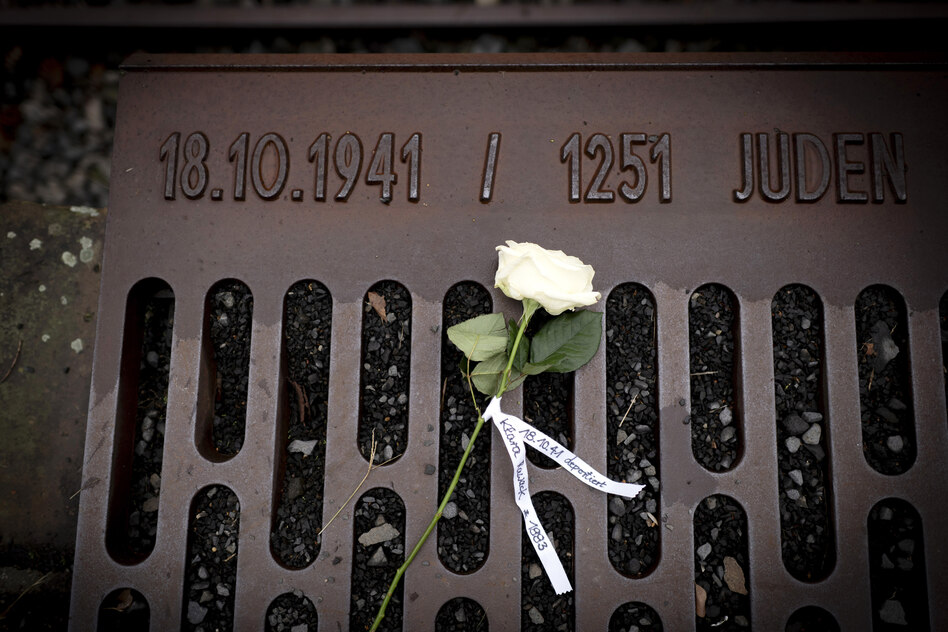
Trains no longer run on platform 17 in Berlin-Grunewald. The rust-covered rails end at two platforms that resemble ramps. The platforms are no longer platforms, just as the tracks are no longer used to carry people into the distance. To the north a small forest has grown on the tracks.
Nevertheless, several hundred people gathered on platform 17 on Sunday afternoon. They have come to commemorate. The first Berlin Jews were deported to their deaths from this platform of a normal train station 85 years earlier. The first Berlin “Osttransport” left the Reich capital on October 18, 1941 for Lodz in occupied Poland, called Litzmannstadt by the Nazis, where they had set up a Jewish ghetto. On board the train, made up of older passenger cars, were more than 1,000 people, old and young, women and men, and children.
Stephan Harbarth, the President of the Federal Constitutional Court, is the keynote speaker. He recalls the “crossing into a space in which law was not even present in traces”. The deportations were the “final transition from right to wrong,” said Harbarth. He avoids any reference to today's political movements and parties. The analogies are nevertheless unmistakable. “The destruction of the rule of law is taking place gradually,” he says, and “lawlessness and arbitrariness are spreading like ulcers.” Because: “Evil infiltrates minds and hearts.”
The two ramps on platform 17 have inscriptions embedded in the ground on their ledges facing the track. They each consist of a date and a name. “Theresienstadt” is there again and again, and “Riga”, very often “Auschwitz”, but also “unknown”. The places indicate the destinations of the trains on which the Jews were taken to their deaths. About 10,000 from this station alone. About 50,000, if you include the other Berlin deportation sites at the Moabit freight station and the Anhalter Bahnhof.
The Israeli ambassador in Berlin Ron Prosor also emphasizes the processual nature of the extermination of Jews under the Nazis. “When this train left, the persecutions had long since reached their goal,” he says and: “The deportations did not begin on the rails, but in the middle of society.” Today, Jews in Germany are being attacked again, “they still have to justify the fact that they are Jews.” The spread of anti-Semitism begins when hatred goes unchallenged. “Freedom of expression must not become freedom of incitement,” says Prosor. "History teaches us: When it comes to anti-Semitism, a red line must be drawn. First it affects the Jews and then everyone else."
In previous years, many survivors came to the annual commemoration on October 18th at Platform 17. Not anymore today. Almost all of them have died. The commemoration also serves to reassure the city's leaders that barbarism must not be allowed to repeat itself. That's no longer so easy to say these days.
The more than 1,000 people persecuted in the first deportation were initially sent to the Levetzowstrasse collection camp. On October 18, 1941, only the frail were taken by the SS on trucks to the train station; everyone else had to walk - across the city, in front of everyone, with the “Jewish star” on their chest. The train was traveling for a long time. It was cold. After arriving in Lodz, the people in the ghetto had to do forced labor. Inadequate nutrition and medical care meant that many were soon no longer able to work. Most of them were taken to Chelmno/Kulmhof and murdered there. Those who lasted longer went to Auschwitz.
Abraham Lehrer, the vice president of the Central Council of Jews in Germany and head of the Cologne Jewish community, talks less about the past. He's talking about the present, about the fact that the AfD, a party that received more than 40 percent of the vote in Saxony-Anhalt, is planning to stop funding school trips to Nazi memorial sites. “The interest in dealing with the past is decreasing dramatically,” says Lehrer.
Petra Pau, the long-time Vice President of the Bundestag and member of the Left and PDS, sits in the front row of the guests of honor. Even after leaving parliament, she remained a constant voice for remembering the Nazi atrocities. She listens to Lehrer when he talks about the Berlin Left Party. He accuses MP Vanessa Emde of wanting to get into anti-Semitism and then get out again. “But she feels best in the middle,” says Lehrer about Emde, who doubts the right of states – and therefore also Israel – to exist. Israel is being turned into an unjust state, teachers complain. In truth, he says, it is “the old hatred of Jews” that is resurfacing again. Petra Pau says nothing.
At the end of the memorial hour, cantor Simon Zkorenblut said the Kaddish, the Jewish prayer for the dead. The perhaps 400 people lay white roses on the two ramps of Grunewald and leave.