
Germany · taz · · 1d
Football above all: Klopp nation Germany
Deutsch (original) · Auto-translated to English
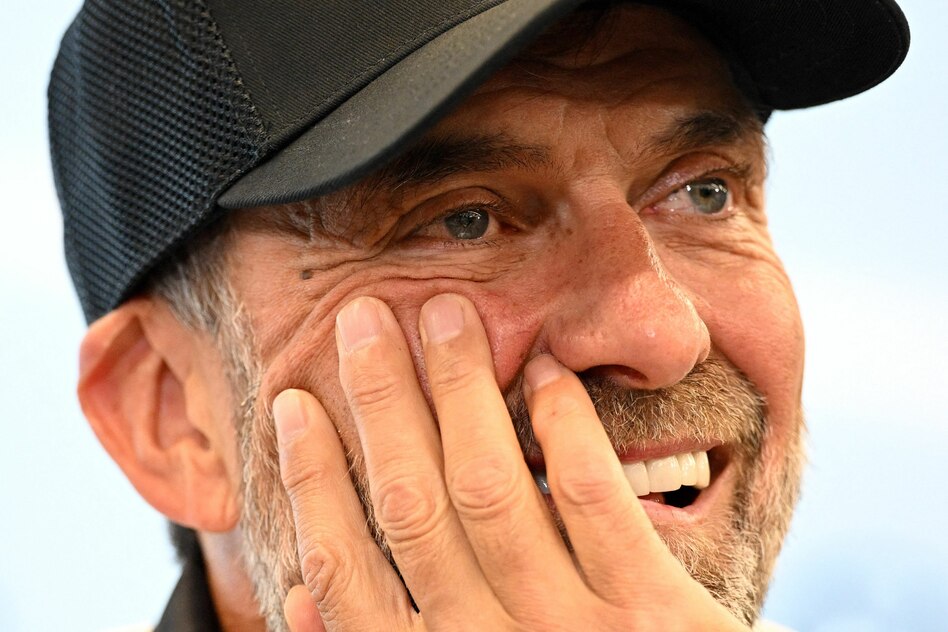
In Germany, sport rules. Fascists can conquer a country by winning at the ballot boxes, the federal government may stagger under the weight of an overwhelmed Chancellor and the world may burn fueled by climate change and wars - if the coach of the national soccer team even announces a press conference, there is only one big topic left: Jürgen Klopp.
The first nominations became public just over a week before the DFB selection will play its first game under Germany's football messiah. The fact that Deniz Undav, Germany's most popular World Cup loser, would not be one of the two teams that Klopp has called up for the upcoming four games in the European Nations League was already being hotly debated, even before Jürgen Klopp had sat down behind the microphones at the DFB campus in Frankfurt am Main.
The power of sport to cover up all other topics with trivialities has rarely been as visible as in this week's nomination of Klopp's first national team squad. You could easily get the idea that Germany is a true sports nation. When you take a closer look at the perception of sport in the country, it quickly becomes clear that this is definitely not the case. Just three days after the Germans' Nations League opener against the Netherlands in Amsterdam, the German Olympic Sports Confederation will decide which location Germany will apply to host the 2036, 2040 or 2044 Summer Olympics. But hardly anyone talks about it. Germany may be a football nation, but the Germans are certainly not a sports nation.
Even if state and federal politicians as well as top officials in German sports never tire of emphasizing that it is finally time to bring humanity's largest sports festival to Germany, a German application for this is a niche topic in the public discourse. There would be exciting questions to discuss about the rings. Questions that go far beyond which of the three applications has the best chance at the International Olympic Committee: the one from Munich, the one from Berlin or the one from North Rhine-Westphalia with Cologne as the flagship.
One could, for example, argue about the meaning of Olympism, one of whose essential features is the quasi-religious worship of sporting achievement. About how such a mega-event could be designed in such a way that it can no longer be so easily exploited for nationalist propaganda.
There could also be a fundamental debate about whether the Summer Games in times of climate catastrophe should still be planned according to the same patterns as in previous decades. And on a small scale, it would be good to discuss how sensible it was to send several cities into the expensive race for the title of candidate city in times of mostly empty municipal coffers. We can't talk enough about the costs of the games and the power of the IOC.
Instead, we learn that Pep Lijnders, Jürgen Klopp's Dutch assistant coach, went to the monastery for a week to prepare for his new job at the DFB. And while the whole nation now knows the name of Felix Keidel, the new recruit from the Bundesliga village of Elversberg, many may not know who Thomas Weikert is. Thomas Weikert? A little tip: He is the President of the German Olympic Sports Confederation.
Read the full story at the source
Source: taz