
Germany taz
Research on vegan foods: cheese is the supreme discipline
Vegan cheese is little more than colored coconut oil. Until now. At the Fraunhofer Institute in Freising, researchers are ripening plant milk. more...
Deutsch (original) ·Auto-translated to English
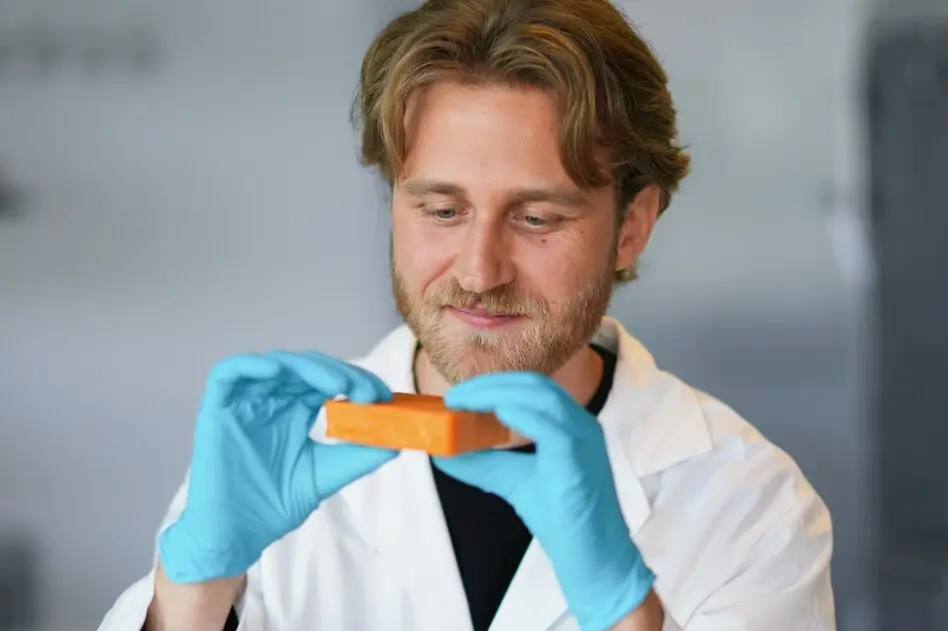
The small cuboid piece spent weeks in a warm cupboard. There it was turned and cared for, slowly changing its color from orange to pale yellow and is now between Daniel Kolesnik's fingers. What he proudly presents is not a new wellness product. It's not cheese either, at least not one that can be called that. Because it was not made from the milk of cattle, goats or sheep, but from plant milk.
In times of disasters and scarcity of resources, the sweaty, holey, slightly sour-smelling piece is intended to help secure our food supply. Don't do it! is probably the thought of anyone who has ever searched in vain for a vegan cheese that also tastes like cheese, that has comparable nutritional values and is more than just a colored block of coconut fat and starch. Animal-free cold cuts, plant-based mince, vegan sausages, all of this has long since found its place in most supermarkets. But vegan cheese?
“This is the supreme discipline of food technology,” says Daniel Kolesnik. The chemist works at the Fraunhofer Institute for Process Engineering and Packaging (IVV) in Freising, Upper Bavaria. “The current vegan products on the market don’t have much to do with cheese,” he confirms. “So far there has only been a technological attempt to imitate the melting properties with fat and starch.” This means that the products contain virtually no protein at all. But people expect something different.
Gouda and Edam, Camembert and Gorgonzola, Cheddar and Gruyère, Feta and Parmesan: there are more than 4,000 types of cheese worldwide. They arise from the milk of different animals that are kept in different places and fed differently there; from milk that is metabolized by different lactic acid bacteria, which is skimmed, broken, matured and refined in a variety of ways. Anyone who wants to imitate this diversity using plants must overcome a special challenge. It is called casein.
This protein is mainly found in cow's milk. If you add rennet from calves' stomachs, the casein breaks down and re-links itself. The milk will thicken without becoming sour. whey comes out; the more, the firmer the cheese will be later. Then the microbes take over. Lactic acid bacteria first metabolize lactose, which contains the most quickly available energy. The organisms then attack the casein. They break it down into peptides and individual amino acids, creating volatile aromas: spicy, fruity, grassy.
“The proteins in plant drinks behave completely differently than the casein from cow’s milk,” explains Daniel Kolesnik. “Developing it into a type of cheese is difficult to get under control.” The plant proteins flocculate differently, trap water differently and do not melt. Many bacterial cultures cannot do anything with them.
So Kolesnik has to play tricks. "We look at which flavors are reproducible. These substances must interact with texture, consistency, melt and other properties." Kolesnik and his team are trying to precipitate the plant protein from certain lactic acid bacteria. “We want to do this without additives and bells and whistles, with conventional fermentation.”
The dairy technology center of the Freising Fraunhofer Institute is a hygienically clean basement full of stainless steel tables and oversized kitchen appliances. Anyone who enters should put on a coat and shoe protectors and disinfect their hands. The bacteria are sensitive.
Here, plant drinks are mixed and pressed so that the fat remains in an emulsion and does not separate. It is heated with steam and gassed with nitrogen to prevent it from going rancid. Lupins, for example, which the institute and the surrounding area have long-standing experience with, serve as protein suppliers. The IVV also tests peas, faba beans and other protein-rich plants that grow on local fields. Since the institute works with international partners from Brazil and Indonesia, nuts and seeds are also interesting.
Instead of using rennet from calves' stomachs, Daniel Kolesnik precipitates the protein with acid. The plant milk flocculates, the mass is pressed and shaped. Then comes the actual research question: Which microbes can develop cheese flavors from plant proteins? The choice is enormous; thousands of potential bacterial strains are known. The bacterial genus Lactobacillus alone, which belongs to the lactic acid bacteria, has become so confusing that a few years ago it was divided into 25 separate genera.
Kolesnik tests well-known laboratory strains as well as cultures that work well with plants. The microorganisms have to balance the acid value so that the cheese does not taste too sour. Fermentation also breaks down bitter substances and other substances that slow down digestion.
People have been making cheese for thousands of years. Because they were lactose intolerant. Because wheels of cheese were easier to transport than buckets of milk. Because cheese is more digestible, rich in nutrients and lasts longer. So why break with this well-honed tradition? “Because we can no longer afford all the cheese,” explains institute director Andrea Büttner.
“Animal farming takes up around 83 percent of the world’s agricultural land,” she says. It also causes a large proportion of all greenhouse gases, with methane from cattle stomachs being a particularly big problem. “We need food produced much more efficiently if we want to supply ten to twelve billion people,” said Büttner. “We need food in all situations, including during climate disasters and animal epidemics.”
In the event of a crisis, Germany only made provisions for the energy sector and less for food. There are structural reasons for this, says Andrea Büttner: “Crisis management is not the responsibility of the Ministry of Agriculture.” The federal government is storing grain as well as a civilian emergency reserve of rice, peas, lentils and around 5,000 tons of condensed milk. The emergency ration must be durable, nutritious and, if possible, locally grown.
Products made from vegetable protein would significantly improve the supply, says Büttner. “Protein supply is an unresolved issue,” explains the institute director. “It has to be refined and stored; it’s not primarily about a tasty result.”
Daniel Kolesnik tries anyway. After all, he conducts research on behalf of food manufacturers. And they want the results to taste good, just as their customers are used to. For the chemist himself, it's not that important to imitate cheese perfectly, he says: "If the nutritional values and resources are right, the product can taste like something else."
In the case of the pale yellow sweaty piece from the Freising laboratory cabinet, customers don't have to get used to a new taste. Daniel Kolesnik's product is not allowed to be tried as it has not yet been approved. But the researcher promises: “It tastes cheesy, nutty, a little sour and beany.” It's towards parmesan.