
Germany taz
Greenpeace warns for Germany: Large data centers can lead to water stress
Some planned data centers in Germany could use as much water as a small town, warns Greenpeace. That endangers the supply. more...
Deutsch (original) ·Auto-translated to English
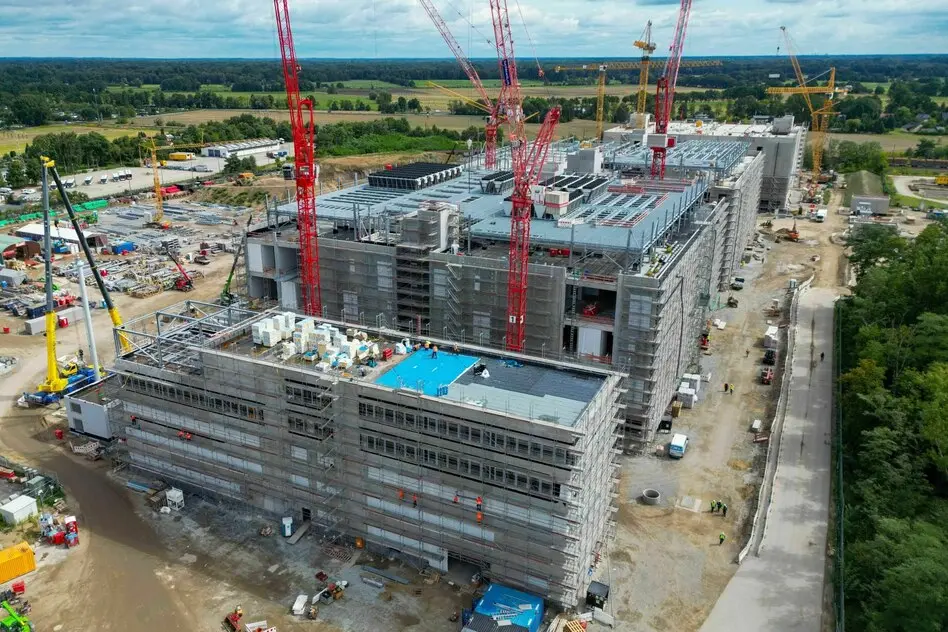
Large data centers can lead to water stress in dry regions of Germany. According to a short study by the Oeko-Institut on behalf of the environmental organization Greenpeace, local server farms will use around 13 billion liters of water for cooling in 2025. By 2030, this demand could grow to up to 27 billion liters per year thanks to new mega data factories - which corresponds to the drinking water consumption of a large city with around 580,000 inhabitants, about as much as food.
“This can have disastrous effects locally,” says Greenpeace expert Linda Klapdor to the taz. Last summer, which was particularly hot and dry, there were restrictions on water use and historic lows in rivers and lakes in some municipalities. Greenpeace is calling on the federal government to provide mandatory water reports before approvals, a ban on water-intensive systems in dry areas and consistent sanctions for violations of official reporting obligations.
The federal government plans to double data center capacities in Germany by 2030. While previous systems usually have less than 5 megawatts of connected power, systems with over 1 gigawatt are now being built, more than 200 times as much. Almost 30 huge projects with more than 100 megawatts of server capacity are currently being planned in Germany.
The study models their annual water requirements at up to 930 million liters per year, roughly the drinking water consumption of a small town with 20,000 people. In already dry regions, the new data factories could “cause acute groundwater stress, distribution conflicts with increasing burdens on people in the affected communities and damage to the local ecosystem,” the study says. The high electricity requirement is also problematic.
These calculations contrast with the representation of the digital economy. The industry association Bitkom recently classified the water requirements of 65 percent of German data centers as “very low”. Almost two thirds of the local systems used a maximum of 0.1 liters of water per kilowatt hour of IT power consumption, according to a Bitkom study published this week.
After cleaning up some incomplete data sets from the official data center register, the Öko-Institut comes to a weighted average of 0.67 liters of water per kilowatt hour of IT power consumption. The current annual consumption of 13 billion liters by German data centers already corresponds to the water content of Berlin's Wannsee.
“The problem is the lack of transparency from the operators,” says Klapdor, explaining the different representations. Less than half of the approximately 1,200 data center operators in Germany that are required to report provided any data to the authorities; only 139 reports were usable for the study. According to Bitkom, the different values “may be explained by the different calculation approaches and the underlying database,” according to a statement for the taz.
In addition, Greenpeace contradicts a central argument from the operators, according to which low electricity consumption must necessarily be bought at the expense of higher water usage. In practice, no statistical connection between electricity and water efficiency can be proven. High energy efficiency can be achieved completely without water cooling. Modern dry or compression cooling could even reduce the water consumption of server farms completely to zero.
While there are only a few protests against new data centers in Germany, they were one of the important issues in the midterm election campaign in the USA. According to a survey by news agencies published on Wednesday, 56 percent of voters considered the issues of data centers and artificial intelligence a decisive factor in their vote. Many Democratic candidates campaigned on tighter regulation of the construction of data centers. There are a particularly large number of planned data centers in three of the states that the Democrats won over the Republicans in the Senate elections: Texas, Ohio and Iowa.
In the USA they are controversial not only because of their high energy and land consumption, but also because of air pollution. Due to a lack of network capacity, operators often built gas power plants nearby to provide electricity.
This also has a negative climate effect. According to a study by the environmental organization Sierra Club, energy production for data centers currently planned in the USA by 2030 will cause 618 million tons of CO2. For comparison: Germany caused 649 million tons last year. In many places, US data center projects failed due to local protests by the population; there were 45 in the second quarter of 2026 alone.
Among other things, Democratic Senator Bernie Sanders' call for a US-wide moratorium on the construction of data centers caused unrest on stock markets worldwide on Thursday and Friday. In many places, stocks related to the chip industry, which are seen as profiting from the AI hype, collapsed.
This could also be felt in Germany. The German leading index DAX fell by 2.3 percent to 25,706 points on Friday. In Japan, the Nikkei index fell by 7 percent at its peak; in the USA, the Nasdaq technology exchange index fell by 5.5 percent on Thursday. “Fears of rigorous AI regulation after the US Democrats’ landslide victory triggered a real panic on Wall Street and in Asia,” an analyst told Reuters. AI stocks had already lost their appeal in the run-up to the elections.