
Germany · taz · · 58m
Flood disaster in the Himalayas: “There was simply no warning system”
Deutsch (original) · Auto-translated to English
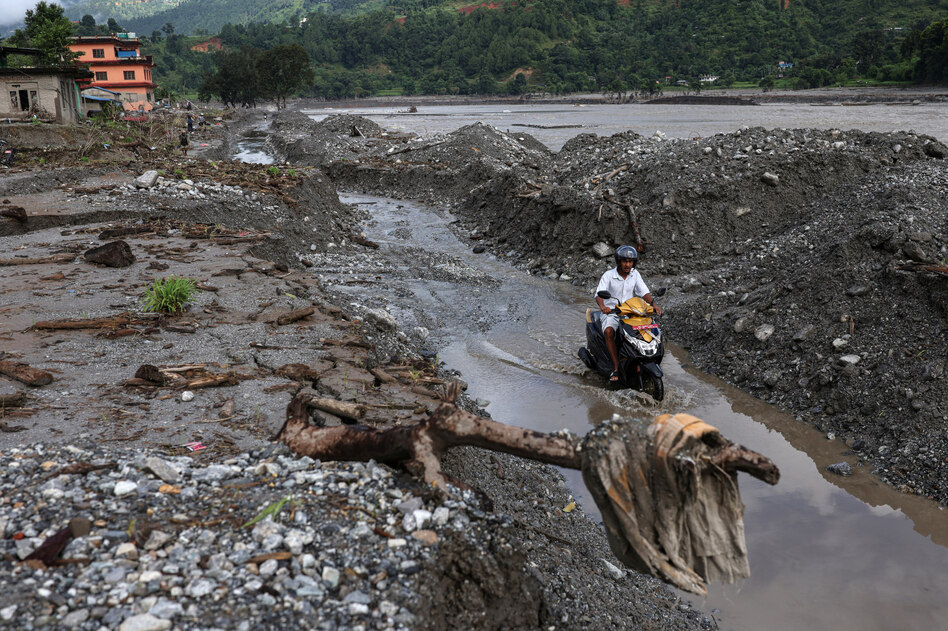
taz: A booklet by the Helmholtz Center for Georesearch was recently published on the subject of early warning systems. One text stands out in retrospect. Illustrated with a photo of a Nepalese mountain, it is about flash floods and seismic networks. Shortly afterwards there was a major flash flood in Nepal. Could people have been warned?
Jens Turowski: Basically yes. There are ways to detect when and where in the mountains rock masses start to slide. Unfortunately, this is happening more and more often due to climate change. For example, permafrost soils, i.e. permanently frozen soils, thaw and move at high altitudes.
born in 1978 in Aachen, studied “Experimental and Theoretical Physics” at the University of Cambridge, Great Britain, until 2003. Today he is a physicist at the GFZ Helmholtz Center for Georesearch in Potsdam and researches natural hazard processes and early warning systems.
In this specific case, however, there was no chance of systematically warning people, even though we were still able to measure the energy of the landslide here in Germany: there was simply no warning system. What there was - but we only know this from the media - are text messages that were sent from survivors further up into the valley.
taz: Are there any examples of successful early warnings?
Turowski: In the Swiss village of Brienz, the measuring systems showed in 2023 that the speed of the debris movements on the Piz Linard accelerated significantly, which is why the community was evacuated at the beginning of May. Seven weeks later, the rubble slipped and reached the edge of the village.
taz: There wasn't that much time in Nepal.
Turowski: That's right. A landslide caused a huge tidal wave that swept away the Chinese-Nepalese border crossing after eight to ten minutes.
taz: Are there still ways to give advance warning?
Turowski: The tidal wave propagated 170 kilometers downstream in the Trisuli valley, causing fatal damage more than 80 kilometers below its starting point. In some cases there would have been several hours to warn people.
taz: What is necessary for warning systems for such events?
Turowski: We first have to distinguish between different methods: In Brienz or two years later during the landslide in Blatten in the Valais Alps, there were decades-long observations of the unstable areas using local measuring systems. But the Himalayas are so big that such measuring systems are like a drop in the ocean. In our approach, we therefore work with seismic waves in the ground.
Turowski: In principle, yes. Such waves travel at speeds of more than 1,500 kilometers per hour and tell us that something is happening. The trick is to find out what is happening where.
Turowski: Such waves also occur when a house is blown up or a dam is drained. Even if a tractor drives very close to a seismic measuring point, they are created. We call this “secondary noise”. They need to be filtered out.
Turowski: Seismic waves have different characters. Earthquakes, for example, can be clearly identified, which is helpful for early warning of such events - a sharp increase in amplitude, which then drops in a typical triangular shape. A flash flood at the surface, on the other hand, causes a long, flat amplitude, more like a cigar shape.
Turowski: It depends. Earthquakes are fairly easy to detect. Even large explosions have a clear signature. This is why the International Atomic Energy Agency can also monitor compliance with the Nuclear Non-Proliferation Treaty by evaluating seismic data. However, it is much more difficult to distinguish a flood from man-made noises, for example. We use data from well-documented events to train a machine learning detection algorithm. In a second step, an event would then have to be localized.
taz: How much time does your research still need before the answer is reliable?
Turowski: Scientifically, we understand what needs to be done. But we would have to invest in research so that we can make progress. My colleague Niels Hovius estimates that an operational system could be set up in Nepal within two to three years for around 10 million euros. This money has not yet been invested.
taz: If you have the necessary results, would warnings against such events be possible?
Turowski: From a scientific point of view, that could work. In addition to optimizing the systems, there are other open questions. For example, at what limit an alarm is triggered. This is a political negotiation process: If we set a low limit, false alarms are often triggered, which leads to distrust in the system.
If the threshold is too high, a warning system may prove ineffective because the danger was not detected. This is where the “last mile problem” begins: How do you alert people? By sirens? Via app? There must also be a clear process principle in the event of a warning. If it's missing, the warnings won't help either, as the flood in the Ahr Valley in 2021 showed.
Turowski: At that time there were advance warnings about the amount of rain from both the weather service and the European flood warning system Efas. What was missing in the Ahr Valley were clear responsibilities and operational plans, such as answers to the question of what amount of rain the valley or individual settlements would have had to be evacuated. The warning was there, but it either didn't reach people at all, arrived too late, or it was often unclear what to do.
taz: Back to Nepal: Is the government interested in the research of the Potsdam Helmholtz Center?
Turowski: Very much so. Flash floods are not uncommon on the southern slopes of the Himalayas, but they receive little attention from the local media. In July last year, for example, there was a similarly catastrophic flood in the same valley with at least nine deaths. Some of what was destroyed back then had just been rebuilt - such as the road to the border post. How serious such events are for the country is shown by the border crossing to China, to which there is no longer even a road in the Trisuli valley: almost a third of trade with China passed through this route.
taz: What would be the prerequisite for a comprehensive early warning system?
Turowski: In addition to a breakthrough in seismic research, an expansion of the measuring system: Because of the high risk of earthquakes, there are already a number of seismic stations in Nepal, but in order to be able to warn of small-scale events such as landslides, 80 to 100 more are necessary.
taz: How much does it cost and who should pay for it?
Turowski: A station can be had for just 15,000 euros, not very much when you consider that the damage from this tidal wave alone is estimated at 4 billion euros. 100 stations then cost around 1.5 million euros. There are also costs for setting up the network, a data and warning center, training of experts, the necessary further research and development and long-term maintenance and personnel costs.
Turowski: Definitely safer. Our system still needs to be tested under operational conditions and a residual risk always remains. The last mile problem also still needs to be solved.
Read the full story at the source
Source: taz