
Climate taz
Financial protection against climate damage: Insurance against climate damage should become better
The federal government is making proposals for better risk insurance. It is unclear how high contributions can be prevented, critics complain. more...
Deutsch (original) ·Auto-translated to English
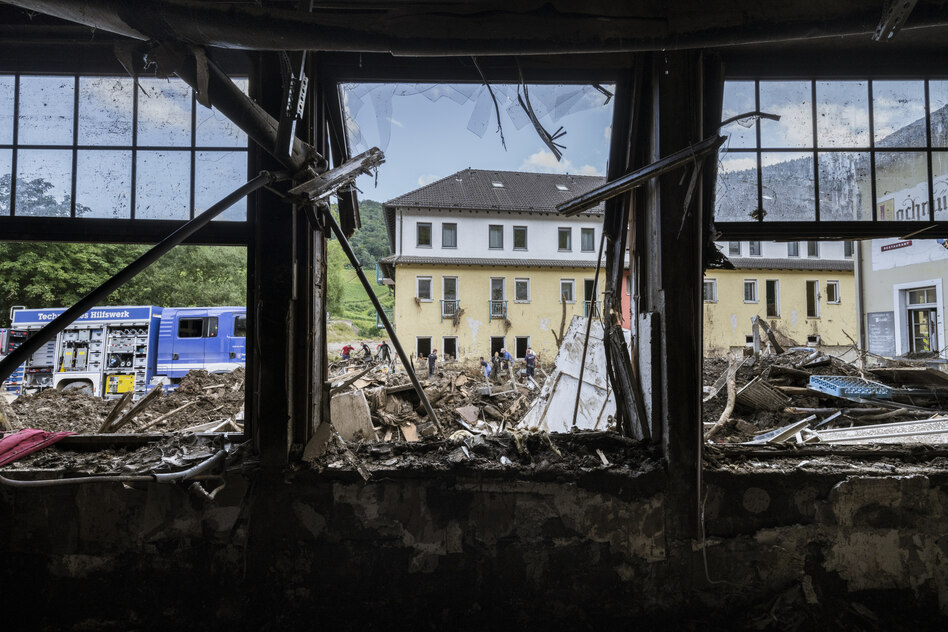
The climate crisis can affect every homeowner: The Federal Ministry of Finance and the Federal Ministry of Justice want owners to insure themselves against damage caused by flooding and other extreme weather events. In the future, a corresponding component will be offered as standard when taking out a residential building policy. For existing contracts, the so-called elementary protection should be taken up within one year. This emerges from a discussion paper presented by Federal Finance Minister Lars Klingbeil (SPD) and Federal Justice Minister Stefanie Hubig (SPD) on Wednesday.
Consumer advocates and the federal states have long been calling for the introduction of mandatory natural hazard insurance for residential buildings. This should also make protection in risk areas affordable. Due to global warming, extreme weather events such as heavy rain or floods are increasing. The damage is immense, as the Ahr Valley flooding in 2021 showed. Experts are also discussing whether climate damage has the potential to cause financial systems to collapse. The possible damage threatens to overwhelm the capital-rich insurance industry. If companies therefore withdraw from business, buildings could lose their value, which would have an impact on mortgages and, in the worst case, the stability of banks.
However, the situation in Germany is far from this. In this country, insurers only pay for damage caused by floods or heavy rain if the building policies have their own elemental damage supplement. In endangered areas this is very expensive. According to the federal government, only 59 percent of residential buildings in Germany have this addition. If citizens do not have insurance coverage, the state often steps in after a disaster.
The ministries are proposing that elemental protection become standard in new contracts in the future. A personal contribution of up to 10 percent, up to a maximum of 20,000 euros per claim, should be possible. The protection should be included in existing policies during a transitional phase of one year. The addition will then be added automatically. When setting the premium amount, the insurer must explain what risks it assumes.
The ministries are leaving one central question unanswered: whether there should be the possibility for customers to refuse elementary protection. The government wants to check this. If you decide not to do so, you should consider a minimum insurance policy that includes a personal contribution of 50 percent of the insurance coverage, up to a maximum of 100,000 euros. In this case, customers should be made aware that they may not receive any government aid in the event of a disaster.
The consumer organization Association of Insured Persons rates the paper positively. “This is an important step,” says board member Stephen Rehmke. “This is de facto compulsory insurance.” He expects that premiums for homeowners will increase. He thinks it's good that insurance companies will have to present their price calculations in the future. “Today a customer cannot understand how the premium amount is determined,” he explains.
The paper is disappointing, says Anna Lena Samborski from the environmental organization Urgewald, which monitors the financial industry. “There is a lack of a consistent line,” she says. The topic has been discussed for 25 years. However, the federal government has still not decided whether it wants real compulsory insurance. Samborski criticizes the fact that the paper does not provide for a mechanism by which the level of contributions can be regulated by the state. This would be possible if the state acted as a reinsurer. The state would then relieve the companies that conclude contracts with customers of some of the financial risks in the event of a disaster. This would make insurance affordable even in high-risk areas. “There is already such a model in France,” she says.
The left-wing faction in the Bundestag also considers Klingbeil and Hubig's discussion proposal to be immature. “It remains completely unclear how this insurance will be affordable for everyone,” criticizes left-wing MP Aaron Valent. According to the paper, insurers should be able to continue to set premiums depending on the risk situation. That is a lack of solidarity. “The climate crisis and its impacts can change quickly and so can risk assessments,” he warns. A house that was built 20 years ago in a low-risk area may be considered at risk today. People should not be punished for increasing the risk.
The left-wing faction also calls for a state reinsurance solution. “We are proposing a sustainable and solidarity-based model with a nationwide natural disaster fund that is reinsured by the state,” says Valent. All owners should pay their contribution there. “In addition, companies that are particularly harmful to the climate should increase the fund,” he demands.
The Greens also lack clear rules that ensure affordable insurance coverage for everyone. They see the paper as a step in the right direction, but overall find it too non-binding and socially unbalanced. “There is a risk of gaps in protection and financial overtaxing for private households in the event of damage,” says Green Bundestag member Lukas Benner.