
Germany · taz · · 3h
Error culture in activism: Failure is beautiful
Deutsch (original) · Auto-translated to English
Start-ups and their founders can be accused of many things: that they believe that the world can be saved with the “right” product. That they are hostile to works councils and unions. The fact that their ideas are based more on the spirit of the times than on values - after all, where sustainable companies were founded ten years ago, defense start-ups are now sprouting up. But what you can't blame them for is a lack of perseverance or lack of imagination.
Out of doggedness and ingenuity, the idea of celebrating failure emerged in the start-up scene. People talk about it on an open stage. About failure as a lesson, as an opportunity to correct course or as an opportunity for a new beginning. They call it “fuckup night”. Loosely translated: “fuckup night”.
Hundreds of such events are now taking place around the world. But why should only entrepreneurs celebrate their failure? After all, mistakes happen everywhere. Social movements use various tactics to achieve progress. Some rely on large demonstrations, others block fossil infrastructure. In doing so, they can fail on a large scale: if they bring hundreds of thousands onto the streets but still cannot enforce their concerns. Or on a smaller scale: when they fall out with the city administration and the public order office wants to pull the power plug from the stage.
We therefore asked three activists what mistakes they made. And what they learned from it.
Julian Miethig organizes the CSD in Köthen. However, since 2025 without support from the city
When did we lose all support from the city? Maybe when Jan Böhmermann shared our Instagram post. He had already supported the first CSD 2024 in Köthen. And through him, several 100,000 people suddenly knew about our difficulties in organizing a second CSD.
In order to be able to provide participants with sanitary facilities, food and drinks for the entire period from 12 p.m. to 10 p.m., we have to apply to the city for special use. That's exactly what we do, on time. No reaction.
Even a few days before the CSD we still don't have permission to set up floats. In the said Instagram post we describe our situation. According to the regulatory authorities, the toilet truck is not allowed to be on the market square; at most behind the church, which is next door. But we see a concrete risk situation for the participants. If sanitary infrastructure is relocated to areas with poor visibility, it is difficult to ensure safety. We asked several times in the weeks before the CSD for a constructive conversation, without success.
Until the great publicity that the Instagram post creates forces the mayor to invite us at short notice. She is completely horrified. What do we think of exposing her like that? Apparently she also has no idea about the conditions she gave us. For example, she absolutely rejects the supply stands, even though we have to set them up. There is a baker, she says. However, it closes on Saturdays at 12 p.m., exactly when our demo begins. She breaks off the conversation.
With our lawyer behind us, we are initiating urgent proceedings at the administrative court to ensure supply and disposal. This then decides one day before the CSD that toilets can be placed on the market square and that supplies must be guaranteed. But the judgment does not explicitly mention eating and drinking; that part remains vague.
And so the fight with the public order office is far from over. When we wanted to connect the stage to the power supply on Saturday morning, the office tried to prevent that too and was on the verge of literally pulling the plug on us. We wouldn't have submitted the relevant applications in advance - that's exactly what we tried to do, and legally they could even be submitted on site. The office calls the police, but luckily they are on our side and we come to an agreement.
But then comes the goulash cannon. We set it up, put the tent and the tables down. There is also a small grill. Suddenly five people from the public order office come to the stand operator and say: "The goulash cannon is not registered and is not part of the demo. It has to be dismantled." What do we do with the grill? It's already burning. “You just have to get water.” Well, let's dismantle this now, I say. The people from the public order office are perplexed: What? Why is there no resistance?
I gather ten people together. We push the goulash cannon maybe 15 meters to the church steps on the edge of the market square and set up a drinks stand. The public order office feels ripped off. “That should go now,” they say. But this is not the city's property, it belongs to the church. I take a document from the priest out of my bag, he confirms: You can use it.
The priest is an old friend of mine, I have taken precautions. At first the public order office doesn't want to accept this, then they tell us, "There will be repercussions" and leave. At 12 p.m. we open the CSD, parade through Köthen and celebrate undisturbed.
We realized that it was a mistake to rely completely on cooperation with the city. And we don't depend on them because we have so many allies in Köthen. The priest, also the police. I hadn't even considered this before: how important these relationships are. It's about the people who get involved, who want to help shape things. This is much more important than administration.
You are reading a text from our future department. If you're interested in more positive perspectives, subscribe to TEAM FUTURE, the constructive newsletter on climate, knowledge, utopias. Every Thursday you will receive an email from us with strong thoughts for you and the planet.
🐾 Sign up now for the TEAM FUTURE newsletter – free of charge
The aftermath that the public order office announced was that the mayor reported me for defamation. I found out about this from the press. The proceedings were discontinued in January. We held the CSD this year without city support.
Sina Reisch was the press spokesperson for Ende Gelände in 2019. During one campaign she found herself exactly where she didn't want to be as a speaker
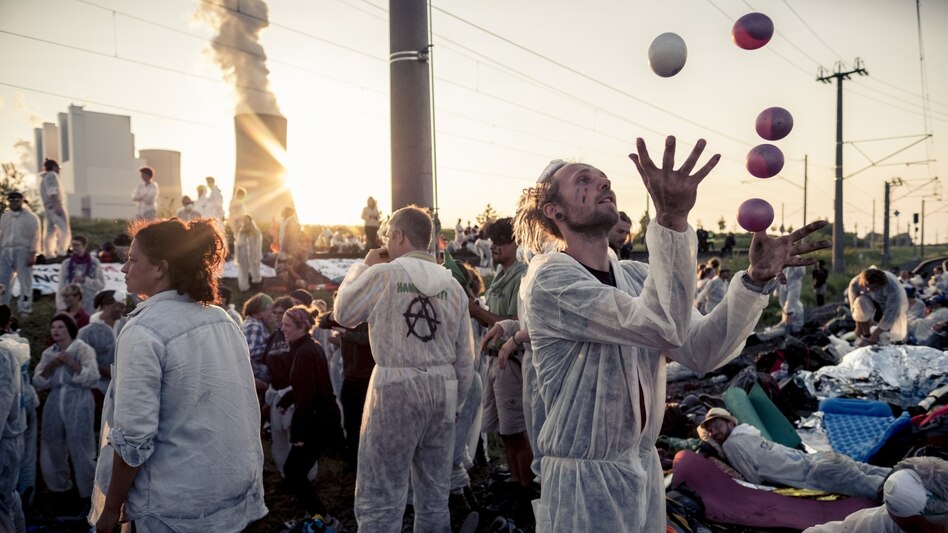
In June 2019, thousands of people blocked coal infrastructure in the Rhineland with their bodies. They climb into pits or sit on the rails on which trains transport tons of brown coal to the power plants. With the mass actions, we at Ende Gelände want to show that, in view of the climate crisis, a fundamentally different economic system is needed, away from capitalism.
As press spokesperson, I go from one action to the next. Always go to where what's going on and where journalists are. Thousands of people are stuck in the blockades and our responsibility as press officers is to explain to the world why they are doing this. We are three press spokespeople and we split up. For us, the following applies: don't go into action, don't get caught up in a police line, but always stand on the sidelines to give interviews. If we are not there, in the worst case scenario the journalists will just quote the police - and they often lie.
Many blockages are successful on the first day. The rail blockade in front of the Neurath power plant in North Rhine-Westphalia - at the time the largest coal-fired power plant in Germany - is particularly beautiful. The place is difficult to reach, so the activists are not evicted and can even spend the night there. To pass the time, the activists play music, dance and sing, and do acrobatic yoga. The food supply keeps coming, bringing stews, porridge, chili sin carne. It almost develops into a festival atmosphere.
On Saturday evening the blockade has been in place for over 24 hours. The activists announce that they will leave on Sunday at 10 a.m. This will also be discussed with the police, who want to leave us alone until then so that we don't have to carry everyone away one by one. So the situation is relaxed, the journalists have already taken their photos and are elsewhere. So for us press spokespersons, the location has a low priority. But I know that friends of mine are there and I would like to see them. So I go, even though I shouldn't, and spend the night on the tracks.
On Sunday we wake up, start packing our things and get ready for a relaxed demo back to camp. But the police appear out of nowhere and surround the blockade. We are in a cauldron. Shit.
For me that means several problems. I have maneuvered myself into a situation in which I can no longer do my only job as a press spokeswoman - giving interviews. In addition, there is now a threat of repression. Ende Gelände actually relies on denial of identity: Anyone who goes into action and actively blocks does not have any ID with them and does not tell the police their name. As a press spokesperson, I spoke with my real name and had my identity with me. Standing next to the action isn't a problem - being in a cauldron is.
My phone rings. A journalist is standing by the kettle, can't get in and wants an interview. We are feverishly looking for a solution – and we find it. During actions, MPs are present for parliamentary observation. They always get through police lines. One of them says, "Come on, just follow me. I'll say you're on my team." No sooner said than done – and the plan works. I'm out of the cauldron and a huge weight falls off my heart. I welcome the journalist and give my interview. But I only have a second of relief.
As soon as I turn around, the head of operations stands in front of me: "What did I just hear? You are the press spokesperson for Ende Gelaende? I thought you were an employee of this MP?!" He wants to send me back to the cauldron because I'm a participant in the meeting. I refuse: "I don't want to attend this meeting. You can't force me to be part of a meeting I don't want to attend!"
Then the police officer says: “If you don’t go back into the cauldron now, we will use immediate force!” Three camera crews are trained on us. A hint of amusement crosses my face and I watch as it slowly dawns on him that he has just made a mistake.
“Police violently throw press spokeswoman into the cauldron” – is that the headline the head of operations wants to risk? I'll let it happen. Finally four officers drag me away with painful grips. Of course I'm screaming like crazy, the pain is not without its consequences. And the whole cauldron chants: "Freedom of the press! Freedom of the press!" Instead of going back to the cauldron, the police take me to their squad cars. I sit there and record videos because I still have my cell phones. The headline goes through the press and the Internet: “Press spokeswoman violently arrested.”
This text first appeared in wochentaz, our weekly newspaper from the left!
Every week, wochentaz is about the world as it is – and as it could be. A left-wing weekly newspaper with a voice, attitude and the special taz view of the world. New every Saturday at the kiosk and of course by subscription.
On the day I went into the blockade as press spokeswoman, I made a mistake. I would have had to stay outside to give interviews. But I am convinced that building movement is always building relationships.
The night on the rail bonded us together and created trust. A few months later I was in Venice with the same people to block cruise ships. I don't want to have to stay away from my friends just to do a job well. Some mistakes are easy to make.
Uwe Hiksch registered a demonstration against the TTIP free trade agreement in 2015. And in the end he was happy that there was no mass panic
Suddenly the entire Street of June 17th between the Brandenburg Gate and the Victory Column is full of people. The police tell us that the main train station will be closed, as will the S-Bahn stations around our demonstration. People would flock from everywhere. So much so that soon they won't even be able to flow anymore, so many are already standing there. As a demo registrant, I am of course thrilled. 250,000 people are there. Appreciated! You can't even count things like that anymore.
They all want to demonstrate with us in Berlin in 2015 for fair world trade. This is based on the two free trade agreements TTIP and Ceta, i.e. between the EU and the USA and Canada. In a broad alliance of environmental associations, human rights organizations, trade unions and many others, we have planned an anti-TTIP demo.
The public controversy revolves around the famous chlorinated chickens. If TTIP came along, different food standards would be set, which outrages many people. And of course food brings people onto the streets. But people also want to protest against the unfair global economic system, against human rights violations, against the dismantling of social benefits and trade union rights.
Under the label “Prevent TTIP/Ceta” the movement succeeds in bringing together a whole range of different underlying currents. Demo organizers always want to mobilize as many people as possible. Most of the time we can only influence this to a limited extent. This time a basic mood simply emerged. Even we didn't expect that it would end up attracting so many people.
At the beginning we are assuming 50,000 demonstrators. That was already a dimension that had to be brought onto the street first. Then bus after bus with participants quickly register. We notice that a dynamic is developing and we are doubling our forecast towards the police. And they also estimate: That could be 100,000.
In high spirits, we adjust our plans. We're making the stage much bigger and putting it next to the Victory Column, because from there the drainage directions are easier if panic breaks out. Wide paths are needed. We also order additional loudspeaker systems - we have to provide sound for the entire huge street.
On the demo day itself, half of those who arrived never see the stage. “Celebrate wherever you are, together we will prevent TTIP!” we say with megaphones. The euphoria is mixed with tension. When the police reported to us that there had been no movement at the main train station - two kilometers away - for an hour and a half, we realized how dangerous the situation was. A friend of mine is coming from that direction. He stands in the same place for over two hours. If mass panic breaks out, it could happen like in Duisburg in 2010. Like at the Love Parade, when 21 people died in the crowd.
We know: Only calm demonstrators and level-headed stewards can prevent this, if at all. Backstage I try to keep track of as much as possible. However, we have no chance of influencing what happens at the main station. There are 150 folders and only one channel for the radios we're talking about. It's just too much.
We speak to the police every quarter of an hour. The basic requirement is that peace remains. Principle of being in a good mood. We praise the cooperation on stage so that the demonstrators follow the announcements. In the end everything goes well. When we talk to the police afterwards, we look deeply into each other's eyes and say: We were all lucky together.
Since then, we have been taking a closer look at the demo process and structuring the folder concept very clearly. We use different channels for the radios so that only a few people communicate with each other at a time. We take better account of how people can flow out.
But the biggest lesson was: mass movements alone do not change society. Political attitudes don't change if I take to the streets twice. I still remember how all the politicians from the SPD, the Greens and the Left Party gathered in the front row of the demo. They made a holy promise to us that they would be against TTIP and Ceta. A short time later, the SPD held a small party conference and decided to say “yes” to the agreements. The Greens also voted for Ceta in the traffic lights.
We couldn't develop more force from the road. But you always have the problem of transmitting this force to parliament. The big industrial lobbies were so strongly behind TTIP and Ceta that we had no chance. Movements can usually only change something in the medium term.
And even if you think about the big Indivisible demonstrations with 200,000, 250,000 people on the streets - that alone doesn't bring about fundamental social change. There needs to be much, much more. I don't know exactly what that is either. But I've been politically active for 45 years now and will remain so until I'm carried away at some point. For me that doesn't lead to resignation. You just have to keep going.
Read the full story at the source
Source: taz