
Politics · taz · · 1d
Exploding oil prices: Even Poland's conservatives want excess profits tax
Deutsch (original) · Auto-translated to English
Chancellor Friedrich Merz and Polish Prime Minister Donald Tusk both belong to the conservative EU party family of the European People's Party (EPP) and are both in coalition with social democratic parties. But Tusk wants what is being pushed forward in the federal government not by the Chancellor, but by Vice-Chancellor Lars Klingbeil (SPD): an excess profits tax for energy and fuel companies.
The tax on extraordinary profits should be 60 percent. This tax rate is due on profits that are one fifth above the average surplus of 2025. The profits below this amount are applied at the usual tax rate.
The government passed a renewed bill on Tuesday. Parliament, the Sejm, will deal with the special tax on Friday. The cabinet has changed the law that was passed in July so that it will no longer come into force retroactively to March.
Nationalist President Karol Nawrocki rejected the first version: “The law was supposed to come into force in August, but the tax should have already affected the profits made since the beginning of March.” It remains to be seen whether Nawrocki, who was appointed by the populist ruling party Law and Justice (PiS) in 2025, will stop the order again - like some of the ruling coalition's laws.
The law, which will come into force on November 1st, would only allow large parts of the excess profits tax to flow into the 2027 budget after the corporations have finally settled accounts with the tax authorities. The government had calculated the equivalent of 870 million euros - money that could be used by the coalition for election gifts in the 2027 election year.
“Mr President, sign!” demanded Tusk after the cabinet decision. At the same time, he promised: “I guarantee that when the President finally signs the re-filed excess profits bill, we will immediately lower fuel prices further.”
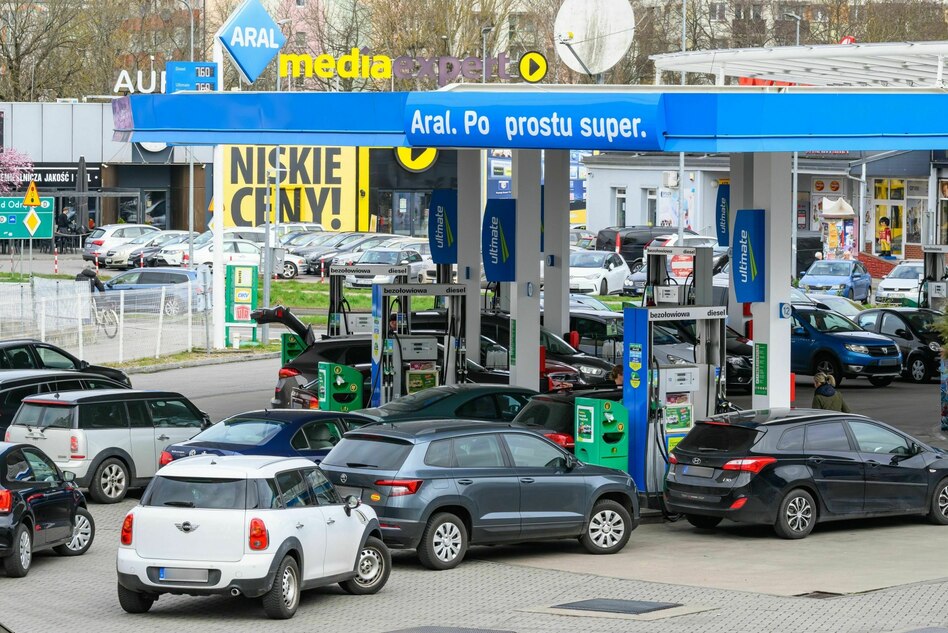
According to Tusk, by far the largest oil company, Orlen, which is 49.9 percent owned by the Polish state, generated 16 billion złoty (3.7 billion euros) in net profit in the first half of the year alone - 10 billion more than in the previous year. “And we have other corporations,” said the prime minister, mentioning the foreign companies Saudi Aramco, MOL, BP and Circle K.
Finance and Economy Minister Andrzej Domański justified the law as follows: He wanted “the fuel companies, which make enormous profits, to finance the protective measures for Polish drivers.” He wants to use the proceeds from the excess profits tax to extend the reduction in VAT on fuel from 23 to 8 percent that took place between March and August.
With the reduction of the energy tax to the EU minimum, this has already consumed 1.3 billion euros. In Germany, which has twice as many inhabitants, the “fuel discount” cost 1.6 billion euros in May and June.
Poland, along with Germany, Italy, Austria, Portugal and Spain, is pushing for an EU-wide excess profits tax for oil companies. So far, the Commission has rejected this, partly because of concerns that the companies could take legal action against it.
PKN Orlen itself is in trouble: In 2023, the Swiss trading division Orlen Trading Switzerland transferred $230 million in advance to a Dubai-based company, which was handed over to Caracas in cryptocurrency for 6 million barrels of Venezuelan oil. An additional $72 million was added for waiting tankers. However, very little of the oil reached Poland.
The EU country, which is most successful in terms of economic growth, is now expecting a budget deficit of 6.8 percent of gross domestic product this year due to massive armaments programs. More than twice as much as permitted in the EU according to the Maastricht criteria.
Read the full story at the source
Source: taz