
Labour taz
First Migra strike in Halle: “All is not lost in Saxony-Anhalt”
On November 5th, migrants went on strike in Halle (Saale). Among other things, it's about visibility, says co-organizer Dalal Mirzo. more...
Deutsch (original) ·Auto-translated to English
taz: Ms. Mirzo, in mid-September you told taz that if the AfD came to power, you would consider leaving Halle, even though you actually want to stay. How are you now?
Dalal Mirzo: In fact, my child and I have been experiencing more exclusion and discrimination for a year and a half - on the street, on public transport and at school. Things got worse after the election results on September 6th. In some encounters I increasingly had the feeling that we, as people with a migration background, were no longer welcome. At the same time, I see how much movement there is in Halle.
Mirzo: How many collectives have been founded in the last few weeks, how many actions are taking place to support people with a migration background or to generally advocate for an open society for everyone. That gave me a lot of hope and courage. Especially in the last two weeks, I have gained new confidence that not everything is lost and that it is worth staying in Saxony-Anhalt and Halle. That's why I'm still considering staying, even if the AfD forms the government.
Born in 1987, has been committed to social participation, integration and the empowerment of women with a migration background in Saxony-Anhalt for many years. She is politically active and is one of the initiators of the non-partisan initiative “MigraStark”, which organizes the Migra strike.
taz: You also co-founded the “MigraStark” initiative after the election. Now you are planning a migrant strike in Halle on November 5th, the second in Saxony-Anhalt. Why?
Mirzo: Because we want to make visible what many people seem to take for granted. What would happen if all people with a migration background stopped working for a few hours or closed their businesses or interrupted their everyday tasks? We are not interested in pitting people against each other. We also don't want to measure a person's worth based on their productivity or economic performance. Every person, regardless of whether they work, pay taxes or contribute economically, has the same value and the same right to social participation and a life in dignity. With the strike, we would rather make it clear how naturally people with a migration background are part of our everyday society and how much their contributions are often overlooked.
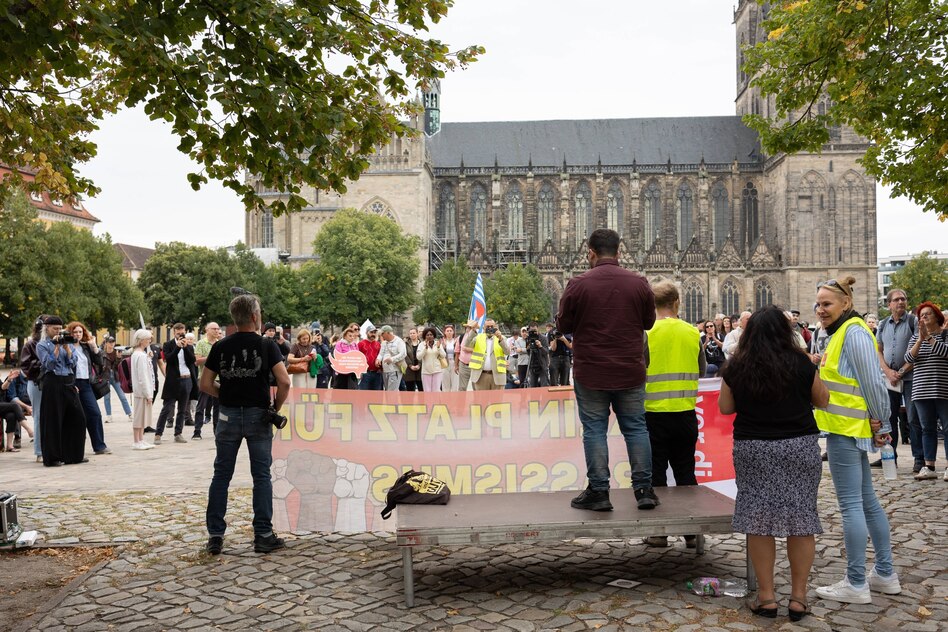
During the Migra strike on November 5th in Halle (Saale), migrant traders stopped their work from 10 a.m. to 4 p.m. There will be a rally from 2 p.m. to 4 p.m. on the market square.
taz: Who do you want to reach with the campaign?
Mirzo: We want to take a stand against racism, discrimination and exclusion. I hope that this action is really noticed, not only by stable people who are fighting for democracy anyway, but also by people who may not yet be aware of what migrants are doing here in this country. The target of our campaign is not necessarily those who are already in a lot of contact with migrants, but rather those who hardly have any points of contact. We want the attention of everyone in this country.
taz: How can solidarity-based people who are not in Saxony-Anhalt support the Migra strike in Halle?
Mirzo: Migrant people can strike in their cities, everyone can share our call, create publicity, show solidarity with a short video message on social media or donate so that we can pay for flyers and posters and the organization of the rally. This is aimed at everyone, including non-migrant people. We welcome people from other cities. When the state parliament presidents were elected on October 6th, I was at the rally in front of the Magdeburg state parliament. I met a person from North Rhine-Westphalia who came specifically to show solidarity because he couldn't imagine being anywhere else that day. That really touched me.