
Germany taz
A piece about the view of others: When gentle Elbe meadows become wild thickets
At the Hamburger Schauspielhaus, “White Fleet” is about real strangeness and foreign realities. It is based on the radio play “The Ridiculous Darkness”. more...
Deutsch (original) ·Auto-translated to English
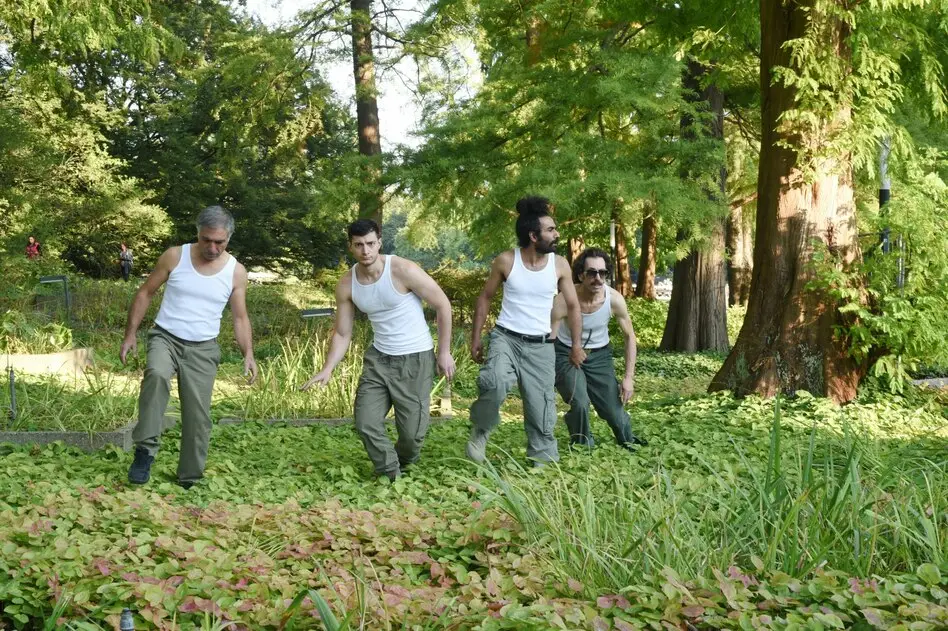
They have lost their real mission. Just like her fifth husband, who disappeared while traveling on the Elbe. More precisely: on a trip in which they tried to “connect the rural population with the migrant man”.
Now they are planning a new one. In the foyer of the Hamburg Schauspielhaus. They call their venture “White Fleet”, which, under the direction of ensemble actress Ute Hannig and theater maker Pia Düsterhus, aims to go up the Elbe in order to search for the missing person, a certain Deutinger. They want to pass Geesthacht, Lauenburg and Tangermünde to Magdeburg. Because that was where Deutinger was last seen. Up until then, like his companions, he had barely survived a number of cruel, uninhibited rituals and had been saved from wild natives who were often drunk on fermented grain.
They are the four remaining. Dave Doughman, Ibrahim Kurt, Nikita Petrosian and Shahin Sheikho are their names on the program list, but in the game their names are similarly resonant: Ultimo Michael, Sergeant Major Pellner, Tofdau and Stefan Dorsch. With these character names and large parts of the text performed, the evening clearly references Wolfram Lotz’s “The Ridiculous Darkness”.
Originally written as a radio play in 2013, this text soon made a career in the theater. In it, the award-winning playwright - loosely based on Joseph Conrad - tells of a journey into the heart of darkness, also about two Bundeswehr officers who wander through the wilderness, and also about a Somali whose local fishing grounds were fished empty by wealthy nations and who became a pirate as a result.
Ultimately, Lotz talks in his text about our inability to truly understand what is foreign. “I always have the feeling that I can’t write about things because I don’t know them,” it is said once. Lotz masterfully overcomes this alienation by repeatedly revealing it, ironizing it and making it the subject himself.
Hannig and Düsterhus, with their four charming actors and some passages from Lotz's dark journey, go in the opposite direction, so to speak. Through the eyes of their migrant team, the supposedly familiar becomes strange that evening, the gentle Elbe meadows become the impenetrable Saxony-Anhalt wilderness. Film shots of the banks of the Elbe and the embankment move across the walls in the foyer, while migrant perspectives meet rural German horizons.
As a framework, the four actors give a lecture and an appeal for donations to support their mission. They draw on a flipchart using the QR code that needs to be scanned, and they repeatedly thank their supporters, sponsors and individual benefactors like “Katja from Eimsbüttel”. Every now and then they sing a German folk song, praise each other for their good knowledge of German and then regularly drift off into history and their (own) stories.
Then they speak in their native language, talk about their origins and childhood, about flying sparks and a deadly awning on the terrace of a Ukrainian family home. Then, as if in passing, presumably biographical catastrophes intertwine with Lotz’s ironic and at the same time infinitely sad text.
Created as part of NEW HAMBURG, a long-term cooperation project between the Deutsches Schauspielhaus and the Ev.-Luth. Hamburg-Ost church district and the local church community in and with the Veddel district, “Weisse Flotte” is an evening that speaks equally about real strangeness and foreign reality.