
World · taz · · 1h
Impending weather event: The fear of “Super El Niño”
Deutsch (original) · Auto-translated to English
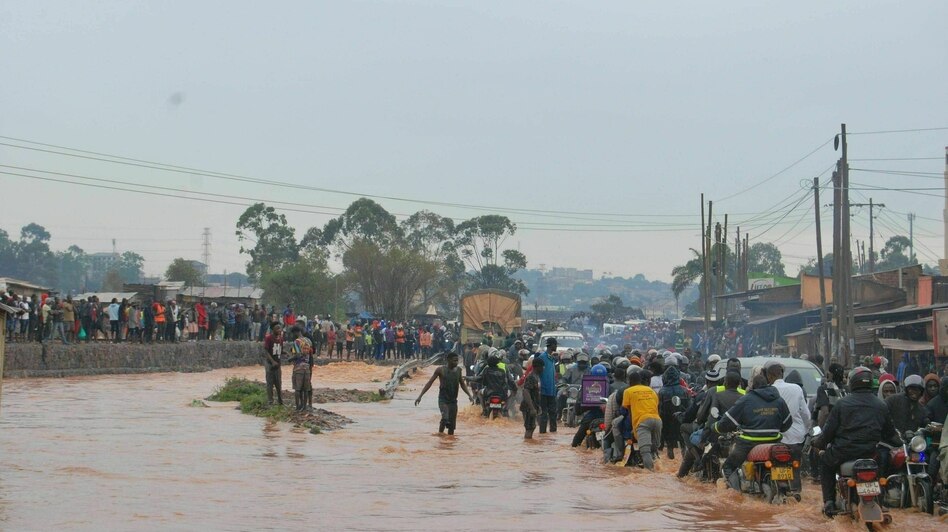
The cement base that blocks access to the shopping center is half a meter high. There are stones in front of and behind it to make it easier to step on. The security guard standing nearby with his rusty Kalashnikov gives visitors a hand so they don't stumble. “After the last flood, we built the base so that the water would no longer seep in,” explains the man in uniform, pointing to the brown puddle in front of it.
The Sekazinga shopping arcade is located in the center of Uganda's capital Kampala. “Downtown” is also the name given to the busy district where arcades line up. The historic city center lies at the foot of Nakasero Hill, where government buildings, hotels and office towers rise into the sky. But while businessmen used to scramble to open their stores downtown, today the location is far less attractive. The reason: As soon as it rains heavily and the water thunders down the hill, these shopping centers are under water.
Noordin Kiwalabye experienced this firsthand. The Ugandan is around 40 years old and has his mattress shop in the basement of the Sekazinga Passage, directly below the stairs that lead down behind the base. “The floods during the last rainy season almost ruined me,” he sighs and points up to the base: “The barrier was only built later, but at least it now keeps out a large part of the water.”
He pulls out his cell phone and shows videos that he posted on Tiktok in November 2025: The dirty water in his shop is up to the ceiling and the mattresses are floating away. “Everything was destroyed, it was terrible,” he says. The flood that November morning cost him the equivalent of around 18,000 euros. “For months afterwards we didn’t know how we were going to pay the shop rent,” he says, because he doesn’t have insurance for such damage.
Floods like those in Kampala could worsen in the coming months. The United Nations warns of a “historic” weather disaster. The main cause is El Niño, a natural climate phenomenon in the Pacific Ocean that throws global weather patterns out of balance every four years on average and results in droughts and floods. Meteorologists are talking about a “Super El Niño” and it could rage from September 2026 to spring 2027.
When asked whether he was afraid of renewed floods, Kiwalabye looked towards the plinth with a worried expression on his face. There has been a dry season at the equator since May. This has already been hotter and longer than usual, and harvests have failed. According to government figures, 16 people have already starved to death in the north of the country due to malnutrition, most of them children. These days the weather is changing radically. Now huge, dark storm clouds are gathering again over Lake Victoria, on whose shores Kampala lies.
Warnings were already issued at the end of July: In the next few months, the heavy rain is expected to be “up to 25 percent” worse than last year, reports the Ministry of Civil Protection. The mattress salesman points to his cell phone. It is connected via an app to a surveillance camera that hangs directly under the ceiling in the store. “This means I can check from home whether water is getting in,” says Kiwalabye. It rained last night, but not very heavily. Kiwalabye says he stared at his cell phone all night.
He doubts that the base at the entrance will stop the coming floods. "But what should we do? The government is letting us down," he sighs. Construction work is currently underway across Kampala to enlarge sewers to allow water to flow better during heavy rains. In many places, sidewalks and asphalt were torn up to lay underground pipes. But now the construction sites are lying idle, the pipes are piled up on the side of the road, unused.
There is a lot of corruption in the construction sector, most construction companies do not complete the contracts because money is wasted, or they allow themselves to be bribed and construction plans are changed. Same in downtown. Until 2025, a wide, open sewer ran directly in front of the shopping center, through which the water masses could flow into Lake Victoria. The problem: People threw their waste into the canal. The water pooled and started to stink.
With a handshake from President Yoweri Museveni, 42-year-old real estate mogul Hamis Kiggundu, one of the country's richest men, received permission to seal the canal and build additional four-story shopping arcades on the lucrative property, without a public tender process or independent assessments. Along Nakivubo Street, where the shell buildings are now rising opposite the Sekazinga shopping center, sewers were built into the asphalt, but fewer than planned and all without manhole covers. The result: The rubbish collects in it and the water cannot drain away. Now when there is heavy rain, everything around is flooded - including the basement of the shopping center.
The number of days on which downtown Kampala is under waist-deep water has increased enormously in the past year, according to recent surveys by the statistics office. Around 3,500 people in Uganda now die from drowning every year, especially small children. Half of the deaths occur not in the country's numerous lakes and rivers, but in floods in cities. The main cause, around 40 percent, is sewers blocked by garbage. At the end of July, Uganda's government introduced a national cleaning day. Every last Saturday of the month, all Ugandans nationwide are obliged to clear streets and the sewers and manholes that run along them of rubbish so that the water masses can drain away. The problem: The residents store the collected garbage along the streets, but the city administration does not have enough garbage trucks to dispose of the rubbish.
“We have to make the city fit for the increasing heavy rain caused by climate change,” explains a member of Uganda’s engineering association to the taz. He doesn't want his name published. “We have all the data, we have also taken floods and extreme weather into account,” says the engineer who is responsible for canal systems. According to the construction plan, many more sewage pits were planned along Nakivubo Road. “But then there are influential people who have good contacts with the president who then simply decide not to build these shafts,” says the engineer. Costs are often reduced and the money saved goes into private pockets.
Mattress retailer Kiwalabye is trying to help himself. Since the great flood of November 2025, he has been fighting in court with other members of Uganda's trade association. Prime Minister Robinah Nabbanja has promised compensation. “But to date we haven’t seen anything about it,” he says.
In the southern Indian state of Karnataka, it is a lack of water that is causing problems for people. Avin H. M. runs a coffee farm of around 20 hectares near the town of Mudigere. Slender tree trunks rise up between the leaves of the coffee bushes. Pepper plants twine around some of them, while cardamom, oranges, jackfruit trees and betel nut palms grow in between. Avin's farm looks more like a lush forest than a plantation. Some shade trees are over 20 meters high. Their crowns are intended to protect the coffee bushes from direct sun.
But Avin fears that even this protection will soon no longer be enough. "We are experiencing extreme heat. That is bad for Arabica," says the former investment banker about the type of coffee he grows. In summer the temperatures rose to over 37 degrees. Drought and high temperatures also encourage the proliferation of the white coffee stem borer, a beetle whose larvae eat into the stems. “I have to pull out the whole plant and burn it so that the others don’t get infected,” says Avin, who has been growing coffee for over 10 years.
This year El Niño is coming. The global climate phenomenon may weaken the Indian summer monsoon. And in 2026 it initially brought significantly too little water. There was 38 percent less rain nationwide in June. After a recovery in July, the deficit is still around 15 percent.
Avin measures the rain on his farm himself. “I’m missing around 60 percent of the rain this year,” he tells the taz. He knows weak monsoon years. “But El Niño made it worse.”
At first glance, this year's harvest looks good. But the coffee cherries ripen too early. They should be ready to harvest as early as October instead of the end of November. The fruits otherwise take eight to nine months from flowering to ripeness. If they ripen earlier, this can affect the quality, explains Avin.
That's why Avin tries to gain time: every year he plants several hundred new shade trees. He collects rainwater in two ponds. Now he plans to add additional irrigation via sprinklers to delay ripening. Half of his coffee now consists of the more heat-tolerant Robusta variety. A complete change would still not be a quick solution. “I would have to wait three to four years for a good yield.”
India is one of the largest coffee producers in the world, but it is grown almost exclusively by small businesses. And it doesn't just apply to coffee. After the dry June, the sowing of rice, pulses and oilseeds was delayed in many regions. The alternation of dry phases and heavy rain also increases the risk of crop failure.
The monsoon not only determines how much water India's farmers have, but also when they sow, fertilize and harvest. India's government has now revised drought plans for particularly vulnerable regions, in which, depending on local conditions, it is advised to switch to varieties that require less water or ripen more quickly. The plans also stipulate that farmers should store more rainwater and use it to irrigate fields more specifically. Like many farmers in the region, Avin has given up water-intensive rice cultivation this year, and fertilizer has been in short supply due to the Iran war: India needs liquid gas to produce nitrogen fertilizer and is largely dependent on ship imports via the Strait of Hormuz. But it has been de facto blocked for months.
LNG is the main raw material for the production of urea, the main nitrogen fertilizer for Indian agriculture. Domestic urea production fell significantly in March. India was able to avert a major urea shortage by developing other gas sources and importing more urea.
Different continent, similar difficulties: In a quiet, tree-shaded residential area in the central Colombian town of Ibagué, the small coffee company “Café 100 Años” is trying to defy El Niño and climate change.
Experts in Colombia have been warning about a possible power blackout for months. More than 60 percent of electricity is produced using hydropower. But the water in the reservoirs is becoming scarce. The rivers that feed them have been carrying less water than usual for months. In August, water levels were a quarter below the level of previous years.
The government's tactic against the blackout: ramp up thermal power plants to protect the reservoirs for as long as possible. But these work with coal, diesel and gas - and are significantly more expensive. The Ministry of Finance has announced that it will provide the equivalent of around 400 million euros to keep these power plants running at full power. But according to the Colombian Association of Energy Producers (Acolgen), this amount is not even enough to pay off the energy producers' debts. Energy Minister María Nohemí Arboleda is warning Colombians about price increases.
“Café 100 Años” is prepared for this. There are six solar panels on the left roof of the two-story house. It's cool inside the company's own store "Mr Wush Wush", the air conditioning is humming: it reads 18 degrees.
“Mr Wush Wush” is the name of the company’s coffee brand. Wush Wush is a type of coffee from Ethiopia that the family grows alongside other varieties on their coffee finca in the mountains, around eight hours from Ibagué.
Coffee bags are carefully lined up in the display. On the back of all of them is a drawing of the company's founder, alias Mr Wush Wush: a serious-looking man with distinctive ears. Behind the counter, son Giovanit pours hot water onto the coffee powder in the paper filter.
Due to high electricity costs, “Café 100 Años” had the panels installed in October 2025. The idea was that they would reduce their electricity costs when they consumed their own electricity. They wanted to sell the rest of the electricity to the local electricity provider. According to their calculations, the panels, which cost around 4,000 euros, would have paid for themselves in about four years, says accountant Lyna Sánchez.
But since the system was on the roof, they haven't sold any electricity, but have used everything themselves: for kettles, roasting, computers in the office - and especially for the air conditioning, which has doubled the electricity requirement. They bought them at the end of July to make it more pleasant for customers in the store. Now it's 18 degrees there, but there's no electricity left to sell. They now plan, says accountant Lyna Sánchez, to invest in more solar panels.
Private electricity companies control the market in Colombia. That's why it's not made easy for people who want to install panels, says Sánchez. It took a lot of paperwork with the electricity provider to connect the system to the grid. Not many people can afford the investment, says Sánchez, even though some banks now offer cheap loans.
In May, the previous left-wing government reported around 24,500 registered solar roofs. More than 15,000 of these have been installed in the past two years - primarily to reduce electricity costs. However, President Gustavo Petro's left fell far short of the goal of the promised energy transition - and the new government of the ultra-right Abelardo de la Espriella wants to rely more on fossil fuels again.
Ibagué is the capital of the Tolima department, which has been plagued by violent forest fires for months - fueled by El Niño and the extreme drought. Company founder and trained coffee taster Newerly Gutiérrez knows the weather phenomenon well. “We coffee farmers are already used to El Niño.” But the fact that the changes are becoming more extreme is something he has experienced firsthand, he says while he is cleaning a machine for peeling the beans.
His family is the fifth generation to grow coffee. Where the coffee bushes stood in his childhood is now far too hot. The plants are now about 400 meters higher. And they looked for other varieties: the Ethiopian Wush Wush, for example, which is still exotic in Colombia, can withstand drought and coffee rust better.
In Colombia, El Niño means: significantly rarer and less rain. Farmers and fishermen are already groaning because of the drought, and the forest fire season started earlier and more intensely. Because of the poor air quality, experts expect more respiratory diseases and diseases that are transmitted via mosquitoes, such as malaria. Not to mention the possible blackout, which would cause downtime and therefore high costs.
Despite the panels, “Café 100 Años” now also has to prepare for a blackout. Because the solar power goes directly into the grid and is offset against consumption - and does not serve your own devices first. Batteries for energy storage are still far too expensive. If the grid goes down, you won't have any power at “Mr Wush Wush”.
Read the full story at the source
Source: taz