
World taz
Documentary about Gaza: The only witnesses
They came to Gaza to save lives. Instead, British doctors experienced death and destruction. The documentary “Life Support” tells her story. more...
Deutsch (original) ·Auto-translated to English
T he Gaza Strip is under water these days. Tens of thousands of tents in which displaced people found refuge in the south of the coastal strip are flooded after days of heavy rain and autumn storms. “The floods have destroyed many emergency shelters and are causing some of the buildings, some of which are still standing, to collapse,” reports Victoria Rose by telephone from London. “There was just a massive landslide that killed several people.”
The British doctor is in contact with colleagues on site who regularly send her photos and updates. Israel still restricts the import of tents, winter aid and building materials, she says. “It is estimated that over 120,000 tents will be needed,” she calculates. “But so far only a fraction of them have been introduced.” The situation remains tense and she fears that diseases and epidemics could spread.
Almost two million people in the Gaza Strip live in tents or makeshift shelters. More than a year after the start of the so-called ceasefire, the Israeli army is still allowing almost no foreign journalists into the area and has also killed a record number of Palestinian reporters over the course of the war. Among the few witnesses who have been able to get their own picture of the situation in recent years - coming from outside - are foreign doctors who were allowed to enter the war zone for temporary relief missions. One of them is the British surgeon Victoria Rose. The 54-year-old has helped out several times in hospitals in the Gaza Strip since autumn 2023.
Rose kept a kind of video diary during her travels: she recorded what she saw when she arrived and stayed and documented the experience by talking about it on her cell phone camera. Using this material, among other things, the British-Italian director Daniele Rugo produced the documentary “Life Support”.
Rugo has so far made two documentaries about the long shadow of the Lebanese civil war. “Life Support” is about the doctors who have been helping out in hospitals in the Gaza Strip since October 2023 despite the lockdown. Using their reports and cell phone recordings as well as material from local cameramen, the film traces the phases of the war and its consequences for the population. In addition to Rose, her British colleague Nick Maynard, the American pediatrician Tanya Haj-Hassan and many others also have their say in the film.
Rugo received celebrity support for “Life Support”: the ten executive producers include Hollywood actress Susan Sarandon; The music comes from, among others, the head of the British trip-hop combo Massive Attack, Robert Del Naja. The 90-minute film was released in British cinemas in the summer and celebrated its German premiere in Berlin at the beginning of November, and has since been shown in selected German cinemas. It is, if you will, the counterpart to the Israeli documentary “Naza,” which is about those who fought this war. “Life Support” shows the other side and the victims of this war.
From a cinematic perspective, “Life Support” is more of a documentary than a film. It chronicles a man-made humanitarian catastrophe and shows images you don't see on the evening news. The film aims to shake people up and draw attention to underexposed aspects of the war. What you can accuse him of: He only repeats the statements of one side. And: Over time, the view from the hospital becomes a kind of tunnel vision.
The film begins chronologically. It shows Gaza just before the war, with bathing scenes, city life and thriving markets. Looking back, the images appear almost idyllic, as if from any metropolis on the southern Mediterranean. But Nick Maynard also remembers in the film his shock at the level of destruction that existed in 2010 when he entered the Gaza Strip for the first time after the first Gaza war. That was after Operation Cast Lead, the first of five more Gaza wars. Maynard is also a surgeon, works and teaches in Oxford and was in the Gaza Strip several times before October 7, 2023.
October 7, 2023: News images show rockets being fired from Gaza, Islamist attackers breaking through the border fence with Israel, killing over 1,200 people and kidnapping over 250 victims as hostages in the Gaza Strip. Israeli tanks are rolling into the Gaza Strip, bombed high-rise buildings are collapsing like houses of cards.
“When the war broke out, we were able to telephone numerous colleagues and receive first-hand, current images of what was happening,” says Victoria Rose, looking back. That's why it was natural for her to return to help them. “We went to Gaza to help our friends and colleagues who were literally begging us for help, saying, 'You have to come here,'” adds Nick Maynard. “But we saw such horrific atrocities in Gaza that we felt we had to speak out.” That's why after their return they sought the public to report on what they had experienced. But the reactions were sobering.
Maynard led the first team of foreign doctors and paramedics allowed to enter the Gaza Strip in late December 2023. There was already a thick cloud over Gaza on the way to the Rafah border crossing, he remembers in the film: “The smell of bombs and war was overwhelming when we entered.” The sky was lit by constant bombardment, the ground trembled from the many impacts. Another doctor who traveled with him reports that he didn't keep up with counting the explosions throughout the night.
“Shocking” is a word that comes up quite often in the film. The film only shows brutal scenes sparingly; it consists of many “talking heads” – interview scenes in which the doctors speak directly into the camera.
March 2024: Victoria Rose collects medical materials in her living room that she wants to bring to Gaza. They are piled up in her living room between sofas and bookshelves. On the plane to Cairo she brings 23 suitcases with her, and in the UN convoy to Gaza she drives past a kilometer-long line of trucks loaded with relief supplies waiting to be let in. When they arrive, the Gaza European Hospital is overcrowded with displaced people camping there; the hallways are poorly covered with sheets and tarpaulins.
The Al-Shifa Hospital in Gaza City was the largest hospital in the Gaza Strip, with around 800 beds and intensive care and dialysis units. In March 2024 it was already largely destroyed, like almost all of the original 36 hospitals in the Gaza Strip. The Israeli army justifies its attacks on the hospital by saying that Hamas operated a command center and a tunnel system underneath. Victoria Rose and Nick Maynard have doubts about such claims.
“I had unhindered access to all departments,” says Maynard about his time in the clinic: he never discovered any signs of the presence of Hamas militias. He and Rose are convinced that the Israeli army deliberately destroyed medical care in the Gaza Strip. When it comes to hospitals as war targets, the Gaza war is one word against the other.
April 2024: The hospitals are so full that injured people can only receive emergency care and patients have to be operated on on the floor or have their limbs amputated there. The pressure waves from the explosions tore apart the internal organs of small children. Others die because their wounds do not heal or because they lack food. The children's charity speaks of a “war against children”.
“I have never operated on so many children in my entire life,” says Victoria Rose. Initially, she and her colleagues primarily treated injuries from explosions, severe burns and shrapnel wounds. But recently they were “fully occupied with gunshot wounds,” she says in the film.
“I have operated on more children than adults,” says Nick Maynard, “and we saw several children die almost every day.” They didn't just die from bombs and gunshots. “So many of my patients who underwent surgery and would have survived under other circumstances died from their injuries or from starvation.”
A film cannot come close to conveying what it feels like to lose your loved ones, go hungry, or freeze from the cold. The descriptions only give an impression of what it must be like to live in Gaza. Especially since they do not come from people who live there themselves, but from foreign helpers who are very aware of their privilege to be able to leave Gaza again.
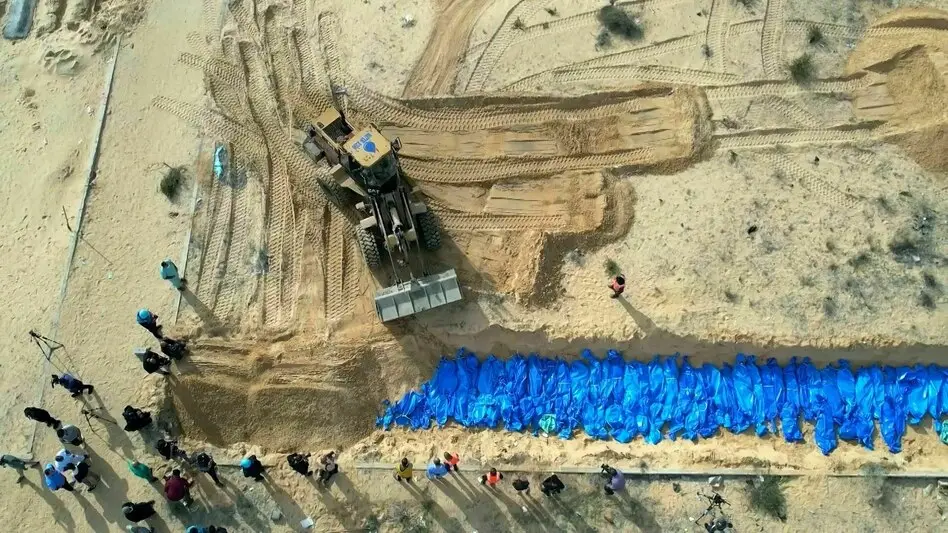
Maynard will travel via Rafah in May 2024, shortly before the Israeli army invades there despite international protests and provokes another mass exodus. The Al-Shifa Hospital has been completely destroyed, and images from the air show the extent of the destruction. After the withdrawal of Israeli troops, several mass graves were discovered there.
August 2024: Victoria Rose returns via the Kerem Shalom border point with her surgeon colleague Graeme Groom, military veteran and co-founder of her aid organization Ideals. When you look out of the bus you can see even more destruction. Everything is in ruins, there is no life left on the streets. The north in particular is like a ghost town. The surrounding area and parts of the Nasser Hospital are also destroyed; a colleague leads you through the building. She notices increasing signs of fatigue, desperation and resignation among her colleagues who, coming from other hospitals, have moved south with their families.
In November 2024, intensive care physician Tanya Haj-Hassan gives a widely acclaimed speech at the United Nations in New York, in which she points out that by that time over a thousand paramedics and doctors had already been killed and hundreds arrested. She criticized the inaction of the global community and appealed to them to end the horror.
Spring 2025: After a ceasefire that lasted almost two months, the border crossings will be closed again. Even painkillers and baby food no longer reach Gaza. Many patients are just skin and bones. In May, Israel introduces a new system for distributing aid. The four distribution points of the newly founded Gaza Humanitarian Foundation are secured by private security forces and Israeli soldiers. Hungry people crowd around metal fences. Many are shot while searching for food.
In the summer of 2025, Nick Maynard noticed a sharp increase in gunshot wounds among his patients: sometimes in the head, sometimes in the neck, sometimes in the arms or genitals. “The pattern of injuries didn’t look random,” he says – it seemed to him as if the Israeli soldiers were playing a game or doing target practice.
In August 2025, Nick Maynard gives an interview to the BBC. After an Israeli attack on Nasser Hospital in Gaza, in which a journalist and 14 other people were killed, the presenter echoes the Israeli army's statement that it would "not intentionally target people who are not involved in the conflict."
Maynard rejects this account. “These statements no longer have any weight these days,” he replies. Numerous witnesses have noted that the Israeli army is “targeting hospitals and medical staff,” he says, and calls on the BBC to “acknowledge this too.” The short interview is going viral online. Director Rugo also wanted to use these and other statements for his film. However, the BBC refused to give him the rights to do so, citing its “neutrality”.
But this film cannot show a true depiction of the war, says Rose. "They had a lot more material. But they were very selective and didn't want to show scenes that were too terrible, otherwise it wouldn't have been possible to show the film in the cinema."
The two of them don't speak well about British politics. “I was once invited to the Foreign Office to meet David Cameron,” says Nick Maynard. He brought photos of killed and seriously injured children. “I showed it to them and said, this is what’s happening right now.” British F-35 fighter jets also contribute. Maynard hoped the pictures would have an impact. “But there was no reaction at all.”
Victoria Rose also had similar experiences with the British government. She remembers a Zoom meeting with Prime Minister Keir Starmer, which she attended along with others. “We had two or three minutes to briefly report on what we were doing in Gaza and what we were seeing there,” says Rose. They shouldn't have shown photos or statistics. “I think in the end he said nothing more than, ‘Thank you very much.’” Then the meeting was over. “It was pretty pointless,” she says.
The film ends in September 2025, just before the “ceasefire” brokered between Israel and the remnants of Hamas more than a year ago. Nevertheless, the Israeli army continues its attacks in the Gaza Strip almost daily. Over 1,500 people have been killed since the ceasefire began and many more have been injured.
“We regularly talk about the current situation in the Gaza Strip via WhatsApp,” says Victoria Rose. The range of movement of the people there has been reduced to a small enclave on the coast and a little way to the north. “Everything else is occupied by the Israeli army and anyone who enters this area will be shot.” Most of their Palestinian colleagues assumed that they would be able to return to their destroyed homes at some point in order to recover mementos or relatives from under the rubble. But now Israel is bulldozing the area, and it is dawning on many that they may never be able to return. “This means they are losing their last hope,” says Rose.
“I keep in touch with friends and colleagues,” says Nick Maynard. Far too little food and relief supplies are still coming to Gaza. There was severe malnutrition and there was a lack of medication. "About three weeks ago, a friend from Nasser Hospital wrote to me saying that they had run out of syringes. The situation is still absolutely dramatic."
In June 2026, an independent United Nations investigative commission accused the Israeli army of specifically targeting Palestinian children. Between October 2023 and October 2025, more than 20,000 children were killed and 44,000 injured. The commission bases its findings on forensic, medical and ballistic evidence, as well as satellite images and witness statements.
The consequences are devastating: it is estimated that more than 60,000 children have lost at least one parent and many are orphans. Thousands had their arms or legs amputated. According to the UN, the Gaza Strip has one of the highest rates of children with amputations in relation to the population in the world.
The ceasefire and the expansion of humanitarian aid were able to reduce the famine. However, around two thirds of the population still suffer from hunger. Thousands of children in the Gaza Strip are malnourished and the drinking water supply remains critical.
“I don’t think we’re getting an adequate picture of the situation on the ground,” Victoria Rose said on the phone on Monday. "When I spoke to some of our MPs recently they were shocked to hear what was not getting into the area. I think if members of the British Parliament are surprised by this then you can hardly expect the British public to understand what is going on."
And it has been a long time since British TV news showed a map of Gaza showing that the Israeli army now controls over 60 percent of the area and has drawn a yellow line there - "And that if you cross it you will be shot."
Victoria Rose was in the Gaza Strip for the last time in the summer of 2025. Since then, she has been refused entry several times - she is considered a "security risk," the authorities told her Israeli lawyer after repeated inquiries over the months. “Now we will go to court in December to find out what threat I and my 76-year-old colleague pose to them,” says Rose dryly.