
Germany taz
Documentary “The Mad Dog of Europe”: Among anti-Semites in Hollywood
The documentary “The Mad Dog of Europe” tells of a failed US film project from the 1930s. It should have warned about Hitler in good time. more...
Deutsch (original) ·Auto-translated to English
It is considered one of Hollywood's first anti-fascist films to aggressively warn against National Socialism. In June 1940, “The Mortal Storm” by Frank Borzage was released in US cinemas. His story takes place in Munich, during and after Hitler's rise to power. The focus is on a Jewish university professor and his adult daughter. Neither finds a happy ending that is typical of classic Hollywood. The father dies in the concentration camp and his daughter is shot by Nazis while escaping.
A film that tells of the horrors of the Nazi regime with such clarity and drama was unthinkable in Hollywood in the early 1930s. The film project “The Mad Dog of Europe” bears witness to this, the failure of which is now recounted in the documentary film of the same name by British-Saudi Arabian director Rubika Shah. The script for this anti-Nazi story was written in 1933 by a certain Herman J. Mankiewicz.
After a stint at the New York Times, the son of German-Jewish immigrants worked as an editor at The New Yorker magazine and was one of the first theater critics there before he was attracted by the gold rush atmosphere that was spreading in Hollywood. With mostly shallow stories, he developed into one of the best-paid screenwriters. In 1942 he would win an Oscar for best original screenplay with Orson Welles for “Citizen Kane.”
“The Mad Dog of Europe”. Director: Rubika Shah. France, Germany 2026, 83 min.
With “The Mad Dog of Europe,” Mankiewicz, as a young author in his thirties, wanted to prove that he could do more than just provide trivial entertainment. Conceived as a parable about fascism, the story about a Jewish and a Catholic family in Nazi Germany was intended to influence the political mood in his father's homeland. An undertaking that is as prophetic as it is hopeless. Any films that degraded Hitler or even sympathized with Jews were banned by the Nazi regime.
Mankiewicz and his producer Sam Jaffe initially tried to place the script with the major studio MGM, headed by Louis B. Meyer. But Meyer didn't want to take any financial risks. Germany was the second most important market for Hollywood after the USA.
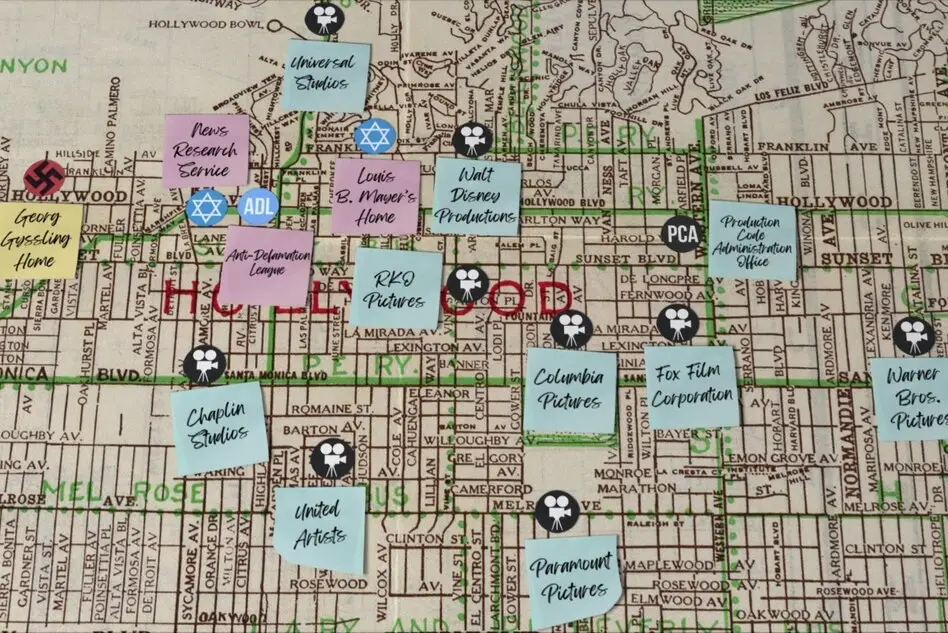
There are two aspects that make this insightful but conventionally shot documentary worth watching. First of all, the question is to what extent Nazi Germany influenced the production of US film studios. In 1933, Georg Gyssling, a German consul, was sent to Los Angeles to keep an eye on Hollywood. In order not to run the risk of already finished films being banned in Germany, some studios presented the scripts of their planned films to Gyssling, who often demanded and implemented changes.
But this was not a willing collaboration, as the historian Ben Urwand put it pointedly in his 2013 book “The Collaboration: Hollywood's Pact with Hitler” and as the documentary also suggests. A closer look reveals a more complex situation. In fact, it was their desire for profit that caused some decision-makers to abandon their moral principles, including Jewish producers like Louis B. Meyer.
Three of the major studios – Paramount, MGM and Twentieth Century Fox – are known to have changed their scripts to accommodate German wishes. The others, especially Warner Brothers, stayed away from this practice. Some Jewish-American groups, in turn, feared that anti-Nazi films would lead Hitler to take increasingly violent measures against the Jews remaining in Germany. Added to this was the Hays Code, Hollywood's self-censorship measure, according to which every foreign country had to be treated with respect.
The violent anti-Semitism that was rampant in the USA and within its film industry at the time is astonishing. For example, when written correspondence with the US censorship board talks about “lice-ridden Jews” who would only think about money and sex. Los Angeles was also a melting pot of anti-Semites, Nazis and racists at the time.
Supporters of the fascist “Silver Shirts” group exchanged hands with members of the Ku Klux Klan. The American German Confederation met in the Continental Theater to watch German propaganda films. Equally interesting is the fact how the Anti-Defamation League tried to stop National Socialist activities through spying activities - supported by many studio bosses.
It took the year 1938 and with it the Kristallnacht pogrom before all of Hollywood recognized the seriousness of the situation and the anti-Nazi films that followed were given the green light. But “The Mad Dog of Europe” was long buried by then.