
Germany taz
“The Fog of Dybern” in Konstanz: The elusive, latent threat
The Konstanz City Theater is showing Maria Lazar's “The Fog of Dybern”. The play, which was banned by the Nazis in 1933, is disturbingly relevant again. more...
Deutsch (original) ·Auto-translated to English
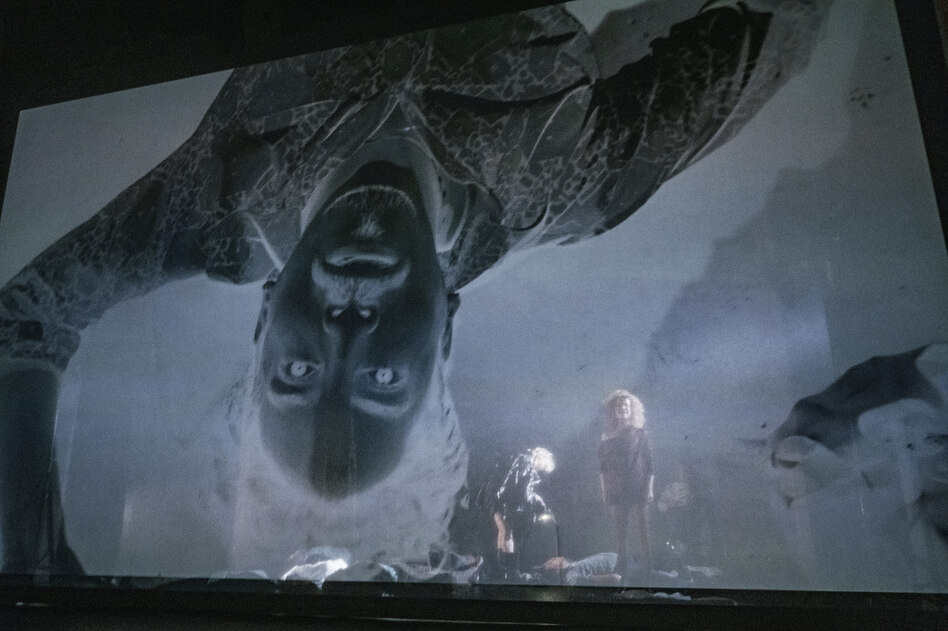
From the start it's there, this eerie David Lynch feeling. Especially in music. Sometimes the off-screen organ playing is reminiscent of a funeral mass, sometimes its repetitions and crescendos seem nerve-wracking. The crunching sounds of an accordion have a similar effect and make you shudder. It is played by Odo Jergizsch, who embodies an old woman who appears senile but is secretly visionary with a fixed gaze and in a wheelchair. Their mantra is that there is bad air in the world, as is talk of a war that is still going on.
In Maria Lazar's text “The Fog of Dybern” from 1932, performed at the Konstanz City Theater, most people don't want to know anything about it. On the contrary, they believe they are in peace and prosperity in the place of the title.
However, one day when more and more dead animals appear and people die, critical questions arise about the chemical factory. If you initially try to downplay the impending catastrophe, it soon becomes difficult to deny that poison weapons are also being developed in a laboratory there. As expected, the situation spirals out of control. Oxygen masks are distributed. In the middle of it all is Josef (Mark Harvey Mühlemann) and the pregnant Barbara (Laura Dittmann), a couple who are being mercilessly swept away by the encroaching whirlpool of violence.
All this just because of the fog, as some would have you believe? Of course, one has to interpret it symbolically in this drama critical of progress. Does the fog represent a virus like in the Corona era? Or, as you read in the program booklet, especially for an unleashed AI? Does it even represent the resurgence of fascism? At least a few reasons make the latter plausible, as the further performance of this almost prophetic work written by the Austrian author, who died in 1948, was banned by the Nazis shortly after its premiere in Stettin in 1933.
Director Philipp Preuss also keeps all avenues of interpretation open by leaving the stage design largely abstract. Apart from an artificial sun in the background, the backdrop is empty. Every now and then stage fog rolls in. Towards the hallucinatory ending, when the characters are crouching on the ground close to death, their faces are projected onto the background in overexposed black and white using a handheld camera.
Not interpreting the parable more specifically is certainly a weakness of the evening. But doing without it also fits with the concept. Be it cleaning glasses or smoking cigarettes – the direction relies entirely on gestures and pantomime. In this way, it reflects the elusive, latent threat.
Although the characters sing the song “Love Is in the Air” several times as if out of spite, the terror increases immeasurably. It culminates in a touching, horrifying image. Barbara looks into the audience with wet eyes and kills her newborn. She wants to spare him a cruel existence. She depicts this act solely in her slowly closing hand. Meanwhile, the organ melody fades away, like a final heartbeat, followed by no more words.
What an intense theatrical event, supported by a blood-curdling text! It is fortunate that Lazar's long-forgotten oeuvre has been rediscovered for some time now; she now undoubtedly belongs in the canon of the most important female writers of the 20th century. And if you didn't know, you could almost mistake her for one of the most political authors of the moment thanks to the massive premiere in Konstanz.