
Germany · taz · · 1h
The home visit: Culinary resistance
Deutsch (original) · Auto-translated to English
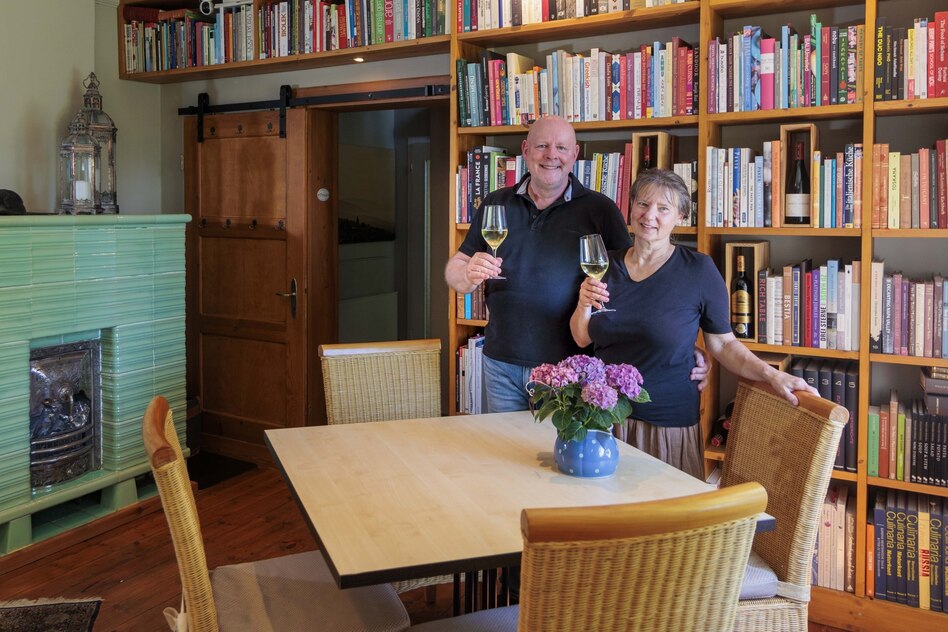
The “Schmeckerlein” restaurant in Lausitz near Senftenberg is difficult to find. But it still exists, even though it was almost doomed.
Outside: Through sleepy towns, past swaying wheat fields, you reach Proschim - a village that was long threatened with being demolished for coal mining; It was only recently that it was finally decided that it didn't have to disappear. There is no sign pointing the way to the inconspicuous, outdated house just before the Welzow slag heap. It is surrounded by a garden with a sea of summer flowers and cast iron ornaments, a reminiscence of the region's industrial history. The flower calyxes buzz and swarm with insects. Savory and sage, among other things, grow in the herb beds, and behind them is the vegetable garden, which also contains edible flowers. The tool shed behind the house has become a small farm shop with “useful delights and pleasure highlights from Lusatia”. The pigsty in turn became an open summer kitchen. There the tomcat Paule lies phlegmatically in the shade. There are tables and benches directly opposite. "When people sit here with a glass of wine under the starry sky, you can see their relaxation, their contentment. People are really touched here," says Alexander Tetsch.
Inside: The residential building is also a restaurant. The private rooms are on the upper floor, while there is space for 18 guests downstairs. In the first room, the so-called boutique restaurant, an old tiled stove creates a cozy atmosphere, and in the adjacent guest room, the library, there are 700 cookbooks. A hatch leads from the restaurant to the kitchen. Alexander Tetsch is the boss there. Dishes with almost forgotten braised vegetables, lamb shanks or veal cheeks in nougat jus are on the changing menu.
Lignite child: Sybille Tetsch was born in Proschim. "I grew up with brown coal. My father worked in the brown coal mine. My grandpa worked for the brown coal mine. We played in the opencast mine. These miners were the kings in the GDR," says the 54-year-old. Her dream career was to be a district forester; her GDR training as a forestry specialist was not recognized after the fall of the Wall. So she studied environmental protection technology in Halle and moved west to Wendland. Tetsch has worked with young people, written a children's book and for a local newspaper. While doing research she met Alexander. He was an environmental journalist at the time. One of his professions in a long line of professions.
Soldier’s child: “I am a soldier’s child,” says Alexander Tetsch, who is now 61 years old. "I was born in the Netherlands and grew up in Wendland. I think I've moved over twenty times in my life." His first job was with the Bundeswehr in Lüneburg as a temporary soldier. He then studied law, particularly competition law and international law. In a large company he got to know the marketing area and realized that his real interest was communication and not law. From 1997 he was responsible for customer loyalty at Microsoft. First in Germany, then in the corporate headquarters in the USA, later in India until 2009 as Director of Marketing and Business Operations.
Career break: The next step would have been for him to go to Stockholm as Managing Director of Microsoft Sweden. “And then I said: No, I don’t want that.” Tetsch got out and became an environmental journalist in his old homeland, Wendland. "I wanted to provide journalistic information about this injustice that is being committed against people and nature with the Castor transports in Lüchow-Dannenberg. And that's where I met my wife."
Commitment: Alexander now wrote and photographed on environmental issues, especially nuclear power. To do this, he traveled to places like Chernobyl and Fukushima and documented the destruction after the nuclear disasters. Sybille, in turn, wrote her second children's book, called “Emmy and the Core of Things”. Both were influenced by resistance to the planned nuclear waste repository in Gorleben. They also went to Chernobyl for their honeymoon. “And then my wife said: You wrote about natural gas fracking, about mercury poisoning among natural gas workers in the GDR, about nuclear energy – now brown coal is still missing as dirty energy.”
Move: They went to Lower Lusatia, in the very southeast of Brandenburg, with the idea of continuing to give lectures and write books on environmental issues. And then running the restaurant in the summer. They came as journalists and stayed as restaurant owners. “We asked ourselves how we could best get involved here and said, we’ll do the culinary resistance.” Sybille and Alexander Tetsch defy the destruction of the landscape with a small, fine restaurant on the waste dump. It is Sybille's parents' house, they renovated it and used the start-up capital they had saved.
Rights: Tetsch is a common surname here in Lusatia. The two deliberately chose it as their family name. “Foreign people are frightening here,” says Sybille. There would always be these whiners, these right-wingers. "The young people here don't learn English, they just tinker with their old tractors and their mopeds. They're not cosmopolitan at all. And then Höcke from the AfD comes along on the Simson and confirms their glorification of the past." And both recount events that frightened them: During a rapid occupation of the opencast mine, “gentlemen with bald heads and leather jackets came and some had baseball bats with them.” They wanted to give the demonstrators a nice welcome. There are people with crowns and bald heads. "Those with the Hitler crown are the people who have a bit of something on their minds. These are the leaders. And behind them are the cohort, the rank and file and all of that is organized." She was also shocked when an old rifle house in the neighboring town of Altdöbern, which had been lovingly prepared as a meeting and cultural place, was set on fire.
Children: "We've known since the 1970s, if you look at the Club of Rome figures, that climate change is coming. We're right in the middle of it," says Sybille. She recently saw the film “The Weight of the World,” a portrait of three climate scientists. “And then I was really confirmed once again that I don’t have children,” she says. “Of course there are sentimental moments,” says Alexander. “But 95 percent of the time I don’t regret not having kids.”
Restaurant: "I come from a family in which hospitality and food were very, very important. East Prussian background, my grandfather served guests at any hour," says Alexander. He trained as a chef on a sabbatical in the USA. "We take responsibility for the quality of our food. This is a huge problem. Where do you want to shop here? If you go to Cottbus, you'll get the worst vegetables in the world." There isn't even any fresh meat on site, just "wrapped things, the main thing is that they're cheap." So only Dresden and Berlin remained. 150 kilometers there and back meant having a bad conscience about the environment, and it took energy and time. Otherwise, they have a clear division of labor: Sybille is responsible for service, ambience and the garden. Alexander cooks, does accounting, marketing and takes care of communication.
This text first appeared in wochentaz, our weekly newspaper from the left!
Every week, wochentaz is about the world as it is – and as it could be. A left-wing weekly newspaper with a voice, attitude and the special taz view of the world. New every Saturday at the kiosk and of course by subscription.
Credo: If you have an idea, you should just do it. Sibylle and Alexander Tetsch want to touch people with food in a beautiful place. "I wanted to touch people with the report from Fukushima. I wanted to touch people with a marketing concept and communication around this dehumanized Microsoft product. It was always about touching people through communication," says Alexander. And he is also successful in marketing here. Positive media coverage and word of mouth bring them guests.
Future: Where do you draw confidence from? "It's very difficult. We're going somewhere. We're going out to eat, we're going to the cinema," says Alexander. “I couldn’t be without my garden,” emphasizes Sybille. "But we don't know how the water money will develop if we get even less rainfall now. Whether we can do this for many more years, or do we want to do this?" They describe themselves as dying fantasists, as a discontinued model. "And perhaps we are naïve. We know that our protests against nuclear power or against lignite did not lead to the shutdown of the nuclear power plants or to the phasing out of lignite. This is primarily determined by economic considerations. But still: the resistance was good."
Read the full story at the source
Source: taz