
Politics · taz · · 3h
Debate about health insurance: Merz causes excitement, Union distributes sedative pills
Deutsch (original) · Auto-translated to English
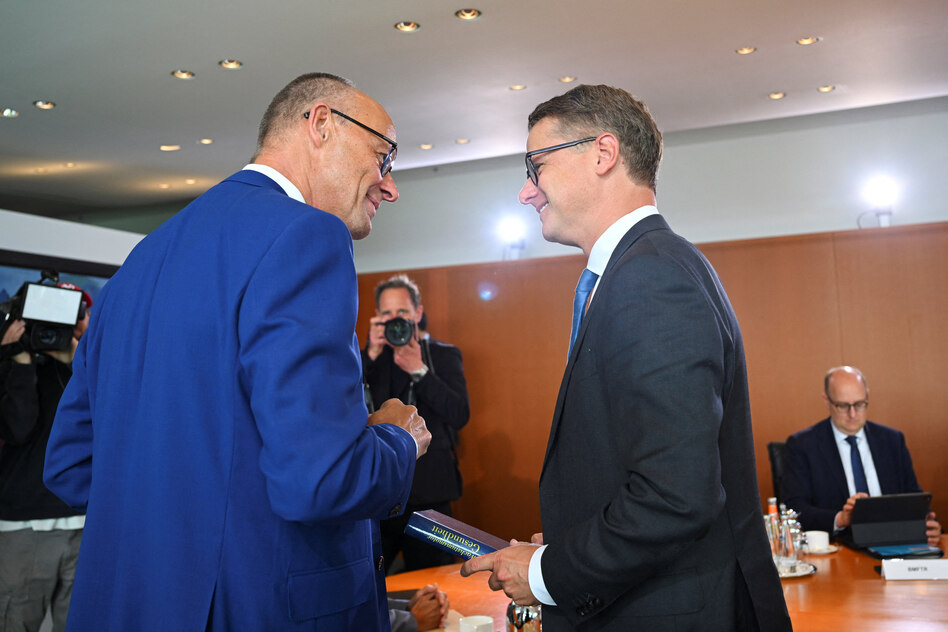
On Monday, Chancellor Friedrich Merz (CDU) commented on the injustice in the coexistence of statutory (GKV) and private health insurance (PKV). Something needs to be changed, said the Chancellor, quite surprisingly. And thereby shook up one of the basic positions of the Christian Democrats.
When the Union parliamentary group met on the following Tuesday, others tried to weaken the Chancellor's statements. While Merz enters the meeting room through the back entrance, parliamentary group leader Thorsten Frei tries to clarify the Chancellor's words in front of the room: What was commonly interpreted, namely that the system of statutory and private health insurance companies was in question, "that was not what was meant and that would not be our policy either". The Chancellor simply pointed out that there are feelings of injustice when it comes to health care. And we're already working on that: doctor's appointments should be available more quickly.
CSU regional group leader Alexander Hoffmann had previously made a similar statement: “I understood the Chancellor to have expressly focused on the allocation of appointments and not put the entire GKV and PKV system to the test.”
At this point, the Chancellor's statement had already sparked a debate in which all relevant players joined over the course of Tuesday. Almost all.
Not surprisingly, the Association of Private Health Insurance warned against questioning the coexistence of GKV and PKV. The umbrella association of the GKV advocated rapid and non-discriminatory access to doctor's appointments for those with statutory health insurance and called for a legal regulation for a daily appointment platform.
A significant proportion of specialist appointments are currently offered via private online platforms such as Doctolib - with mechanisms that are sometimes opaque. The waiting time for specialist appointments has become increasingly longer for those with statutory health insurance.
The health policy spokesman for the coalition partner SPD, Christos Pantazis, expressly welcomed the Chancellor's statements. People need to be able to trust that financing and access to health care will be fair, said Pantazis. “If insurance status determines how quickly someone gets a doctor’s appointment, that trust is damaged.”
Pantazis also emphasized that the SPD has long been in favor of citizens' insurance, i.e. common health insurance for everyone. Even if this certainly still does not find a political majority, Pantazis hopes that Merz's statement will also have consequences - for example in the upcoming reform of long-term care insurance. The SPD is calling for risk compensation between private and statutory nursing care insurance.
However, the responsible minister, Carsten Linnemann (CDU), remained silent. Linnemann has been Federal Minister of Health since the end of June; He replaced Nina Warken, who had moved to the Federal Chancellery at Merz's behest.
The Federal Ministry of Health also did not want to comment on Chancellor Merz's statements. A draft for long-term care insurance is to be approved by the cabinet in September. A draft bill to improve outpatient care – including shorter waiting times for doctor’s appointments – is expected to follow by the end of the year.
Read the full story at the source
Source: taz