
Germany · taz · · 3h
CSU retreat in Banz Monastery: Söder threatens Berlin
Deutsch (original) · Auto-translated to English
If something changed in this country every time there was a call that there should be no “business as usual,” it would no longer be recognizable after the past few days. The fact that this is not the case is probably due not least to the fact that the no-business-as-usual approach often rhetorically includes one's own person or party. The message is: we have learned. In fact, it is above all an invitation to others.
In Banz Monastery, where the CSU parliamentary group has been meeting since Monday for a closed meeting, the plea against continuing as before is immediately followed by the announcement not to deviate from the reform course now, and not to start any personnel debates.
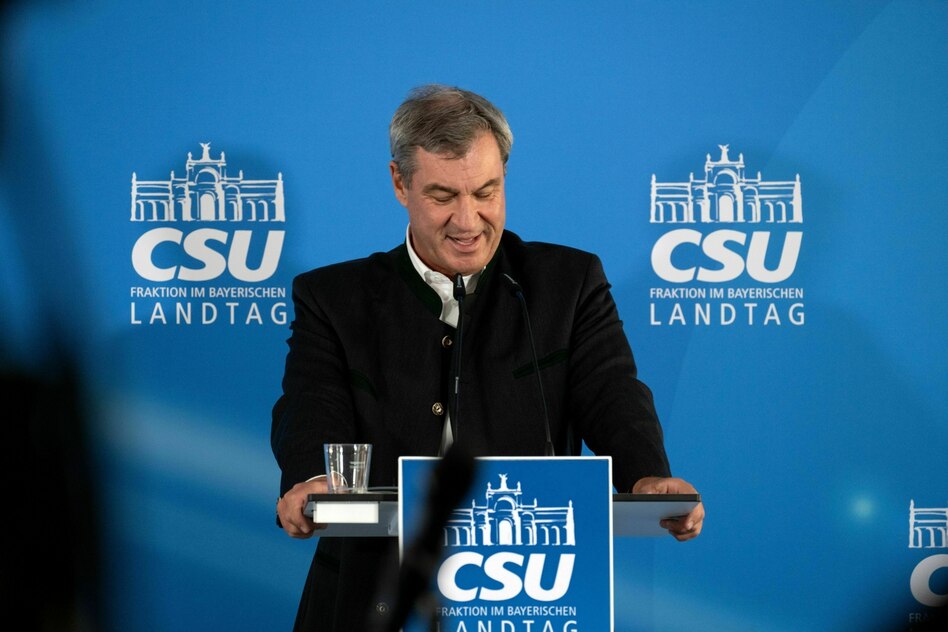
When party leader Markus Söder and parliamentary group leader Klaus Holetschek stood in front of the cameras and microphones in the monastery's courtyard early on Monday afternoon, Söder presented his thoughts for the first time after the catastrophic election evening for his sister party. He describes the result of Sunday's elections as a "total loss" and speaks of a "blue wave and a red front". Söder is careful to mention the AfD and the Left Party, which he describes as clearly anti-Semitic, in the same breath, as if the threat from both sides was equally great.
The AfD is in the process of almost taking over the Union, says Söder. And it is friendly to the sister party that he speaks of the Union, not just the CDU. He demonstratively includes his party in the community of fate, even though the CSU was not on the ballot this time. He is also talking about the Union, not the CDU, when he says that it should not now turn into a heap of chickens.
As little as he shares the opinion of Manuela Schwesig, who wants to roll back the planned pension reform, he also pays respect to his colleague from Mecklenburg-Western Pomerania for her catch-up effort in the last election campaign: “Ms Schwesig is a fighter in this regard,” he says. Just like himself, one might imagine. Unlike Friedrich Merz, one might also imagine. Of course Söder doesn’t say that. Under no circumstances does Söder want to raise any doubts about his loyalty to the Chancellor. “We are in this together.” There is no personnel issue. Just don't become a regicide if you still want to become king.
And then he proclaims a “new closeness to the citizen”. After the elections you have to think carefully: “What were the concerns, what do the citizens want to tell us?” Söder makes it clear in the postscript that these considerations should not be open-ended. The reforms are necessary for our country, they just have to be explained. That sounds like Merz again, only in Söder's case a little more confident and combative. One could already talk about exceptions to social injustices. Söder could imagine a pension-free pension after 45 years for certain professional groups. But the pension reform should by no means be fundamentally questioned.
A little later, Klaus Holetschek, one of Söder's closest confidants, reacted very negatively to Merz's surprising suggestion to put the dual health insurance system in its current form to the test. He recommends that you always think carefully before making new suggestions to the Chancellor.
Even if the shock of the elections casts its shadow over the CSU meeting, officially this is of course about state political issues. Söder takes this up in his keynote speech on Tuesday. He describes the Free State as the heart muscle of Germany, as he reported afterwards at a press conference. “Here in Bavaria, the world is still somewhat in order,” he says, and then raves about upcoming quantum computers, giga factories and robohubs. The commitment to high-tech is also intended to underline the establishment of a space school: “Like Strauss and Stoiber, only by a factor of X more.”
But it's also about a fast lane for families in queues, more teaching hours at primary schools, compulsory anthems at school events and the reform of Bavarian Radio. He should please play more brass music again in the future.
The day before, Söder had already announced two personal changes: Munich state parliament member and former mayor Josef Schmid will succeed Justice Minister Georg Eisenreich, who surprisingly announced last week that he would be resigning from office at the end of the month for personal reasons. On the occasion, Söder also appointed the Bavarian JU leader Manuel Knoll as State Minister for Youth and Democracy - a position that is being newly created. For this to happen, European Minister Eric Beißwenger must vacate his seat; State Chancellor Florian Herrmann will take on additional duties in the future. Knoll should be the contact person for the youth, but also act as a mouthpiece for the youth in the cabinet.
The fact that state and federal politics cannot always be separated is shown by the state financial equalization, which of course also goes unmentioned at this closed meeting. Only: This time it's not about the payments, which are fundamentally perceived as unfair and far too high, of which Bavaria bears the majority, but about a very concrete threat towards Berlin: If the government there is led by the Left Party in the future, Söder announces, Bavaria will insist on a fundamental reorganization of the state financial equalization system in order not to co-finance socialist and anti-Semitic policies in Berlin. The capital city contract that has just been negotiated will then also have to be reopened.
Read the full story at the source
Source: taz