
Politics taz
China's Communist Party: Xi Jinping brings his party leadership into line
At the 5th Plenum of the current Central Committee, Xi Jinping sets the course for his next term in office. “Purges” have become permanent. more...
Deutsch (original) ·Auto-translated to English
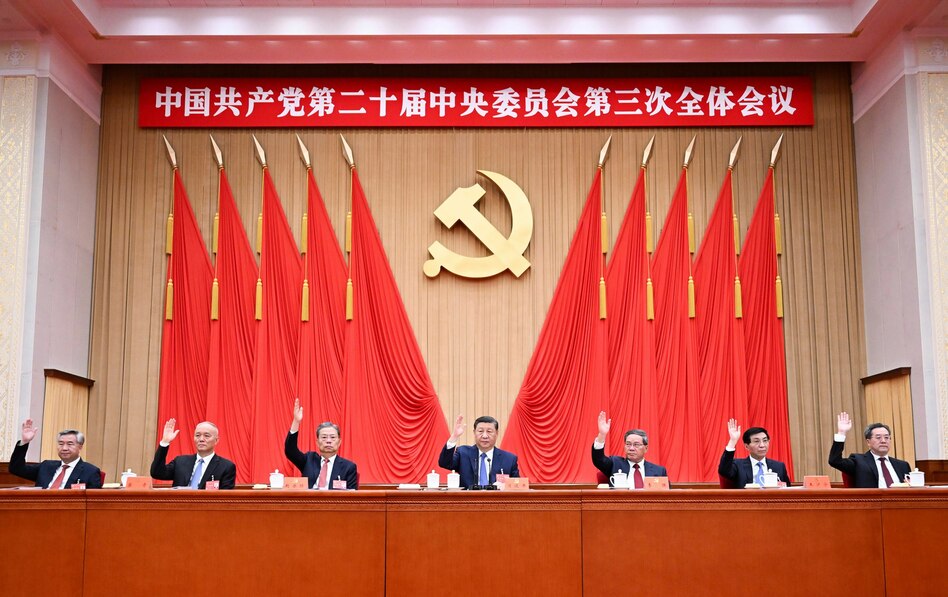
On Thursday, Xi Jinping made heads roll again in Beijing. At the end of the so-called 5th Plenum of the Central Committee, the party leadership excluded a total of 33 senior cadres from its own ranks - more than ever before.
At one of the most important events in the Chinese political calendar, it became clear once again that party leader Xi has by no means become mellow with age. On the contrary: After almost a decade and a half in power, the 73-year-old is not letting up in his will to reshape the Communist Party according to his own ideas - also in order to secure a historic fourth term in office.
When Xi came to power in 2012, he cited rampant corruption as the party's "biggest threat." Nothing has changed to this day. The “cleansing waves” of the last few years are unprecedented: in 2022 the Central Committee started with over 370 members, this year only 279 are still in office.
Recently, a number of military officers were also shot, including General Zhang Youxia. He was long considered Xi Jinping's right-hand man. Only historians will probably be able to clarify whether he had to vacate his seat because of bribery or because he behaved politically disloyally.
Anyone who looks through Xi's current speeches will see a dogged ideologue with almost paranoid traits. In a document published in mid-October, he railed against “duplicitous” party cadres who are secretly opportunists: “Some represent liberal ways of thinking, place individualism above all else and only apply the ideas of socialism (…) selectively – depending on whether they suit them or not.”
Before Xi's term, the CCP was actually undergoing an identity crisis. Because ideology only played a subordinate role for the vast majority of cadres. Many viewed their position of power primarily as an opportunity to enrich themselves. Local party cadres, who only earned the equivalent of a few hundred euros per month, proudly showed off their gold watches and mistresses.
Such excesses are now largely a thing of the past. The Communist Party is now ideologically omnipresent again in everyday Chinese life. Every larger company must maintain its own party cell. The brightest minds from the universities apply for party membership. Anyone who abuses their power or accepts money will face harsh consequences.
But Xi's waves of purges have practically taken on a life of their own. The actual exception has long since become a permanent condition. From January to September alone, the anti-corruption agency disciplined 680,000 party members. Xi is also concerned with maintaining his own power: the Chinese party and state leader, who has put thousands upon thousands of opponents in prison and expropriated entrepreneurs over the years, now sees potential enemies and opposition on every corner. Anyone who is not completely loyal makes themselves suspicious.
Just a few weeks ago, Huang Qifan, the former mayor of the southwestern metropolis of Chongqing, was hit. The 74-year-old, who repeatedly intervened in political discourse with speeches and books, is currently being investigated. There is no evidence of his alleged misconduct. But in China, the mere fact that an investigation is underway is tantamount to a guilty verdict.
There is a second reason for the unprecedented party discipline: Xi is currently in a critical phase of his political career. In 2027, the party leadership will be reorganized, and China's most powerful leader since the country's founder Mao Zedong is setting the course for his fourth term in office. Xi is also driven by historical hubris: he is convinced that only personally can he return the Chinese nation to its former greatness.
No party cadre has long since dared to openly question the decisions of the party chairman. But while political opposition has been eliminated, corruption remains a major problem. This is proven by regularly leaked documents.
The most recent case: Zhang Xiang, the head of a state-owned agricultural company in Hunan Province, can be seen on surveillance videos in his office receiving dozens of employees on a working day who hand him filled envelopes as a matter of course. Zhang counts the banknotes with relish and completely naturally before hoarding them in his drawer, while on Zhang's desk there is a bust of Mao Zedong, right next to the party emblem of the hammer and sickle.