
Migration taz
Federal police officer about Frontex: “Nobody expects any consequences”
The EU is increasingly sealing itself off from refugees, and Germany is joining in. Jonas Müller experienced what that means while working at Frontex. more...
Deutsch (original) ·Auto-translated to English
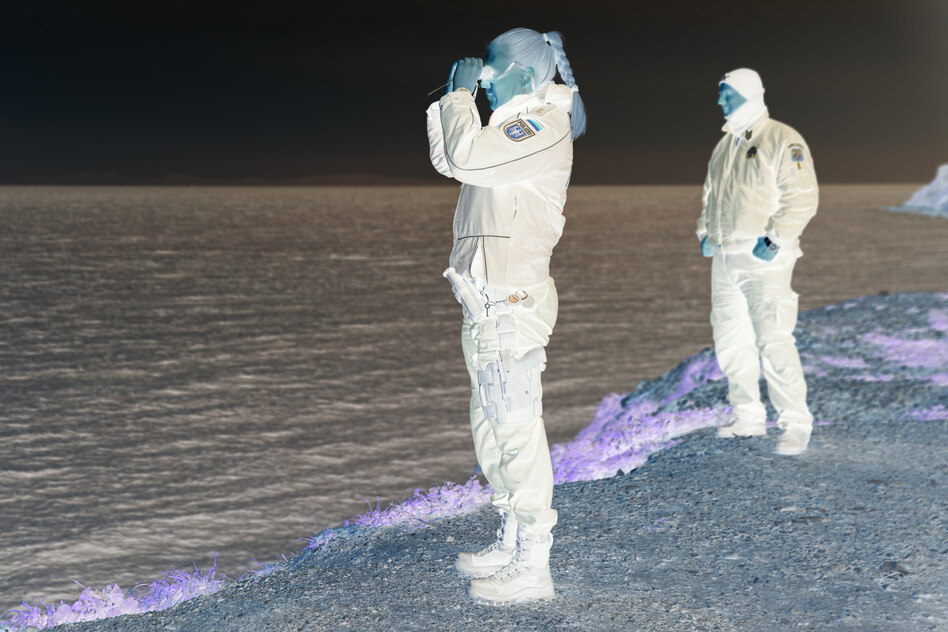
Jonas Blume* reported to taz in spring 2026. His actual name is different, his real name is known to the taz, and there were several conversations with him. To protect Blume's identity, some details in the text remain vague, such as the time and place of the incidents he describes. To verify his statements, the taz interviewed various people from Blume's environment, including one of his colleagues at the federal police and a volunteer who met him in a refugee camp. The taz also has various documents that prove Blume's career as a federal police officer and his work for the EU border protection agency Frontex.
taz: Mr. Blume, Frontex regularly borrows emergency forces from EU states. So do federal police officers like you. What did you experience during the missions?
Jonas Blume: I worked for Frontex at the EU's external borders several times. Our job was to support the local police in border protection. I've had a lot of bad experiences.
This text first appeared in wochentaz, our weekly newspaper from the left!
Every week, wochentaz is about the world as it is – and as it could be. A left-wing weekly newspaper with a voice, attitude and the special taz view of the world. New every Saturday at the kiosk and of course by subscription.
Blume: For example, our colleagues specifically put on masks and took out their submachine guns when we found a group of refugees. People cried, parents held their children. Nobody but me tried to calm people down. I used to think that the German state and the EU ensured that refugees were treated humanely. This belief has broken down bit by bit.
taz: And yet you continued to work for Frontex?
Blume: The operation lasted a few weeks. But I started going to a refugee camp in my free time and made friends with some of the residents there. The people were housed in very poor conditions. To me it seemed like they were supposed to be worn down to scare others away.
taz: The helpers were certainly thrilled that a Frontex man was suddenly in the camp.
Blume: As far as I know, I was the first police officer to show up at the NGOs. I was initially met with corresponding skepticism. But they realized I was serious. I was very impressed by how well organized the NGOs were. They occasionally ordered clowns to the camp for the children. There was even a women's shelter. I then packed packages there and sorted donated clothes. To this day, it gives me hope how civil society steps in wherever the state fails.
taz: First Frontex, then refugee helpers – sounds like the script of a German feature film. Or a personal break. What happened there?
Blume: When I met two Afghan refugees personally, it moved me a lot. I gradually understood that the many reports of human rights violations at the borders were true.
taz: And your colleagues simply didn't see it?
Blume: It was shocking how little my work colleagues were interested in it. In their free time they went for fancy meals and went on great hikes. Most police officers probably don't deal with the injustice or make light of it because the truth is hard to bear and certainly makes their own lives more difficult. I couldn't do that: just do my job and not ask any more questions.
When confronted with Blume's reports, a Frontex spokesman said they took such allegations "very seriously." Racist or discriminatory behavior is incompatible with the organization's standards. There are independent control mechanisms to identify and check suspected cases.
In recent years, a large number of media reports have repeatedly documented the misconduct of Frontex and its officials. The agency is said to have ignored excessive violence by national border guards and, particularly in Greece, to have systematically supported local emergency services in so-called pushbacks, in which refugees are illegally driven back across borders by force.
Despite all the scandals, the EU member states massively increased Frontex's budget to over 1.2 billion euros per year. Only 2.38 million euros of this amount goes to human rights-related matters.
taz: You seem to have been out of place at Frontex. How did you end up there anyway?
Blume: I don't know whether Frontex was as criticized back then as it is today. If so, I wasn't aware of it. And if you don't know about the moral problems, then the deployment sounds like a cool thing. You get about twice the salary, and the experience abroad is good for your career. I was a bit naive.
taz: Despite your experiences during your first deployment, you were later at Frontex again. Why?
Blume: I had probably suppressed how difficult the first mission was for me. But I was also simply interested in how the situation there developed. On the way there, a colleague used the word “oil eye” to talk about non-white people. That was a first low. But things really went downhill when I read a newspaper article about us on the first day of deployment.
Blume: It was about a pushback in which Frontex was involved. Apprehended refugees were handed over to the local police, who then forced the people back across the border. That was super intense. I swore I would never get involved in something like that. Now I could read in the newspaper that my work amounted to exactly that.
Blume: Yes, I really thought before that the police in my area of operation would abide by the law. I then went to my boss with the newspaper article. He agreed with me and we went to his manager. But he argued that that was okay. How the local authorities deal with the refugees is their business. They would send us away anyway because they don't want any witnesses to the pushbacks.
Blume: I struggled with myself for a long time and tried to talk to colleagues about it and sensitize them to the topic. A colleague thanked me for that. Another colleague said that my attitude to the Federal Police was wrong. There is a difference between theory and practice. How can you have such an attitude? But the bad thing is that he's right: there really is a huge difference at the EU's external borders between what it should officially be and what it is.
Blume: When I got back to Germany, I couldn't sleep anymore and was completely beside myself. I had excessive fears and couldn't carry out the simplest tasks. The worst part was the feeling of betraying my values. I never did a Frontex mission again.
Frontex denies that the organization or any of its officials took part in pushbacks. In response to Blume's allegations, a spokesman for the taz said that reported incidents or media reports about them would be "reviewed as part of the agency's monitoring and reporting mechanisms" and that "appropriate follow-up measures" would then be taken.
The German Federal Police says that if its officers are involved in such incidents, information will be “passed on to the designated reporting and testing channels and cleared up.” Despite media reports about systematic, illegal pushbacks by Frontex, the federal police sent around 300 officers to the agency's operations this year.
taz: You not only served for Frontex at the EU's external borders, but also as a federal police officer at the German borders. How was that?
Blume: There were some intense situations. We were deployed in southern Germany and checked on the motorway. A colleague showed me a photo on his cell phone of a naked woman with swastikas tattooed on her. Isn't that cool? I reported this to my platoon commander and was simply brushed off. The colleague is actually a good guy. Afterwards I had the feeling that I was no longer wanted in the unit.
taz: Because you reported the incident?
Flower: Yes. The people in a unit know each other. And I think many people had the same attitude as the man who showed me the photo. At least no one seemed to mind.
Blume: There were many situations like that. A group of colleagues stood together and one of them said that a refugee had recently forced his way to the doctor's office. The colleague said he should be castrated. A few laughed, no one said anything against it except me. One thing is clear: such people don't belong in the police. And at the same time I find it difficult to deal with it. I actually kind of liked whoever said that. I don't think you can understand that unless you're involved and spend so much time with the people.
taz: Has the racism of some of your colleagues also been directly reflected in their behavior towards refugees?
Blume: There was a situation that really sticks in my mind, it must have been at the German border in 2015. When I got there, a black man was crumpled on the floor and screaming. He begged us that he had a stomach ache and couldn't take it anymore. I wanted to call an ambulance. My colleague then said that we wouldn't call an ambulance because "in the banana country" where the man came from, no ambulance would come in 20 minutes.
Blume: I still called the ambulance without my colleague noticing. But he noticed and yelled at me. I am a do-gooder and a Green Party voter. He really wanted to attack me and had to be held back by colleagues.
When confronted with Blume's allegations, a federal police spokeswoman replied that she could not provide any information about such cases because the descriptions were not sufficient to attribute them to any registered incidents. In principle, the federal police carry out their tasks “in compliance with legal requirements” and this “always regardless of skin color, gender, religion or based on other indications such as ethnic origin”.
taz: Why did you actually join the federal police?
Blume: I was very young and wanted a varied career with people and sport. I also have a high sense of justice. In my family, a career in government service was considered a good idea. Looking back, I think to myself: At least I didn't join the Bundeswehr - even if the decision to join the police wasn't that great either.
Blume: I've always been against fascism, but never at demonstrations. Maybe that's why I wasn't really sensitized to issues like racism and police violence. But that has changed over time.
Blume: I quickly learned that if you want to get ahead, you don't speak back and submit. We marched in step a lot. As a punishment we had to fight again and again, like in the military. A common punishment was “Germans”. That's what we called push-ups. When I later rose to senior management, we had lecturers whose positions I found problematic. One of them was Stephan Maninger, a professor of security policy. He is one of the founding members of the sponsoring association of the Institute for State Policy and wrote in new right-wing media about “ethnosuicide” and “demography as a weapon”. I don't understand why such people are employed by the Federal Police, let alone employed as lecturers.
Stephan Maninger is a German-South African security policy researcher. He was one of the founders of the right-wing extremist Institute for State Policy and published texts in the right-wing weekly newspaper Junge Freiheit. The police union described him as a “proven extremist” in 2025. After his right-wing connections became public, the Federal Police Academy initially placed him on leave. He is now teaching there again. In May 2026 he was even appointed professor for life. When the taz explicitly asked the federal police, they did not comment on the Maninger case.
taz: Since spring 2025, officials have also been using pushbacks against asylum seekers at the German borders, although the Federal Ministry of the Interior prefers to speak of rejections. Is the injustice of the EU's external borders seeping into Germany?
Blume: The Berlin Administrative Court has ruled in several cases that these rejections are unlawful. Actually, every federal police officer should protest if there are legal concerns.
Blume: That's what civil service law says when you go to your superior and express concerns about an order that seems illegal.
The rejections at the German external borders continue. According to official information, a total of around 42,000 people were turned away by June 2026, including at least 2,000 who had explicitly asked for asylum. A spokeswoman for the Federal Police did not directly answer taz's questions about the officers' actions in the rejections, but said that they always work "in compliance with legal requirements".
The federal government recently had to admit that courts that have dealt with the practice have so far decided in every single case that the rejection of those seeking protection is unlawful. The Federal Ministry of the Interior argues that these decisions only apply to individual plaintiffs and not generally.
taz: Why do you think the officials don't protest?
Blume: A few may have remorse. But I'm sure many police officers are fully behind it. And as long as the action is politically backed, no one expects any consequences. You just have to look at the EU’s external borders and the systematic pushbacks there. Of course, the impression arises that illegal actions have no consequences, while advocating for the rights of refugees can damage one's own career.
taz: Do you think this is a structural problem in the federal police?
Blume: I know that my experiences are subjective and that there are big differences between departments. But whenever I raised problems, the result was rejection and sometimes tangible disadvantages. This seems to me to be a structural problem. There is also the question of who controls the police. At the moment it is other police officers who are investigating misconduct. This is a conflict of interest. And when someone brings this up, the argument always comes up that it raises general suspicion against all colleagues. It's exactly the other way around: fending off any accusation by pointing to a general suspicion seems pretty suspicious to me.
Updated 10/19/2026. In an earlier version of the text, the pseudonym “Jonas Müller” was used instead of the pseudonym “Jonas Blume”. However, there is a federal police officer whose name is actually Jonas Müller and who has nothing to do with the taz interview partner. In order to avoid any misunderstandings, the pseudonym was changed. d. R.