
Germany taz
Book “That’s what life is like with adults”: They hold a mirror up to you in a tough way
In an anthology, children dissect their experiences with adults. The editors presented the book on Sunday in Berlin's Grips Theater. more...
Deutsch (original) ·Auto-translated to English
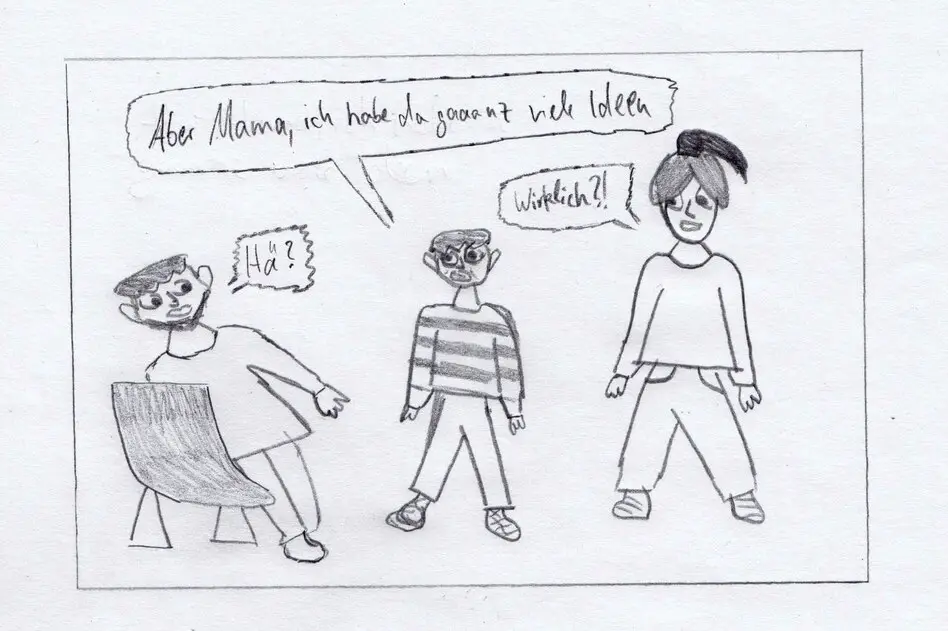
There are plenty of guides in which adults give other adults parenting tips. But guides in which children tell other children about the pitfalls of being with adults – do they even exist? Almost not. The three editors ManuEla Ritz, Simbi and Sookee*Sukini address this gap with their book "That's what life is like with adults. Young people report on adultism and adults learn from it."
In comics, flip books, poems, correspondence and experience reports, young authors explain pars pro toto for their generation about everyday life with adults. Explaining things doesn't go far enough - anger, criticism and the fun of finally having the floor are just as much a part of it.
In a sense, the book has a strange starting point: As people grow up, many people forget their childhood experiences with adults. And the next generation of children will have to pay for this memory gap.
Simbi, Manu, Sookee*Sukini (ed.): "That's life with adults. Young people report on adultism and adults learn from it." Unrast Verlag, Münster 2026, 143 pages
The book premiere last Sunday in the Grips Theater on Berlin's Hansaplatz was equally strange. Humble adults sat next to proud children. And when the children spoke, the adults were quiet - who had the floor seemed clear from the start. A small parallel universe in the Grips Theater in which children seemed to get rid of everything that had always been on their minds.
Something similar in the anthology: the authors dissect the behavior of adults in an accessible and playful way. It's about adults' sovereignty over children, gentle arrogance and a lack of empathy, but also always about endless love and a kind of underage solidarity. Adultism, we also learn, rarely comes alone: often combined with racism or classism, it is found in damaging relationships or the like. Only to then notice again and again that it is mostly inconspicuous, but omnipresent.
This everydayness is countered with a very unique kind of dialogue, which is noticeable in the book and in the afternoon. There are two sides to an “uprising against adultism,” which Noah addresses in an article with the adult Quentin: Just as children need the courage to defend themselves against unfair adults, they need adults who can support them in self-critical ways.
Two of the three editors, Simbi and ManuEla Ritz, are children and mothers. In this joint work you are “held up to a hard mirror,” emphasizes Manu. This is also why it was probably one of the “most emotional projects” for other participants.
Understandable when you consider what the authors reveal: that children are seen as children first and as people second and not the other way around. They do this in situations in which we would see nothing more than ordinary child-adult everyday life.
The grotesquerie that is hidden in the demands, gestures and encounters towards children is subversively presented to you - also to the adults present, whose faces occasionally show a little shock. Whether reflection on one's own childhood or one's own parenthood is responsible for this remains an open question. However, both indicate that the book began to have an ad hoc effect - a success for the young authors.
So replacing exhausting book launch rules with conversations with strangers, a painting class and questions to the audience was the best way to have a productive conversation about this topic. Maybe cultural stuff for adults also needs this “childlike” influence - or why are there slides only in playgrounds and not in the opera?