
Politics · taz · · 1h
BSW in Mecklenburg-Western Pomerania: Wagenknecht party tries it without a fight
Deutsch (original) · Auto-translated to English
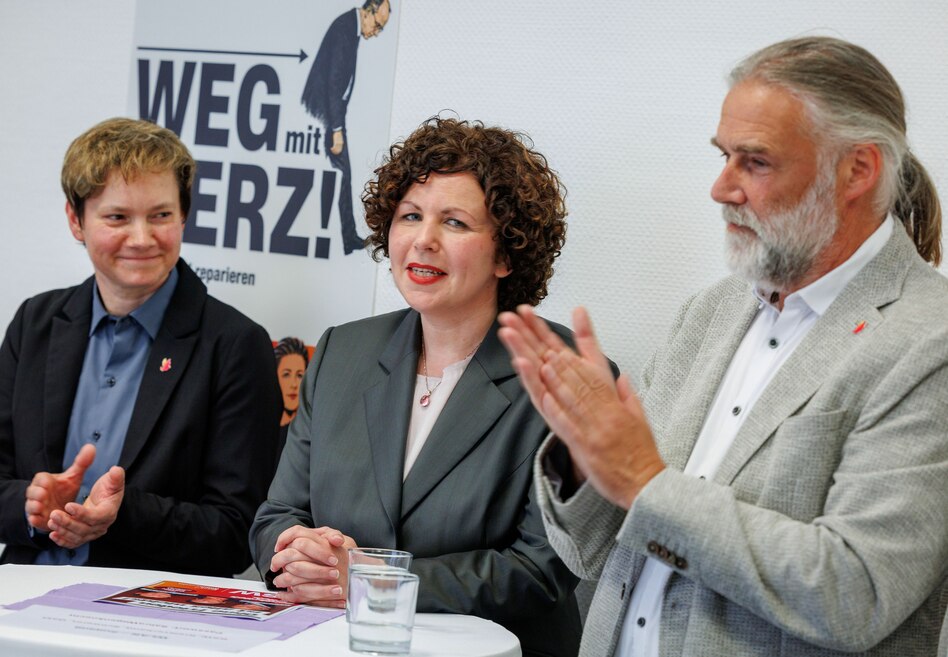
First Magdeburg, now Schwerin: The Sahra Wagenknecht alliance is convinced that it will achieve the next success in the state elections in Mecklenburg-Western Pomerania on Sunday. “We hope that, like in Saxony-Anhalt, we will tip the scales,” says BSW top candidate Sabine Firnhaber. She sees her party “realistically at 6 to 8 percent” in the northeast.
Most pre-election polls see something different, namely a failure to pass the 5 percent hurdle. But Firnhaber is of little interest. “The survey institutes always write us down.” And the media joined in. “But I believe that more and more people are questioning this and that this will give us confirmation in the election,” says the 49-year-old farmer to taz.
Shortly before, party founder Sahra Wagenknecht made her big appearance to support the election campaign in Mecklenburg-Western Pomerania. Sabine Firnhaber and BSW co-leading candidate Peter Schabbel had to take part in the preliminary program. As expected, Wagenknecht also complained about the media. “There’s a hell of a lot of lying.” But “the East” no longer believes any of this because it is not stupid.
On this cold evening at the Old Market in Stralsund she meets a busy clapping, but rather small audience. Only about 200 people listen to her. There were better times for Wagenknecht, including in Mecklenburg-Western Pomerania.
Wagenknecht's voice still whips across the square so loudly, as if there were several thousand people to entertain. For 25 minutes she presents her classics: The economy is being “run to the wall”, the federal government has “run into ruin”, a war with Russia is imminent, the real terror is coming from Ukraine. "Shame." "Scandal." “Ripoff.” “Where will it all end, dear friends?”
The dear friends Sabine Firnhaber and Peter Schabbel don't want to contradict that. Like Wagenknecht, the top candidates also see Germany at the end. They too are calling for a “non-partisan Prime Minister” for Mecklenburg-Western Pomerania. And that the Nordstream pipeline is being “turned up”. They know Wagenknecht's war and peace songs by heart. Schabbel says: “Russia is not our enemy.”
The 59-year-old alternative practitioner points out that he was already involved in the peace movement during the GDR era. He was close to the Greens for a long time. In the last state election in 2021, he ran for the “lateral thinking” party Die Basis. Since October last year he has been head of the BSW regional association, which has just 440 members.
University professor Peter Langer, who alongside Schabbel was also elected as the new state chairman, quit four months later. Langer has since left the BSW. According to media reports, he is said to have accused his party of pandering to the AfD. It was said that the appearance as an “anti-system party” increasingly disgusted him.
Yes, says Peter Schabbel to the taz: “We don’t want to hide the fact that there were disputes here.” Then he adds: “The Thuringia question certainly didn’t do us any good.” It should be noted that Schabbel does not like to talk about the conflict between the BSW federal leadership and the Thuringian regional association, which has now been “resolved” by the resignation of the Wagenknecht critics.
At the end of August - at the height of the party war between Berlin and Erfurt - Schabbel stated in an interview that "the Thuringians" were also "having very good success with their participation in government".
As a reminder: Wagenknecht and the BSW federal bosses Amira Mohamed Ali and Fabio De Masi only saw traitors and careerists at work in Thuringia. They viewed the coalition there with the CDU and SPD as damaging to the party from the start. As early as 2024, De Masi made a disparaging statement that the BSW did not compete “to grill a few bratwursts in Thuringia”.
Schabbel is the opposite of De Masi and Co. More like a friendly uncle. He doesn't like the over-the-top, angry citizen sound that BSW usually uses. It is similar for co-leading candidate Sabine Firnhaber, whose path into politics began in 2019 with co-organization of the farmers' protests. Firnhaber says: “We’re just North German.” She and Schabbel have their “own style, not such a tough mentality”.
Unlike the cross-front-minded BSW leadership in Saxony-Anhalt, Schabbel and Firnhaber also have a clear position on the AfD: no cooperation. While there are lively discussions with the right-wing extremists in Magdeburg, Schabbel says: “I’m ruling that out.” He will neither prepare motions in the state parliament together with the AfD nor “develop specific strategies to achieve a parliamentary majority.”
These are sounds that could also be heard from the breakaway enemy state of Thuringia. To be on the safe side, Schabbel cautions that the BSW in Mecklenburg-Western Pomerania naturally sees itself in the opposition: “We cannot imagine a coalition, not with the AfD, but not with the other parties either.”
In general, it is time to look forward. "We are a young, still new party. There are also signs of settling," says Schabbel. “I think we’ve gotten through that pretty well now.” The BSW is back on the road to success. In the three days after the election in Saxony-Anhalt alone, there were “12 or 14 membership admissions” in Mecklenburg-Western Pomerania. That's a lot.
Read the full story at the source
Source: taz