
World · taz · · 2h
Brics summit: India takes the potential heat off Brics
Deutsch (original) · Auto-translated to English
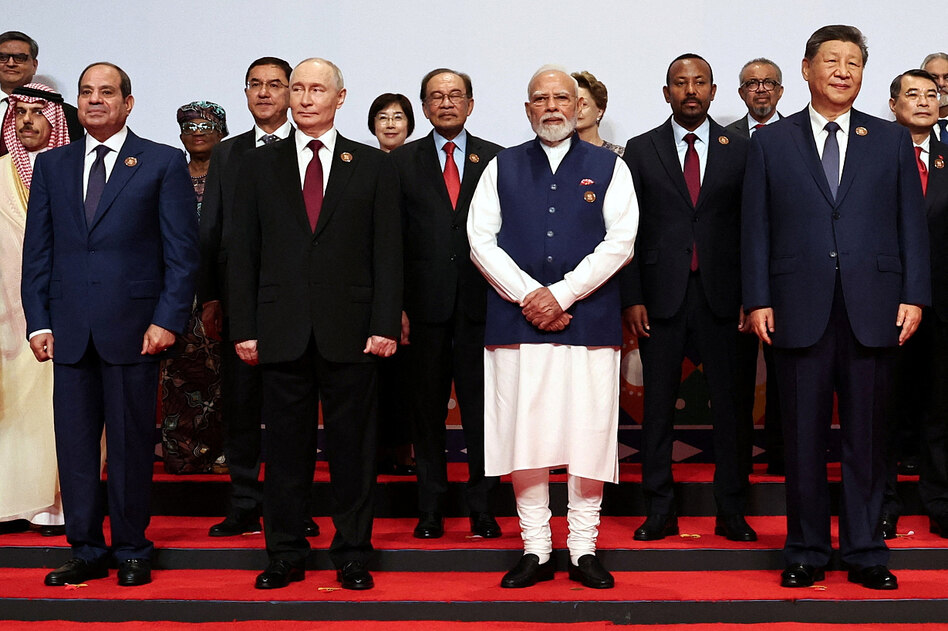
They want to reform the international order, but not be a counter-block to the West: The 18th summit of the Brics states in Delhi ended with a joint declaration on Sunday. In it, eleven leading emerging and developing countries oppose unilateral tariffs and sanctions and call for more say from the Global South.
“Not Western, but not anti-Western,” is how Indian China expert Srikanth Kondapalli describes the alliance. China and Russia want to push back the influence of Western-dominated institutions, while India emphasizes its strategic autonomy: Delhi cooperates with China, Russia and Iran, but at the same time expands its relationships with the USA, Europe and Israel. According to Kondapalli, many emerging countries cannot economically afford to oppose the West.
Indian Prime Minister Narendra Modi reiterated that Brics is “not directed against anyone”. What was new, however, was the emphasis with which Modi demanded concrete results. The Global South must develop from a “rule taker” to a “rule maker”. India and Brazil have been striving for a permanent seat on the UN Security Council for years.
The fact that a joint final document was reached on the first day is a success for India. In May, the Brics foreign ministers failed due to differences over the Iran war. Now the group expresses “deep concern” about the escalation and calls for restraint. In the conflict between Israel and Palestine, a two-state solution and thus a sovereign Palestinian state are called for.
There is also a common denominator in trade and business. The Brics countries criticize unilateral tariffs, sanctions and other trade restrictions that have affected global trade. This can be interpreted as a message to Washington.
However, the interests remained different. On Sunday, Modi warned against the “instrumentalization” of technologies and critical raw materials as a means of political pressure. By this he also means China, on which India is currently trying to reduce its dependencies.
China's head of state and party leader Xi Jinping was the most important guest in Delhi. On his first visit to India in seven years, he was conciliatory: “China and India are partners and not rivals.” They offer each other opportunities for development and not threats.
Xi's visit was accompanied by protests from Tibetans in exile. Relations between Delhi and Beijing were at their lowest point after the deadly 2020 border skirmish in Galwan. It was only from 2024 that dialogue channels were revived, investment restrictions were relaxed and direct flights and tourism began again.
But mistrust and the unresolved border conflict remain. Brics at least offers Xi and Modi an opportunity to meet without either side having to invest “political capital” in an independent bilateral visit, says Indian political scientist Happymon Jacob of the taz. This does not solve structural conflicts.
China and India are competing for influence in the Global South, while Russia is increasingly seeking confrontation with the West. Brics has changed a lot since its beginnings in 2006. The merger of Brazil, Russia, India and China became a group with eleven members, its own development bank plus ten partner states. The Brics states make up almost half of the world's population and are calling for reforms in international financial institutions and more participation in artificial intelligence.
However, the group's contradictions do not become smaller as the group grows larger. Now there was at least a meeting between Iran's President Massoud Peseschkian and Abu Dhabi's Crown Prince Khaled bin Mohammed bin Zayed al-Nahyan. Iran has recently shelled the Emirates, where there are US military bases, several times.
Brics will “not be a counterpoint to the G7 or the American-led order,” believes Jacob. What was missing was a common understanding of international security and mechanisms for being able to count on each other. Russia, in turn, is now just “one of several partners” for India instead of the central anchor of its foreign policy. Delhi's diplomatic achievement right now is to keep Brics "boring" despite all the rhetoric about a new world order, says foreign policy expert C. Raja Mohan.
Read the full story at the source →
Source: taz