
World taz
Brazil before the runoff election: “Olé, olá, Lula”
The fight for the Brazilian presidency is being decided on social media. Does the US company Meta prefer the right-wing candidate Bolsonaro? more...
Deutsch (original) ·Auto-translated to English
"Never before have there been so many people here at once as today," ACM Neto shouts from the stage into the humid evening air of Salvador da Bahia and gives the signal to the not-so-massive people in the square to cheer and wave flags. "Flávio," he roars, "you mustn't forget that, you still have to help us, even if the PT still rules here." ACM Neto, the youngest scion of a political dynasty in Brazil's northeast, has just been defeated by his competitor from the PT workers' party in the gubernatorial election. Now he's getting in the mood for the appearance of the right-wing candidate for the runoff election for the presidency on Sunday: Flávio Bolsonaro.
Bolsonaro is also the son of a well-known politician: his father is Jair Bolsonaro, who was convicted of an attempted coup. The delinquent father did not harm the son: in the polls, Bolsonaro junior from the Partido Liberal (PL) is two percentage points ahead of incumbent Lula da Silva, who is running for the PT.
In the eastern state of Bahia, Lula won in 413 of 417 municipalities. Perhaps that's why Flávio's campaign advisors put the capital of Bahia, Salvador, on the list of cities that the candidate should visit in person before the runoff election. His previous live events have been moderately successful: Jair's eldest son has neither his father's charisma nor his coarse language, with which some identify.
This article was made possible through the financial support of the Forschungsfonds Ausland e. V. You can support the research fund through a donation or membership.
When Flávio Bolsonaro finally stands on stage at dusk, he tries melodramatics: “Here stands someone who sacrifices himself every day of his life for the people,” he announces, “someone who even risks his life for you.” The spectators are not very impressed. On the one hand, it seems to be the enemy of the Workers' Party.
The first round On October 4th, the right-wing candidate Flávio Bolsonaro from the Partido Liberal (PL) emerged victorious from the first round of the presidential elections with 47.05 percent of the votes cast. Lula da Silva from the Workers' Party (PT) only got 45 percent. Lula won the last election in 2022 by just 2 percentage points. He had previously said he was “confident” of winning the first round of voting.
Shift to the right in Brazil The PL, which also includes Flávio Bolsonaro's father, ex-President Jair, and his wife Michelle, also dominates the Senate with a two-thirds majority. After October 4th, the PL also dominated in parliament and at the state level, among the state governors.
The second round Because none of the 13 candidates from the first round achieved an absolute majority, the two candidates with the most votes, Bolsonaro and Lula, will face each other in a runoff election on October 25th. Lula has made gains in the polls, particularly among those under 25, a group many of whom did not vote in the first round. The issues shaping the election campaign are security, dwindling purchasing power, corruption, health care and low pensions. Bolsonaro promises to increase the latter if he wins the election. In health policy, NGOs fear that Bolsonoaro's neoliberal austerity approach could further weaken the already precarious health system.
US President Donald Trump has not officially expressed his support for Bolsonaro. After the first round of voting, however, he spoke of a “very, very big victory”. If the right-wing conservative candidate wins, the last left-wing government in South America would be voted out. The USA violently kidnapped the Chavista ruler Maduro in Venezuela at the beginning of the year. (akl)
“The PT will die,” they chant, and: “Lula is a thief who belongs in jail,” “PTlers, we will find you.” The slogans are refrains from Rio funk songs, accompanied by hard beats, like those played in slums dominated by militias. On this evening in Salvador, they sound like a real threat. It seems almost ironic when Flávio shouts to this sound: “From January I declare war on narco-terror!”
He received the biggest applause when he announced that he would “chemically castrate all sex offenders.” The crowd finally goes wild with enthusiasm and answers the question: “Which one of you wants Jair Bolsonaro back?” with many voices: “Bolsonaro, come back!” The candidate may only be second choice for those present because his father is not eligible. After eight minutes of speaking, he disappears into a limousine and leaves the city without shaking hands with any of the people.
The audience consists of many seniors, the majority of whom are middle-aged. Young people or children are hardly represented. Many are white, many have frustrated faces. “Jair was a saint, he should never have been convicted,” says 72-year-old Luiz Bahiano and lists: “He improved social justice and brought water to the dry hinterland.”
In fact, it was a Lula government program that provided small farmers with water storage tanks and pumps. But Bahiano doesn't allow himself to be distracted by facts and simply says: "Finished, I wanted to say, nothing was ever finished under Lula!" The pensioner chooses a Brazilian flag for his home from a dealer. They also come in a version where the middle is split like pizzas with two flavors: Brazil/Israel or Brazil/USA. “The USA stands for freedom,” explains military police officer João Paulo. "We have professors who fail students if they don't choose PT. Americans can say whatever they want and have financial freedom!"
Brazilians suffer from high fuel and food prices; They are worn down by a series of scandals and disappointed with politicians and institutions. Despite compulsory voting, one in five people did not show up on the first election date - a low in the past 30 years. The candidates are fighting for these non-voters in the last few meters before the deadline.
Flávio Bolsonaro presents himself – like his father before him – as the man of change. His election program mainly consists of wanting to take Lula's place. On the T-shirts at sales stands, the 45-year-old is shown in a digitally edited version with a heroic long-distance look, without gray hair or belly. In WhatsApp groups, the Bolsonaro team publishes AI-generated videos in which avatars illustrate alleged statements by President Lula, which are edited from his speeches. There are emotionally charged messages and polemical content on Instagram that the algorithm prefers to spread. Young politicians with little or no real political experience are now emerging from influencer circles.
One of them accompanies Flávio Bolsonaro on his election campaign tour: Nikolas Ferreira, MP from the PL. The 30-year-old distributes AI-edited posts, including alleged audios of President Lula in which he supposedly calls for drug use. A court order prohibits Ferreira and his colleague, the influencer Pablo Marçal, from spreading hoaxes that have already been identified as such or from increasing the reach of their posts by paying Meta.
However, many Brazilians use social media extensively - but not necessarily critically. According to a 2025 study by the DataSenado institute, more than half of Brazilians get their information primarily digitally, predominantly via Instagram. Another study shows: Those who believe they are confident in dealing with false reports are particularly easily deceived.
In the bubble of Bolsonaro supporters, a very own interpretation of the world is propagated, explains the commentator on the news portal Brasil de Fato, Rossano Rafaelle Sczip. Anyone who is exposed to this closed world view for long enough will hardly be influenced by external reality.
There are numerous examples of this: The imprisoned head of Masterbank donated tens of millions for a film about Flávio's father? Bolsonaro lost a few evangelical voices, but they soon returned to him. It becomes known that the father of the family took part in sex orgies with prostitutes? His image as a God-fearing Christian remains undamaged.
The candidate Bolsonaro is like an avatar that exists independently of facts. This parallel world on social media has been prepared for a long time: Flávio's brother Eduardo set up his own department for digital election campaigns and false reports as early as 2022 and successfully spread such absurd false reports to the general public, such as the claim that the PT would use feeding bottles with penises as suction attachments in public crèches.
After the shock of October 4th, when Lula was around 2 percentage points behind his right-wing opponent with around 45 percent, the left is finally ready to position itself more digitally. “Lula may be analog, the campaign must become digital,” demands MP André Janones, who led Lula’s digital election activities in 2022.
On his Whatsapp channel with the title “Exercito do Lula” (“Lula’s Army”) he calls for active cooperation for the victory of the PT man. With daily video messages, Janones managed to gather more than 7.3 million “soldiers” within a very short time, to whom the social media expert explains the rules: that they have to ignore provocations from their political opponents because the algorithm upgrades posts with negative reactions. That they not only have to like posts from the left, but also add comments and forward them. That concerted actions attract more attention.
Every day Janones spreads new declarations and tasks that his growing following carries out. In numerous cities, his followers accompany Bolsonaro's TV interview with the noise of thousands of rattling pots. A day later, thousands of people published at the same time under the motto “Yellow-green is ours!” on Instagram selfies in the national colors and make the L sign for Lula. The national colors have actually been a symbol used primarily by the right-wing. But this action by the “Lula soldiers” dominated the discussion on the platform for days. One can get the impression that the tide could turn again.
At the same time, legal disputes surrounding deliberately launched false reports are increasing. Bolsonaro's PL wants to block 32 Instagram accounts, withdraw 221 publications and have other profiles monitored by court order.
The number and scope of the lawsuits indicate an attempt to control the debate in the election campaign, said lawyer Lucas Mourão, who specializes in digital law, to the ICL news channel. The prophylactic deletion of content classified as political interpretations is dangerously close to anticipatory censorship.
The targets of the lawsuits include the trade union headquarters CUT, the left-wing news channel Midia Ninja and various politicians from the PT workers' party. The conservative news magazine Veja claimed that the imprisoned banker Vorvaro had subsidized a 2010 biopic about Lula with 30 million reais (around 5.3 million euros). Although the magazine did not provide any legal evidence, the claim was allowed to stand. The police and Vorvaro's defense reject the report as false.
Mark Zuckerberg's Meta group also remains elusive. The PT accuses him of unequal treatment because it is temporarily not possible to create digital advertising for Lula using AI agents, while posters for Bolsonaro can be created without any problems. Despite higher follower numbers, content from Lula-friendly Instagram accounts reaches fewer people than that from Flavio-friendly accounts. Meta states that it was not a case of favoritism for Flávio Bolsonaro, but rather technical problems that not only affected Brazil. A new lawsuit on the same issue has not yet been decided.
We have to occupy the streets and the internet, Janones shouts to his followers. And people take to the streets. Students in particular, but also workers, artists and LGBTQ people are walking through Brazil's inner cities, shouting their support for President Lula to the world in more than 70 places. On October 11, just 14 days before the runoff, more than 1 million people gathered for Lula on Avenida Paulista.
Jair Bolsonaro had always considered the boulevard in the center of São Paulo his territory. In view of Lula's analogue successes, Flávio Bolsonaro rethinks his schedule and hastily begins an analogue tour of the country himself. In São Paulo, he managed almost 80,000 visitors, less than a tenth of the number of Lula's event. In Salvador Bahia, eight days before the runoff election, he again couldn't get more than 80,000 people together.
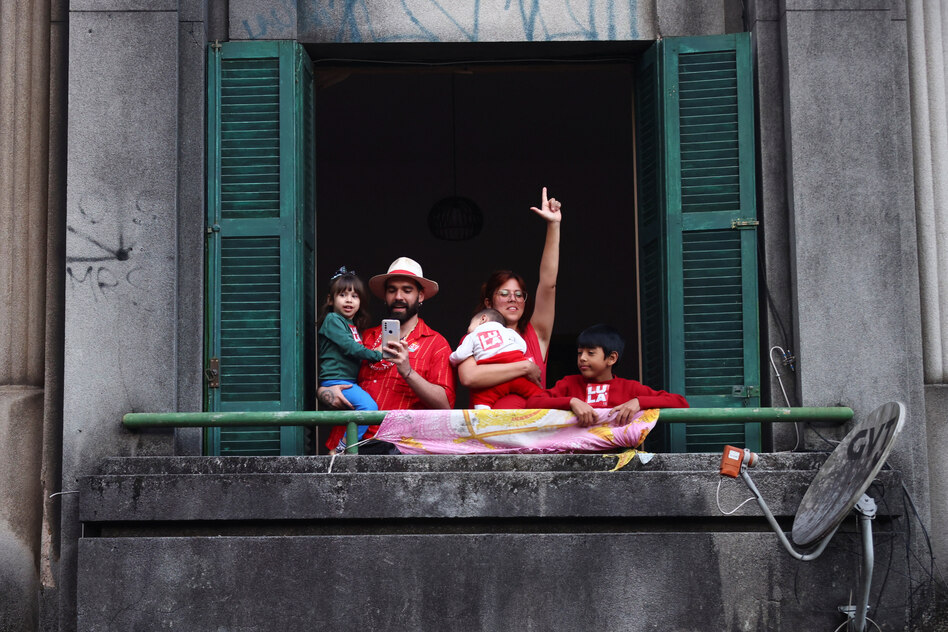
A day later, nine out of ten passengers on the 0145 bus in Salvador are wearing red. A chant spontaneously forms, cautious at first, then increasingly wild, louder, more joyful: “Olé, olé, olé, olá, Lula, Lula.” Valdelice Silva shakes her fist and her wild curls, then bursts out: “I don’t want to go back to slavery!” She is the daughter of a domestic worker and a bricklayer who could not read or write. "I know exactly how it used to be. My mother broke the pencils in half so that two children could go to school with them. That only changed with Lula."
Her neighbor on the bus agrees: "I've been working since I was 13! As a child, I collected crabs so we had lunch. Today I have a car and a motorcycle and my two daughters go to university! I'm evangelical, but I'm not stupid," he says. “Jesus is my soul savior,” he says. “But only Lula will ensure my freedom!”
More and more celebrities are speaking out in support of Lula: the Oscar-nominated actor Wagner Moura, for example. In Copacabana, singer Caetano Veloso is organizing a mega show with more than two dozen artists, in Salvador it is the singer Daniela Mercury who is calling for an “act for democracy” because a change of government could threaten massive constitutional changes given the shift to the right in Congress.
Large fan groups on social media of international pop stars such as Katy Perry, Taylor Swift, Billie Eilish and Harry Styles are also calling for support for Lula - in order to increase the reach of the left-wing candidate. “Taylor always says that young people have to take the initiative,” the British Guardian quoted a fan as saying. That’s what they’re doing now.
“We will turn the situation around, we will win,” says a passenger on bus 0145. Her neighbor comments with emotion: “I never thought I would experience such mobilization again.”
On this day, 500,000 people sing and dance for the president in Salvador. Three more days until the runoff election.