
Germany taz
Boxing Gloves: The ounce makes everything softer
The longer the history of the sport progresses, the heavier the mittens used for boxing become. The matter remains dangerous, however. more...
Deutsch (original) ·Auto-translated to English
Günther Jauch recently had this question: “What is usually offered for adults in sizes 10, 12, 14 or 16 oz?” Answer B was “boxing gloves”, and what surprised me the most was that the correct answer was worth 64,000 euros.
What “oz” is is easy to explain: ounces. Heavyweight professionals, both male and female, fight with 10-ounce gloves. They weigh 283.5 grams, and the weight expresses how padded they are. When Joe Louis fought Max Schmeling in 1936 and 1938, it was already 8 ounces. The impact should always be better absorbed.
What sounds so technical has a lot to do with the civilization of boxing. It is becoming less and less dangerous, which, if you read the sentence carefully, means: it is still dangerous, and the pressure to make it less dangerous continues.
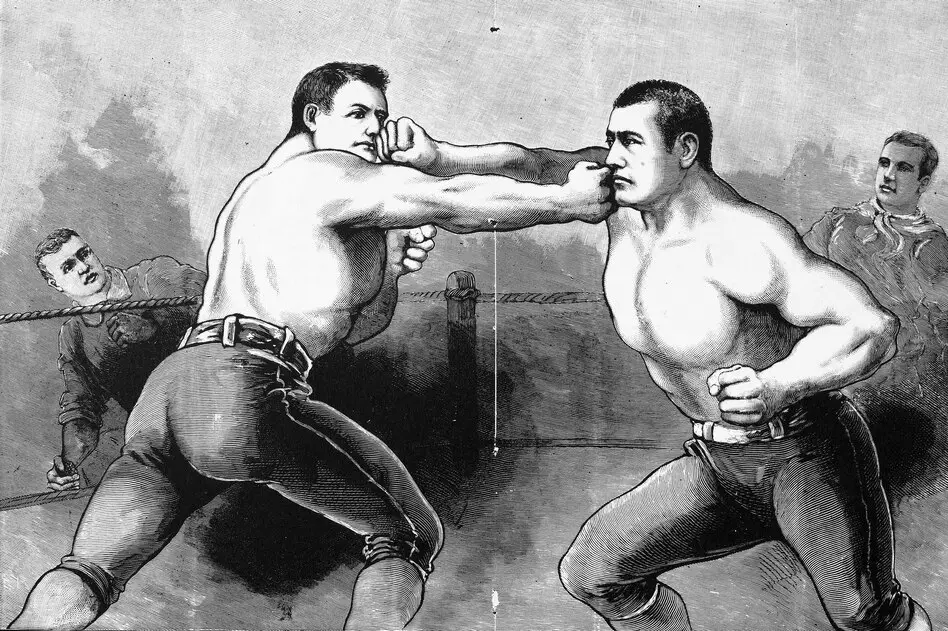
A look at the history of boxing gloves provides information about the development of human relationships. The mittens we know today have been around since the mid to late 19th century. They really asserted themselves on September 7, 1892.
The fact that such an exact date can be given is simply because James J. Corbett ("Gentleman Jim") and John L. Sullivan fought for the heavyweight world championship on that day - with 5-ounce gloves. Sullivan, who lost and had to give up his title, had previously fought unpadded several times. The technical term is “bare knuckle,” and that actually still exists today; However, it is only popular in a few communities.
Boxing gloves are part of civil society, just like parliaments, cinemas or the railway.
Speaking of which: Boxing gloves actually represent the historically welcome containment of brutal individual power. And that conversely means that anyone who doesn't adhere to this has a competitive advantage. That can be criminal.
In 1983, Billy Collins Jr. and Luis Resto boxed against each other. A non-important welterweight fight in New York's Madison Square Garden. After round five, Collins had said to his father, who was looking after him: “Daddy, it feels like he has stones in his gloves!” Resto wins, Collins is dazed, Stern writes that his head looks “like a watermelon, his eyes resemble mushy plums.” His father grabs Resto's gloves and protests.
The investigation shows: the gloves were tampered with. The horsehair that provides feeding had been pulled out through two holes. Luis Resto and his coach are banned for life. His opponent Billy Collins Jr., who was previously considered a great talent, suffered irreversible eye damage, became depressed and later died in a car accident.
There have always been arguments about gloves and bandages. Fortunately, it is rare for them to end as dramatically as they did in Madison Square Garden in 1983. But the planning of the manipulation may well be even more criminal.
During the Antonio Margarito vs. Shane Mosley welterweight fight in 2009, it turned out that the gloves had not been made lighter, but harder. It is a good tradition for a representative of the opponent to be present when the other boxer is bandaged. Mosley's trainer noticed that there was a white substance in Margarito's bandages. It was examined and found to be in a cast. If Margarito's hands came into contact with damp sweat, they would have become rock hard.
Boxing gloves must be well lined. And that has nothing to do with the fact that it's cold outside again.