
Germany · taz · · 1h
Blind people help with cancer prevention: Breast cancer is hard as wood
Deutsch (original) · Auto-translated to English
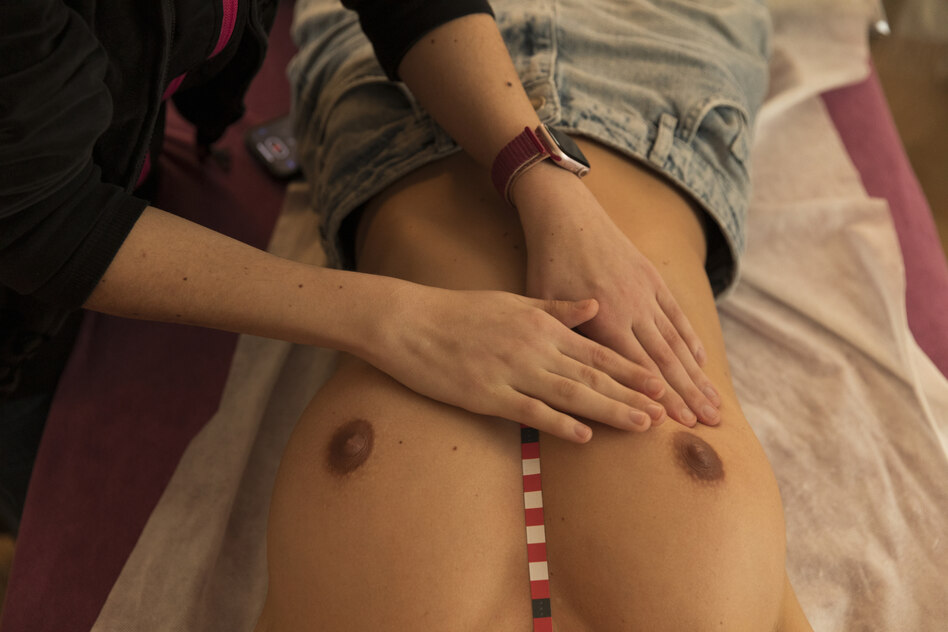
On the desk in front of Marie Hövener there is an iPad with cable headphones and red and white adhesive strips that look like short barrier tape. The March sun falls onto the parquet through lace curtains. There is a knock and a doctor's assistant from the gynecology practice brings in the first patient of the day. Today she will have her breasts palpated by Marie Hövener.
Hövener is blind. Your vision is less than two percent. The 28-year-old can see differences between light and dark and, if she concentrates, rough shadows. Like many blind people, their sense of touch is exceptionally well trained. That's why she works as a medical-tactile breast examiner - known in the usual abbreviation as MTU. Hövener is one of 42 women in Germany who practice this profession.
For five years, Marie Hövener has been feeling breasts in various practices in Erlangen, Oberasbach and Fürth to feel for unevenness. She detects cysts and tumors in the early stages when they are no larger than pearls on a classic pearl necklace. Hövener's sense of touch is her most important tool - in everyday life and at work.
Saheed Demir is here because she wants to do more to protect herself than before. Demir is 38 years old and actually has a different name - but would prefer not to use her real name in a text about such an intimate procedure. The investigation is important to her. “To be honest, the scanning was always too fast for me,” she says. “Did they tell you on the phone that I’m blind,” Hövener asks her friendly. You have. Demir looks a little unsettled. Hövener will later explain that many patients tell her that she doesn't look so blind. Her light brown eyes never look far away from her patient.
After school, Marie Hövener trained as a specialist in office communications. After an internship at a government agency, she knew that this work was not for her. Too little contact with people. Through the Nuremberg Blind Association, she heard about the Duisburg inclusion company Discovering Hands, which has been training blind and visually impaired women to become MTUs since 2012. 100 practices in German-speaking countries are currently working with Discovering Hands, including the practice in Fürth.
The research developed by Discovering Hands is called tactilography. It is not a replacement for sono and mammography screenings with ultrasound or X-rays, but rather a supplement. The screenings are primarily aimed at women between the ages of 50 and 75. They are expensive and are only paid for by health insurance companies at this age or if there is a specific suspicion. Tactilography starts earlier and can sensitize younger women in particular to cancer prevention. An examination by Marie Hövener costs 79 euros. Currently, 44 of the 93 statutory and all private health insurance companies reimburse the costs.
"I read back then that we blind women can accept our weakness as a strength through breast examinations. We can give other women security, we can save lives," says Marie Hövener.
Before she is admitted to training, Hövener must prove her tactile skills in an assessment test. She passes and so she can persuade the employment office to finance the qualification. It starts in September 2020. Marie Hövener and the other trainees spend six months learning about the female anatomy. The focus is on the breast and its tissue. First they practiced on plastic torsos and “towards the end we were let loose on each other,” says Hövener, laughing at the memory. In the next step, the trainees accompany gynecologists and other doctors for three months to feel what the cancer feels like on real bodies.
Because Saheed Demir is being examined tactilely for the first time, Marie Hövener conducts an anamnesis interview with her. Demir mentions her height and cup size. Nipple piercings or implants? No. Larger scars or birthmarks? No. Hövener types everything into her iPad, which, like her laptop, is equipped with a Braille display and a screen reader. She wants her patients to feel seen and takes time to go through their list.
“Mammary carcinomas, i.e. breast cancer lumps, are not smooth, but they are hard like a wooden ball and cannot be moved,” she explains and hands Demir a key ring. Six balls of different sizes dangle from it. Hövener explains: "The upper balls are the size in which women can feel the bumps themselves. The middle ones are as large as the abnormalities that doctors feel when palpating them and the small ones, with a diameter of six millimeters or more, we MTU can feel them." The patient listens carefully. “But unlike here, breast cancer is not round like a pearl and it does not have a smooth surface,” says Hövener.
Breast cancer can be easily cured if it is detected early. Statistics from the Robert Koch Institute show that over 80 percent of women with the disease live five years after treatment without a relapse. In everyday life, gynecologists only have 3 minutes per patient to palpate the breast. With MTUs like Marie Hövener, the scan takes between 30 and 60 minutes, depending on the size of the breast. A study commissioned by the Austrian Ministry of Health with 1,148 test subjects was able to show that MTUs detect around twice as many abnormalities during their more detailed examination as doctors do during their standard procedure. However, the number of false positive findings was also slightly increased.
Saheed Demir's investigation is about to begin. She takes off her top and sits on the lounger. Hövener washes her hands thoroughly. She moves around the entire practice without a stick and with light feet, she has walked the paths often, knows her room, knows exactly where the sink is and where the door is.
Then she stands in front of Demir and asks her to put her arms on her hips. It's very quiet in the room. Hövener asks: “Are you excited?” Demir says: “Yes, quite a bit.” Then they both laugh briefly and it seems as if the patient's tension is released a little.
Hövener begins to feel the lymph in his armpits. She presses into the tissue with three fingers and makes circular pressure movements. When the lymph nodes have been checked, her patient lies down on the table and Hövener begins to stick strips onto her chest. The strips divide the chest area into zones, which Hövener works on one after the other. Hövener can feel the dots on the strips. They result in a coordinate system. It helps her later to describe the exact location of a bump.
This text first appeared in wochentaz, our weekly newspaper from the left!
Every week, wochentaz is about the world as it is – and as it could be. A left-wing weekly newspaper with a voice, attitude and the special taz view of the world. New every Saturday at the kiosk and of course by subscription.
There are three layers of breast tissue. The fatty tissue is soft and varies from woman to woman. The glandular tissue lies on the muscles and is susceptible to hormonal changes such as tumors. The surrounding connective tissue holds everything together. Hövener has to go through all shifts. What can be moved is good, what cannot be moved is usually bad.
Hövener finds a suspicious change about every two months. If this happens, the patient will have an ultrasound in the office. Hövener then hands her over to the responsible gynecologist. Your job is actually over after the handover. But she always asks afterwards what she felt. Whether it was malignant or a benign cyst.
Marie Hövener has recently noticed a change in her clientele: “Previously, the women who came for the first time were between 40 and 80. Today I have patients in their early to mid-20s.” Awareness of breast cancer prevention has increased.
About 15 minutes have now passed on the lounger. “I can reassure you, everything was fine on the right side,” says Marie Hövener. She switches to the other side, running her index finger along the lounger to feel where she needs to go. Everything on the left side is also inconspicuous. Only one last test is missing: Hövener has to check whether fluid is coming out of the nipple. Outside of pregnancy, such discharge can be a sign of hormonal changes and should be checked out.
Hövener gets a cotton ball and dabs it on the nipple. She then asks her patient to help her: “I don’t feel any fluid, do you see a spot on this swab?” The cotton ball is dry. “Everything is fine with you,” Hövener says to her patient. While still on the lounger, Demir thanks him several times. She already knows that she wants to come back. “In a year then?” – “Gladly in a year.”
Marie Hövener washes her hands again and sits back at her desk to type the patient data into her program. In ten minutes the next woman comes to see her - the second of five to eight she examines in a day. Do her hands sometimes hurt? Different. “But I care for and massage my hands well, they are my main tool,” she says.
Read the full story at the source
Source: taz