
Germany taz
Conclusion Jazzfest Berlin 2026: The signals come from all directions
“Dream baby dream!” – the motto of the Berlin Jazz Festival was to be understood as an invitation to pursue wishes even in difficult times. more...
Deutsch (original) ·Auto-translated to English
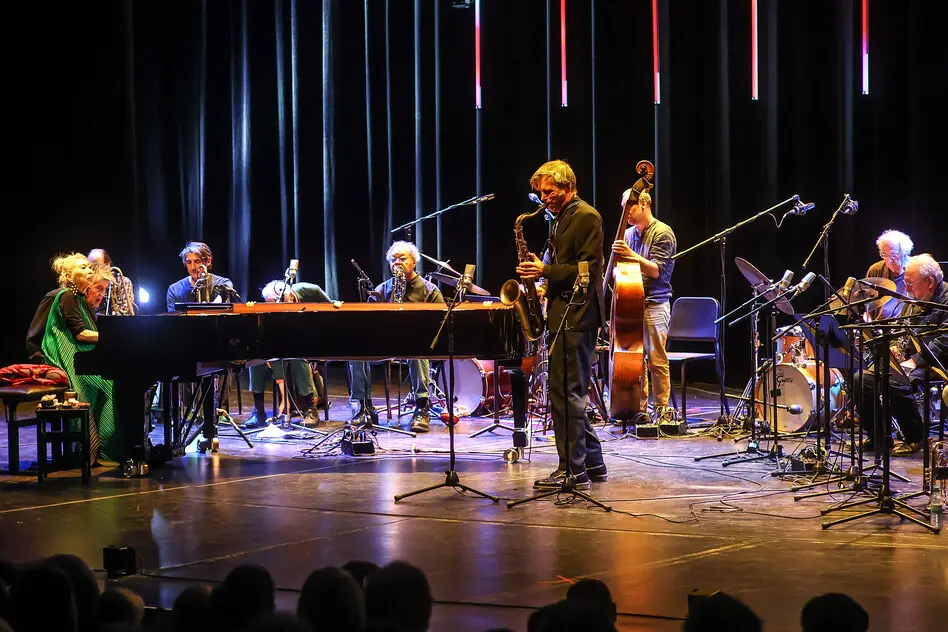
“Dream Baby Dream” was the motto of the 63rd edition of the Jazzfest Berlin. This gentle slogan became known primarily through Bruce Springsteen, who released a cover version of the 1979 song of the same name by the New York synth-punk duo Suicide in 2014. The power of dreaming in times that seem hopeless – a long-running favorite in the jazz business too.
“Dream Baby Dream” is also the title of a psychedelic short film that the festival had produced in 2025 as part of a community project and has now proudly presented.
When festival director Nadine Deventer addressed the audience in the packed hall of the Berlin Festival on Thursday evening, she skipped a few talking points because even as she was speaking she noticed how extensive the program has become: from improv theater circus to neighborhood sessions with young musicians in the SOS Children's Village Moabit. “Music, music!” could be heard the first impatient interjections during Deventer's speech.
It was finally Maria Portugal, the drummer, singer and composer who now lives in Berlin and comes from São Paulo, who gave a rousing opening concert with her Erasão Percussion Trio together with Burkhard Beins and Emilio Gordoa.
An unheard of music that showed connections between the movements of Berlin real-time music and Brazilian tropicalismo, in which artists like Tom Zé sang against the military dictatorship in the country as early as the late 1960s. Given Lula da Silva's current election victory, the choice of this trio to kick off was an absolute stroke of luck from a curatorial perspective. Yes, we can still dream of democracy in these times. No, we actually have to in order to follow the imperative of the festival motto!
Afterwards there was a concert by the now 81-year-old US artist Anthony Braxton, one of the great saxophonists, composers and thinkers of jazz. Braxton performed a commissioned work with a specially assembled septet consisting of four saxophones and three tubas - with his own notation system, which he calls “Language Music”. It consists of different modules, so-called “language types”, which as a conductor he is currently calling up from the musicians using hand signals.
Braxton's music did not happen linearly along a timeline, as is the case with classical scores, including jazz, but rather the signals came from all possible directions. A sound with a different understanding of space and time. And this has been the case for over 50 years.
With all the impressive multidimensionality at the Jazzfest Berlin, you should keep your fear of missing out well under control. Because the certainty that while you are attending a concert you are missing another great concert in another venue is more than certain.
For example on Saturday evening, when you had to choose between the New York Immanuel Wilkins Quartet, a first-class Blue Note contract artist of the moment, or the guitarist Wendy Eisenberg, who also lives in New York, and who presented her current album at Quasimodo. For the writer of these lines, the choice fell on Eisenberg.
Playing alongside them was the super-musical violinist Mari Rubio and Nick Dunston, who has now become something like the festival's house and court bassist, who could be heard on bass at several gigs, such as the very good performance by the Camilla Nebbia Large Ensemble just a few hours earlier.
In her songs, Eisenberg describes the challenges in a compulsorily individualized society with a razor-sharp mind and a pleasant dose of self-irony. Her songs repeatedly tipped into the surreal at the concert. A daydreamer who would make you want to read a novel.
Saturday was then the day of the festival favorites, which Nadine Deventer and her co-curator, the US journalist Peter Margasek from Chicago, appeared at the festival once again: for example the cellist Tomeika Reid, who, together with the exceptional guitarist Mary Halvorson, recorded their joint album "Dance! Skip! Hop!" in a quartet. performed. Catchy compositions with fast-paced Django Reinhardt riffs, Latin grooves and hand-played hip-hop loops.
Immediately afterwards, the Chicago Underground Duo performed with drummer Chad Taylor and trumpeter Rob Mazurek. They put on an impressive show with electronic loops and loving references to the sound of Don Cherry. Mazurek would definitely have made a good frontman for a post-punk band of our crazy present.
But he embodies perhaps the most extravagant trumpeter of our time and, as an enfant terrible, plays the fever dream march to an audience that is no longer very young!
On Sunday evening, after the New York singer Ganavya, who is now also based in Berlin, introduced her newborn daughter to the audience on stage and sang meditative chants to the accompaniment of a harp and double bass for all the souls connected to her, Alexander von Schlippenbach's 15-member Globe Unity Orchestra then celebrated the band's 60th birthday with a successful improvisation revue. This rebellious free jazz collective certainly wouldn't have dreamed of this in 1966. Incidentally, Schlippenbach's wife Aki Takase, who played the grand piano with him, was the first time a female artist was on stage in this legendary collective.
But that doesn't matter much for the present of this successful festival. Because Deventer and her team have long since succeeded in refreshingly shaking up the old men's club Jazz.