
World · taz · · 2h
Canada-EU relations: Canada wants “closer ties” with Europe
Deutsch (original) · Auto-translated to English
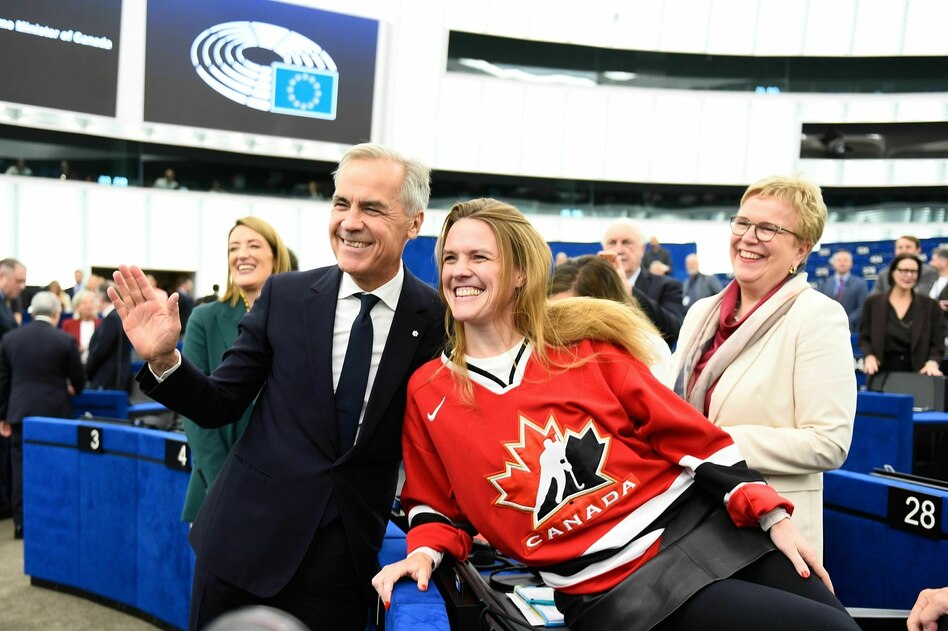
The European Parliament has rarely been in such a good mood as when it welcomed Mark Carney. Shortly before the Canadian Prime Minister's speech in Strasbourg on Thursday, US President Donald Trump made new threats. But the parliamentarians were not impressed by this.
They took selfies with the guest of honor from Ottawa, who was in a great mood. Green party leader Terry Reintke donned a red Canada jersey for the “historic moment”. The photographers ran after her, Carney smiled into the cameras with Reintke.
What he said next was actually full of historical references - he even mentioned Goethe. But anyone who had hoped for details about the new European-Canadian pact that Carney wants to work out with EU Commission President Ursula von der Leyen was disappointed.
Unlike von der Leyen the day before, Carney did not speak of “associated” EU membership in his speech, which was repeatedly interrupted by applause. However, he said: “We welcome this move.” The majority of Canadians want “much closer ties” with Europe.
After von der Leyen's speech, Trump called the idea "nonsense." EU diplomats also have doubts. European law does not provide for “light” membership.
But a lot of things are possible at a lower level of ambition. Carney called for closer cooperation on defense policy, energy supply, finance and industry. “We have 34 critical raw materials and every form of energy,” he said. Student exchanges should also be further expanded.
But the most important thing is the shared values. “If we don’t shape our future together, others will – with a very different narrative,” Carney said. It’s about building an “alliance of the future” together.
But this was not directed against the USA or other countries, emphasized the Canadian. He does not propose a third bloc that would rival the major powers. Together with Europe, Canada wants to “become strong enough so that no one can dominate us.”
This was a barely concealed swipe at Trump. The MAGA man has embroiled Canada in a trade war, and Carney is vigorously resisting. This has made him an idol for many Europeans, who had also hoped that the EU would show more steadfastness against Trump. In 2025, von der Leyen agreed to an unequal trade deal that is more beneficial for the US than the EU.
Now there may be a new showdown. Late on Wednesday, Trump threatened the Europeans with penalties if plans for associated EU membership were implemented. “If they do that, I will consider that a hostile act,” Trump said. Then he would “impose very drastic tariffs or stop trade with Europe in many areas”.
Carney also fended off this attack. “Nobody will tell us who we can make international agreements with,” he said in Strasbourg. The alliance with Europe is “a positive initiative, that is my answer to the American President”.
The EU reacted much more cautiously. The EU Commission announced in Brussels that the closer integration of the partnership with Canada is not directed against others, but rather serves common strength. It was said in Paris that people should not be intimidated by tariff threats.
What happens next is unclear. “Trading partners must now also become future partners,” said the head of the Trade Committee in the European Parliament, Bernd Lange. However, not even all 27 EU countries have ratified the Ceta free trade agreement with Canada.
The 27 EU states are responsible for partnerships with third countries and new members - the EU Commission can only make suggestions, the European Parliament usually only comes into play at the very end. In addition to Canada, Ukraine and Moldova as well as the Western Balkan states are also on the European waiting list.
Parliament Speaker Roberta Metsola said one should not be afraid of new ideas. Carney said at a press conference with Metsola that he was now waiting for proposals from the EU Commission. Von der Leyen had apparently also surprised him with her advance.
The next EU-Canada summit on October 29th and 30th is likely to be a first test. Then it will become clear what the 27 member states think of von der Leyen's association plan. The German federal government reacted cautiously in its initial reaction on Wednesday. Berlin welcomes the initiative for a particularly close partnership with Canada, said government spokesman Stefan Kornelius. With regard to “associated membership,” he added: “But I think we should think about the term again.”
Read the full story at the source
Source: taz