
World · taz · · 1d
Attacks on Ukrainian railways: Drone fire during operations
Deutsch (original) · Auto-translated to English
T he wagon looks like a soda can that someone has bitten a piece out of. There is a large hole on one side. On the other side it has a bump that bulges outwards. The vehicle is slightly twisted along its longitudinal axis. All windows are missing. Through the openings you can see a tangle of twisted and rusted metal inside. Everything that wasn't made of metal burned. In one of the few places that were not burned, the inscription on the body reads: Next inspection in June 2031.
The wagon is on a track at the edge of Kyiv Central Station. The Ukrainian State Railways runs a small railway museum there. Above all, it exhibits all kinds of equipment: snow plows with jet engines, machines for track construction and various wagons. These also include saloon cars that the communist rulers once used to travel through the country - armored and equipped with bathrooms and meeting rooms. The exhibits represent different phases of railway history. The destroyed wagon represents the present.
Russian attacks on the Ukrainian railways have been increasing since the spring: on trains and on train stations. Last week, the news that a long-distance train at the border station with Poland in Jahodyn, just a few kilometers from NATO territory, was hit by a Russian drone caused a stir.
A video shows fleeing people on a platform next to a blue-painted Ukrainian Railway night train. You can hear screaming in the video, the roar of a propeller engine. Then there is an explosion at the far end of the station.
There were no injuries. What was explosive about the attack was that a diplomatic train had been in the same station shortly before. As the Ukrainian railway company announced on the Telegram messenger service, high-ranking Western politicians were on board, returning from a conference in Kyiv. These included security advisors from several EU member states as well as former top European politicians, such as former British Prime Minister Boris Johnson. Former CIA director David Petraeus was on another train that was in Jahodyn station at the exact time of the attack.
In the previous week there had been reports of attacks on trains almost daily. Most of the time people were injured. It only happened further east or south in Ukraine. According to authorities, six people were injured in a Russian drone attack in the Kharkiv region of eastern Ukraine.
Attacks on the railways are not new. As early as April 2022, the Russian army killed at least 59 people waiting for an evacuation train on the train station square in Kramatorsk in Donbas with a short-range rocket with a fragmentation warhead.
But new technologies now make it possible to specifically hunt trains. The new drones combine optical target recognition and artificial intelligence. Apparently they were trained on locomotives. They get hit a lot and are more difficult to replace than a wagon.
Natalia collects admission to the Kyiv Museum, and because there are no other visitors waiting on this August morning, she gives a tour of the exhibition. One of the frequent air alerts has just ended. And in the meantime, potential guests may find it advisable not to stroll through a strategic infrastructure facility in the open air. The main station building is always cordoned off during alarms. Passengers then have to walk through a tunnel to the platforms.
Natalia doesn't know what exactly hit the shot-up wagon. “It was destroyed in a Russian attack in the Sumy region,” she says. The region lies east of Kyiv on the border with Russia. The main route to the regional capital of the same name runs just a few kilometers from the Russian border. On the body you can see many small holes with outwardly curved edges. So whatever exploded released a lot of shrapnel. According to media reports, it was a Shahed drone. Six people were killed in the wagon.
It's not just moving trains that are the target: on September 1st, the Ukrainian railway experienced one of its darkest days when six railway employees were killed during a major attack on Kyiv with ballistic missiles and cruise missiles. Russia attacked the Ukrainian capital during the night with around two dozen ballistic missiles and numerous drones.
Some of them apparently targeted an industrial area in the east of the city. Not for the first time: If you are driving along Borispilska Street, you will see many buildings with boarded up windows on the right and left. A few of the side streets are blocked off. In between there are apartment blocks from the 1950s and 1960s. Some half collapsed. In others, the roof structure was torn away by explosions.
Behind it, the Kyiv marshalling yard stretches for kilometers. A network of tracks that can only be understood from a bird's eye view. There are also huge workshop halls from the Soviet era. The Darnytsia Wagon Repair Plant (DVRZ) is so large that it is its own district. However, railway boss Oleksandr Pertsovskyi pointed out in Spiegel in August that they actually urgently needed more staff to “repair our locomotives around the clock”. However, you are competing with the military, which pays better. The railway has not yet responded to a request from the taz.
Lviv is an important railway hub in western Ukraine. The pompous train station hall from the time when Lviv belonged to the dual monarchy of Austria-Hungary and was called Lemberg bears witness to its early importance. The city was connected to the grid as early as 1861. Today, two routes to Poland meet here with routes to Kyiv, Odessa and Chernivtsi. Two routes lead directly south through the Carpathians into the Zakarpatia region.
On a morning in late August, the train is scheduled to leave Lviv for Uzhhorod, the regional capital of Zakarpatia. In Ukraine it is only decided about half an hour before departure which track the trains will use. When the time comes, a few travelers pull their suitcases through the pedestrian tunnel to platform 5. Most of them are wearing comfortable jogging suits, as is usual given the long travel times in this large country. Almost all of them are women, a few of them with small children. Uzhhorod is a border area. Men of military service need a permit to go there.
But passenger train number 3 from the city of Dnipro in the east of central Ukraine does not appear. Those waiting scroll through their smartphones. The railway app usually provides detailed information about delays. Then the train disappears from the large display board. A few minutes later the message comes that the train is 1 hour and 40 minutes late. The travelers are still lucky: all trains from the east are sometimes delayed by several hours.
When the train actually arrived at 11 a.m., conductor Viktoria greeted the passengers in car 3 with the advice that they should familiarize themselves with the evacuation instructions. She had to do that once during the night. Hopefully there will be no further evacuation. “God willing!” she says and crosses herself.
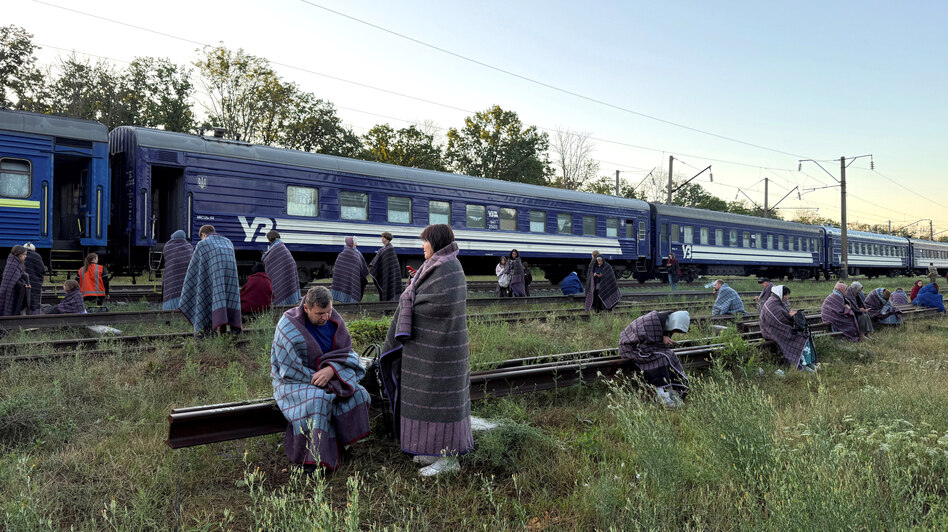
Until last winter, Ukrsalisnytsia allowed trains to continue running even when there was an air alert. Now they should be stopped at the nearest train station when drones approach. If it is too far away, the passengers have to leave the train on an open route. Even at night.
There is a flyer with information in the compartment - in Ukrainian and English. “The train should not become a trap,” it reads. At a signal from the train attendants you should get dressed and pack your documents and phone. Luggage should be left behind. If available, a shelter should be sought. If not, you should move away from the train but keep an eye on the train attendants. When explosions occur, you should lie on the floor and open your mouth. “The enemy is trying to stop us, but we keep going.”
The attacks on the trains disrupt Ukrsalisnytsia's previously surprisingly stable timetable. In the first years of the war, despite everything, most trains were punctual to the minute. Now delays are increasingly being counted in hours rather than minutes.
The railway clearly shows that Ukraine is the largest country that lies entirely in Europe. The route network was around 20,000 kilometers long before the full Russian invasion in 2022. That is fifth place in Europe and at the same time it is only about half as many kilometers as in Germany. There were around 1,700 train stations and stops. Around 20 percent of Ukrainian territory is now occupied by Russians. The train no longer runs there, nor does it go to some frontline cities.
The railway is the country's largest employer after the army. Around 170,000 people work for the company, which operates as a stock corporation but is 100 percent state-owned. The legal construction brings with it a few difficulties. Actually, the railway should not cost the state budget anything, but should at best generate a profit. On the other hand, ticket prices in passenger transport are a political issue because many people rely on traveling by train. Passenger transport is therefore a loss-making business for the company. Prices were only increased for connections abroad at the turn of the year. Tickets for 1st class are sometimes sold with dynamic prices: the greater the demand, the more expensive.
Before 2022, the company was mostly able to offset the deficit with surpluses from freight transport. But because of the war, less grain and steel products are being exported. Either because ports are blocked or because the industrial facilities are occupied or destroyed by Russians.
Pertsovskyi has headed Ukrainian Railways since 2024. He posts frequently on social networks such as Facebook and X. Recently, this has often been about damage caused by Russian attacks. “We have lost 492 locomotives due to attacks since the start of the war in 2022, more than 250 of them in the last three or four months alone,” he recently said in the Spiegel interview. The Ukrainian government asked supporting states on Tuesday for help in finding a replacement. This requires railcars that are suitable for the track width of 1,520 millimeters that is common in former Soviet states.
Before the war, in April 2021, the company operated 1,532 locomotives, about half diesel and half electric, according to the Ukrainian news agency Interfax. A further 445 locomotives were kept as reserves.
Even though the attacks are overshadowing everything right now, there are plans for the future. A few weeks ago, the company signed a strategic cooperation agreement with Spain's railway company Renfe to develop passenger and freight transport by rail. This is about know-how in high-speed areas, accessibility and stronger rail connections between Ukraine and the EU. There is also a broad-gauge network on the Iberian Peninsula, which is gradually being adapted to the European standard – usually 1,435 millimeters.
In the afternoon, passenger train number 3 arrives in Uzhhorod. He was unable to make up for the delay on the winding route through the mountains. Most travelers quickly move on to the waiting minibuses and taxis in the forecourt. Platform 1 in Uzhhorod offers something special. Something that will one day be the future of Ukrainian railways.
There is a Eurotrack next to a spotlessly clean platform. This is the name of the new tracks that will gradually connect the Ukrainian network with that in the European Union. There are not just two rails mounted on the concrete sleepers, but four. A pair in the conventional Eastern European broad gauge and, a hand's breadth apart, a pair in European standard gauge.
The difference dates back to the early days of the railway. Most countries on the continent adopted the new technology and its dimensions from England from the 1830s onwards. In the Tsarist Empire, however, a wider track width was established. The Soviet Union didn't change anything either.
However, the few centimeters cause massive logistical effort when the nets collide. Passengers either have to change to another train at the border stations, such as in Przemysl, Poland, where a Ukrainian broad-gauge track leads into the first Polish station. At other border crossings, the wagons are given new running gear in large workshops. Depending on the length of the train, re-tracking can take a few hours. Cargo needs to be reloaded. Everything costs time and money.
That should change. Olena Franzusova heads the Uzhhorod train station. “Our train station is the first to be newly connected to Europe with Eurotrack,” says the 57-year-old. She's a little proud. The pilot route, which was laid last year, is around 22 kilometers long. The quad tracks lead to the Tschop border station. There is a connection to Hungary and Slovakia. The construction was financed by the EU and the European Investment Bank.
“Thanks to Eurotrack, trains from Uzhhorod can now travel to Vienna without having to change tracks,” explains Franzusova. There will also be a direct connection to Prague. “Maybe at some point we can even drive straight to Berlin.” At the moment, however, nothing is happening on the new track. There is a construction site on the Hungarian side. She hopes that it will be finished there this year. She is an optimist.
Also this year, Eurotrack should be installed on another route – between Lviv and the border with Poland. However, the Ukrainian Railways did not reveal how far the project had progressed by the time this text went to press.
A small exhibition in the waiting hall of the Uzhhorod train station provides information about the further plans. By 2030, the aim is to lay quad tracks on the route through the Carpathians from Uzhhorod to Lviv. This would save travelers from western Ukraine to Hungary and Austria a lot of time. So far, however, Eurotrack ends at a buffer stop at the end of Olena Franzusowa's train station. Only the conventional broad gauge tracks continue towards the Carpathians.
A second route connecting Lviv with Chernivtsi and Romania is likely to be important for freight transport. It would shorten the rail route from the Baltic Sea to the Black Sea. “The aim is to forge a new iron bracket between Ukraine and the EU,” it says in the exhibition. In the long term, Eurotrack will also be installed on several routes between Poland and Kyiv. The change in gauge is not only important for logistics, but also politically. It is a symbol of the turn towards Europe and the break with Russia.
The project also means a lot to her because of her own history. Until 2022, Franzusova had managed the train station in her hometown of Mariupol for nine years. On February 24th she went to work normally, but after that nothing was normal. In the first few days, the trains were dispatched according to the regular timetable. “Nobody expected the city to be cut off so quickly.” But after just a few days, the tracks further north near Volnowacha were destroyed by a bomb attack. This also ended train traffic in Mariupol. The train station in Mariupol was beautiful, she remembers. Unfortunately there is nothing left of it. She sighs.
For weeks she and her family waited in the destroyed city, which was increasingly occupied by Russian soldiers. After a few weeks she got lucky. She reached the free part of Ukraine in a car convoy. They were stopped several times for so-called filtration. The Russian invaders were looking for signs of pro-Ukrainian attitudes. The following year she took over the job in Uzhhorod. You can't be further away from Russia in Ukraine. That's what she would like for the entire country: for Russia to feel as far away as possible.
Read the full story at the source
Source: taz