
Germany · taz · · 2h
Visit to the Merkel portrait: Everyone still wants a photo with her
Deutsch (original) · Auto-translated to English
Do you think Merkel will come back?" a friend asks as we walk through Berlin-Wedding with a friend. I pause. "As chancellor? Hardly." My friend replied: "No, with a speech to the people or something similar. To ensure order."
These are politically turbulent times, and that's putting it in a positive way. The ruling CDU has cemented its dispensability, not least with the election results in Mecklenburg-Western Pomerania. A copy of the AfD is no more needed than a chancellor who lashes out wildly with wrong political decisions in a crisis situation. The most positive headline the CDU man could deliver was: Friedrich Merz lasted another day.
Phew! This really doesn't provide a feeling of stability. But could Angela Merkel deliver that now? Is it the answer to the conservatives' crises? I would like to get to the bottom of the question and am on my way. Bored police officers lean against their car in front of their apartment on Kupfergraben in Berlin-Mitte. I walk past them and, a few hundred meters away, enter the neo-baroque building where people have been able to get close to the former Chancellor for a few months.
The taz is an independent, left-wing and opinionated daily newspaper. We have been arguing in our comments, essays and debate texts since the taz was founded in 1979. We often cannot and do not want to agree on an opinion. That's why you'll find some completely opposing positions here - all part of the very broad left-wing spectrum of opinions.
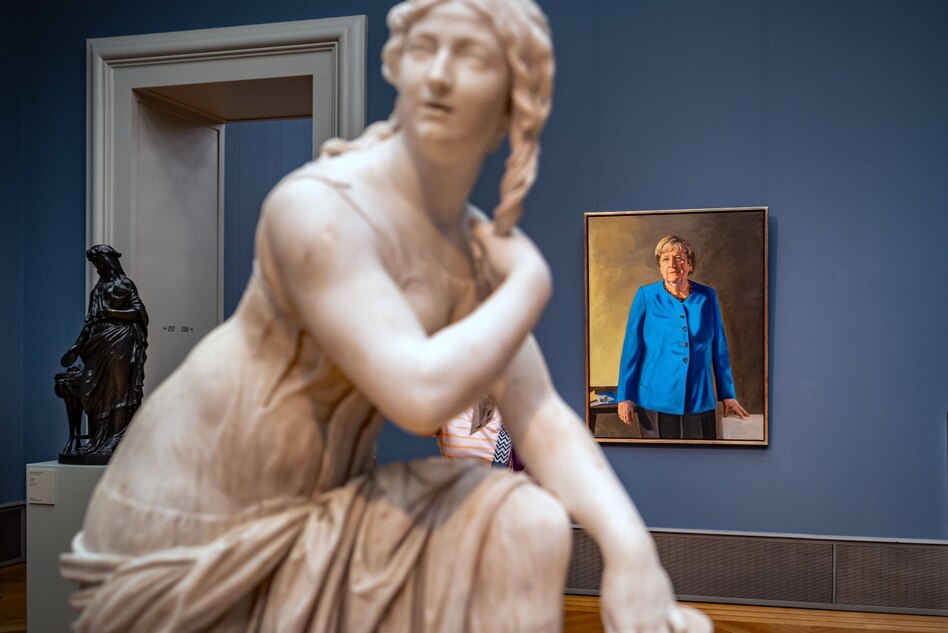
On the first floor of the Bode Museum, a group of visitors examine Merkel's portrait. In an ultramarine blue blazer, she stands in front of a gold-colored background, her right hand hanging calmly at her side, her left hand resting on a pedestal. The face is lined with wrinkles, just like a woman in her 70s looks, and there is a hint of a smile. The portrait, painted by the French-German-Canadian artist Jérémie Queyras, appears calm, but it attracts crowds. The museum has had twice as many visitors since the picture was shown. The exhibition has just been extended until next year.
On the afternoons when I spend time in front of the portrait, the audience changes every minute. Everyone stops, at least for a brief moment: retired couples, mothers with small children, tourists from all over the world and young adults from the city. When they see the portrait, most people groan. There is something longing in the “ahs” and “ohs” I hear. Actually everyone reaches for their cell phone. You want a photo with her. Merkel is the star here.
A mother pushes her stroller in front of the picture so that the sleeping baby is also in the snapshot. An older man takes several selfies from different perspectives. A couple asks the guard to take their photo.
“We take mom into our midst.” – “Oh yes, mom. She’s missing.”
Mom, mom, mom, it always echoes between the sculptures and paintings. Of course the term has a sexist connotation. It was a derogatory nickname for the then Economics Minister Michael Glos. But from today's perspective it is clear: he helped her.
Merkel has managed to fill the various stereotypical facets of a mother: thrifty housewife (she once described herself as a “Swabian housewife”); strict mother who can not only keep the boys in check, but also the entire country; the mother, who, as the most powerful woman in the world, can appear authoritarian but can also be loving and caring. The fact that some people had a difficult relationship with her wasn't an obstacle; that's just how relationships with mothers are sometimes: complicated.
Many people miss her today. The calm that she brought to the country. Anyone who listens to the people in the Bode Museum will quickly realize that nostalgia is not a desire for more conservative politics, but rather a longing for stability.
“It looks like she only has three fingers.” – “It was still enough for a steady hand to govern.”
“And she doesn’t laugh at all.” – “There is little to laugh about in politics.” – “After all, she stoically guided us through 16 years.”
“It was somehow more relaxed back then with Merkel.”
When a guard says that Merkel also met with school classes to answer questions, one of the visitors remembers her appearance in 2015: "It was so nice to see how lovingly the Chancellor responded to the story of a Palestinian girl."
But his memory is deceiving. Merkel was more likely to come under criticism at the time. During the dialogue, student Reem Sahwil talked about her life as a stateless Palestinian and her escape and asked whether her family's uncertain residence status could be improved. Merkel responded that Germany could not accept all refugees. When the then 15-year-old began to cry, Merkel patted her awkwardly.
As is typical for nostalgics, they romanticize. They don't remember what was, but rather how they would have liked it to have been. Merkel is benefiting from this today. Because if the overall picture is correct, misbehavior (and Merkel's behavior was much more serious than a small pat) is simply erased from memory.
The CDU should not rely on Merkel now. It will not ensure order and calm; the Chancellor has to do that himself. He can still set a record: He could become the chancellor who ruled for the shortest time. He has to hold out for a good 500 days to prevent this. Hardly anyone in this country really believes in it anymore. One can only advise Merz to discover some motherliness in herself.
Read the full story at the source
Source: taz