
Germany · taz · · 3h
Berlin Left: The cityscape has chosen
Deutsch (original) · Auto-translated to English
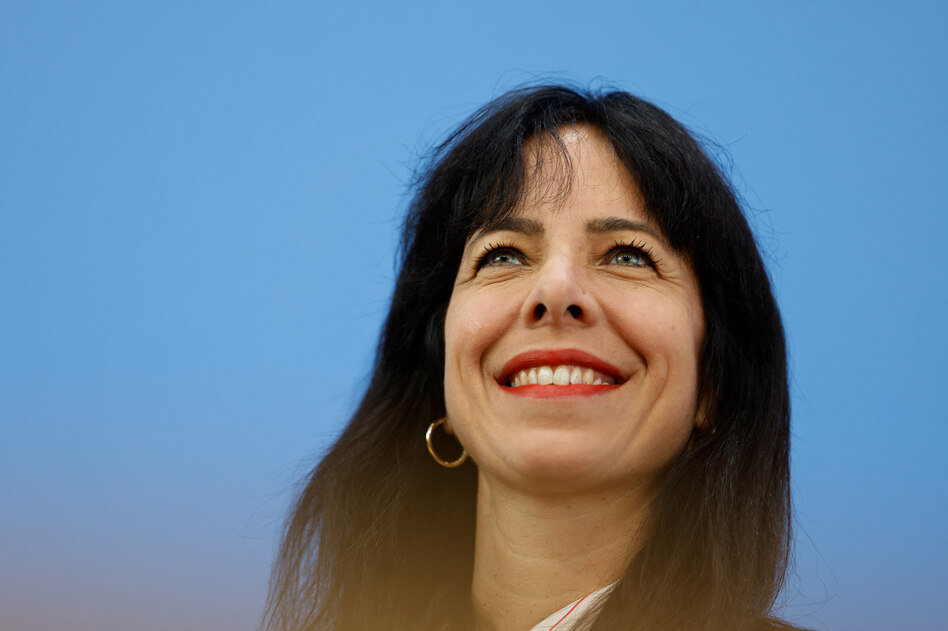
W hen the Kurdish DJ takes over the turntables at the Left Party's election party in the Kreuzberg festival hall, Elif Eralp is the center of the dance floor. The likely next mayor of Berlin dances exuberantly to a Turkish folk song with an electronic beat called Erik Dalı (“Plum Branch”), then she hooks her little fingers into her comrades and dances the Kurdish circle dance Halay with them. The DJ says over the microphone to the “beautiful Elif”: “Do you want to hear Tarkan now or later?”
When Tarkan's super hit “Şımarık” plays, probably the Turkish pop star's best-known song, the crowd goes wild. The exuberant atmosphere is reminiscent of the legendary parties in the Kreuzberg trendy club SO 36, where Syrian gays, Turkish transvestites, Kurdish lesbians and Swabian students have been hugging each other late in the evening to Anatolian techno folklore for over 25 years. The “Gayhane” parties have long been an institution in Berlin’s nightlife. Now their spirit has moved into the political center of the metropolis.
The election party of the Berlin Left is a reflection of the diversity of the city at this moment: no white, older men in suits are setting the tone here, a post-migrant society is celebrating here. The “sweet potatoes”, as the DJ calls them, dance around Eralp together with people with a visible migration background and queer people, young and old. As a young woman whose parents once came to Germany from Turkey as political refugees, 45-year-old Eralp embodies this diversity. From the dance floor she will soon have to be in front of the camera again and answer questions from the journalists present. She is the election winner, and the city wants to know what happens next for her.
The landslide victory of the Berlin Left, which won a quarter of all votes in the capital with 25.7 percent, also shows that the Left now best symbolizes the city in its entirety. 42 percent of people in Berlin have a migrant background, but so far they have only played a minor role in the political system. Eralp and the Left stand for the promise to change that. This is also why so many people voted for her - especially in the inner city districts, from Friedrichshain-Kreuzberg to Tempelhof-Schöneberg to the north of Neukölln, where she outclassed the Greens and the SPD. The Left even won a direct mandate in the northwestern outskirts of Spandau.
At the federal press conference on Monday afternoon, Eralp highlighted the successful mobilization of previous non-voters in the election campaign: “I have heard from many who are voting for the first time, many with a migration background, many people of Turkish origin who feel represented for the first time.” There were votes from those “who do not feel sufficiently represented by the other parties”. Now it is important to “bring together” all the people in the city, who all suffered equally from the rent crisis. And then she says a sentence that perhaps expresses a new matter of course: “People who have lived here for decades are not foreigners, but Berliners.”
Ayșe Demir, board spokeswoman at the Turkish Association of Berlin-Brandenburg (TBB), confirms the success of mobilization in the communities. They took a closer look at the voter turnout in three constituencies in Kreuzberg and others in Neukölln, Moabit, Gesundbrunnen and Wedding, all of which are dominated by migrants: “And the voter turnout there was on average higher than in Berlin,” she says. And: “That certainly also has to do with Eralp as the top candidate.” This was already evident for the TBB before the election. “There was also a lot of reporting about Eralp in Turkey and in the Turkish-language media,” she says. “I think that motivated many people to vote.”
Eralp managed to unite different communities behind it and appeal to people from very different political camps, from conservative to progressive. Demir observes that she found connections in Sunni Muslim circles as well as in Alevi and Kurdish circles. Even if the TBB is “non-partisan,” as Demir emphasizes, she says: “It is a strong sign for us that a woman with a migration background has been given the government contract.”
Never before has a party and a candidate in the city addressed society at large so casually and so naturally. In her 20-minute speech, shortly after the first forecast on Sunday evening, she thanked her Turkish friends, as well as the Kurds, and mentioned the support from Sinti and Roma circles. And without even thinking, she kept switching from German to Turkish. In the ballroom she speaks of the vision of a city in which “all people, no matter where they come from, no matter what they believe in, no matter who they love, no matter how much income they have,” are heard. They should all move into the Red Town Hall with her, Elif, as it says on their posters, much larger than Eralp.
“It was like a promise,” says Hamze Bytyçi about the fact that Eralp had expressly addressed Sinti*zze and Rom*nja in her acceptance speech. Bytyçi is a party member of Eralp, and at the same time an artist, activist and chairman of the Roma self-organization Roma Trial e. V. The community trusts her and supported her during the election campaign, knowing that “she will support us later, that’s the deal,” he says.
As Governing Mayor, Eralp will also ensure that “a few things that are no longer said these days are actually no longer said,” he is sure. “I think this will also be a learning effect for many.” What he means is something like the so-called “Z-word”, the racist external term that still appears in the discourse.
The trust that Eralp enjoys also comes with great responsibility. This definitely also applies to dealing with anti-Semitism and protecting Jewish life. “We clearly have red lines here,” says Bytyçi. But this also applies to a clear commitment not to pit two camps against each other.
The debate about anti-Semitism within the left, which Bytyçi mentions, shaped the weeks before the election, especially after a call for Intifada by the rapper Dahabflex at a Left Neukölln election campaign event. Suddenly hardly anyone was talking about the fact that the AfD was perhaps the greatest threat to Jews in this country and that the Berlin CDU was distributing funds for the fight against anti-Semitism not based on qualifications, but to party members.
On the evening of the election, Josef Schuster, President of the Central Council of Jews, expressed concern about the left's election victory and called on the SPD and the Greens not to form a coalition with them. SPD top candidate Steffen Krach said on Monday that he expected a clear commitment against anti-Semitism if he worked with the Left.
Werner Graf, the Green Party's top candidate, said before the election that he would not join a left-wing alliance that depends on the votes of Neukölln's left-wing MPs. Now that the Left will move in with 47 MPs, he doesn't have to. Red-Green-Red has a majority of a whopping 15 seats. The Neukölln Left will not matter.
At the Left Neukölln election party in the Ballhaus Rixdorf on Sunday evening, two men sit on the podium and play Anatolian tunes on the saz, the Turkish long-necked lute. At the round café tables, young hipsters sit next to women with headscarves, graying old leftists sit next to young migrant activists with keffiyehs: it is a reflection of the district, which is decried as a problem area and at the same time glorified in series like “4 Blocks” as the most dangerous area in the capital.
After the first projection, Jorinde Schulz, the 37-year-old spokeswoman for the district association, jumps onto the stage and gives the reasons for the success: “We were present everywhere in Neukölln, with our political program, with information stands, with flash mobs, with spontaneous rallies, with leaflet distribution, and of course with many door-to-door conversations,” she lists.
In the north of Neukölln, the Left has become a people's party. Here she won half of all votes and won three direct mandates, well ahead of the competition. What will she do with this new power? The Left Neukölln is “a central actor in the left wing of the Left Berlin,” says Jorinde Schulz.
She names the conditions that she considers to be central for a Senate under left-wing leadership. “The expropriation of large real estate companies” is a “red line,” that much is clear to Schulz. “We also recorded other topics at our state party conference,” she emphasizes. The left must not participate in further social cuts and must oppose the “authoritarian restructuring”. The police violence, which was particularly directed against the Palestine solidarity movement, must come to an end.
Rouzbeh Taheri also emphasizes that the Left should not make any cuts in the education and cultural sectors - despite tight budgets. The 53-year-old, who was spokesman for the “Expropriate German Housing & Co” initiative from 2017 to 2021 and works as publishing director and managing director at the left-wing newspaper nd, topped the state list in his district and is now moving into the House of Representatives for the first time. “I expect a different attitude towards people who are affected by wars and oppression,” he says.
Yurtsever Özdemir grew up in the south of Neukölln, as the child of a working-class family of Kurdish-Alevi origins. “The AfD opened its first office in the district here in Gropiusstadt,” he says. That is a challenge: “It is crucial for us that we can offer the people there a perspective.” Özdemir himself ran as a direct candidate in Gropiusstadt. In the end, the CDU is ahead of the AfD, the Left is ahead of the SPD. Özdemir has nothing against his party taking part in a government. “This is important because people want change and we want to bring that about,” he says.
Given the great success of the Berlin Left, all those in the party who are skeptical or categorically reject participation in the government will have a difficult time. The Greens and the SPD can hardly refuse the clear vote of the majority of Berliners.
The former trade unionist, Hermann Nehls, 71, is co-chairman in Neukölln. “The focus on Neukölln was intense and hard,” he says of the last election campaign. Nehls rejects the accusation that the Neukölln Left is “infiltrated by Islamists and Stalinists,” as some tabloid media claim. And he defends “Basem, Vedi and Ahmed” – three comrades, two of them Palestinians, who were the most attacked and hostile.
The Palestinian left-wing politician Basem Said can only be half happy about his election success. On election Sunday, many newspapers reported outraged because he had shared a post on Instagram by an activist who had called for an “Election Intifada”. “Intifada means rebelling against oppression in Arabic,” says the educator. “With regard to Neukölln, for me this means: We stand up against racism and anti-Semitism, against anti-Palestinian racism as well as against all other racism.”
This is not a call for violence, he emphasizes, and feels consciously misunderstood. "I am very disappointed and horrified because I have always supported coexistence in Neukölln. And I am surprised that I am constantly being defamed." For him, being for Palestine means “being for universal human rights for all people”. And he promises: “I will be there for all Neukölln residents, whether Germans or Arabs, Jews or Muslims.”
Later, an unannounced guest who suddenly shows up at the Left Party's election party in Neukölln causes quite a stir. Issa Remmo, head of a large Neukölln family that is associated with organized crime, wants to go to the celebration, but is then quickly escorted out of the hall. The PFLP official Ibrahim Ibrahim is also said to have been spotted, Spiegel reported on photos showing him with Neukölln MP Ferat Koçak and published a post on X. The “Popular Front for the Liberation of Palestine” is banned in Germany and is on the EU terror list.
Elif Eralp later immediately distanced himself. The Left Party's top candidate says her party has nothing to do with organized crime. Later on Monday, however, the news caused a renewed stir that Firas Remmo, one of Immo's sons, posted a chat history: In it, Koçak asks Remmo's son to distribute an excerpt from one of his Bundestag speeches and also sends "greetings with respect" to the father. Left federal chairwoman Ines Schwerdtner announced that they wanted to clarify the matter with Koçak.
At the federal press conference, where Eralp sits next to her federal chairwoman Ines Schwerdtner, several questions are aimed at the left's anti-Semitism. Eralp replies that she is making a “promise of protection so that all people feel safe again, “especially Jewish people.”
In the Alevi community, people certainly believe she can do this: “My impression is that she takes religious freedom seriously,” says Kadir Şahin, deputy chairman of the Alevi community in Berlin. “We also trust her to influence district associations in the party accordingly,” he says, referring to the allegations of anti-Semitism in the ranks of the Left Party.
Şahin also finds it gratifying that a woman with migration experience has the prospect of becoming the governing mayor. The spirit of optimism that the Left's election is spreading is not only being praised by political and social officials. For many people, it is noticeable the day after in everyday life, for example in the Turkish supermarket. “Maybe it’s just my imagination, but here we are beaming at each other,” says one customer.
“We already noticed it in this year’s U16 election,” says Ayşegül Taşkıran, head of a youth club in Schöneberg. "In the U18 election before the last House of Representatives election, the animal protection party was at the forefront. This time the left clearly won," she says. "In the conversations with many families before the election, I had the impression that many people gained hope from Elif Eralp from the Left. They found themselves in her and her story," says Taskiran. There was a feeling “that their perspectives were being seen.”
Read the full story at the source
Source: taz