
Germany · taz · · 1h
Berlin CDU election campaign conclusion: history lesson with Papa Merz
Deutsch (original) · Auto-translated to English
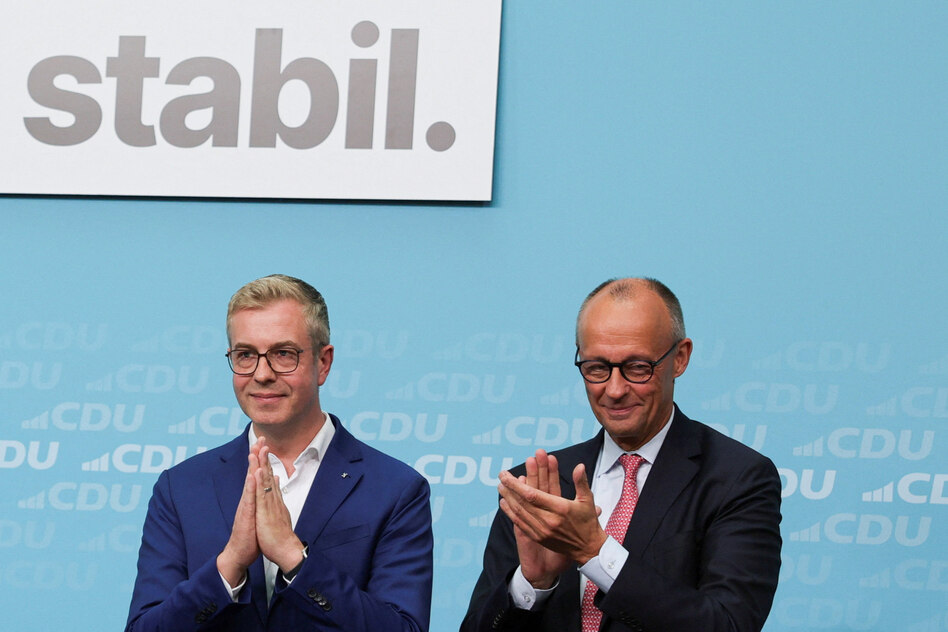
How long will Merz stay in the Chancellery? After many in his party are dissatisfied with him, he is now trying to make his party colleagues more lenient at all levels. That's why he came to Berlin for the end of the election campaign. Because while the CDU in Mecklenburg-Western Pomerania is scratching the five percent hurdle, the result of the Berlin election is also seen as threatening for Merz's chancellorship.
“Together”: CDU General Secretary Franziska Oppermann and Berlin top candidate Stefan Evers used this word particularly frequently in their speeches on Thursday evening in the Konrad-Adenauer-Haus. After the recent discussions about her party leader, Oppermann emphasized that the Berlin election campaign showed what “pulling together” means.
Stefan Evers also used one of his central strategies of the last ten weeks at the end of his election campaign: the CDU prevented the Left from entering the Red City Hall and thus a government led by “extremists” and “Israel haters”. The CDU used the debates within the Berlin Left about solidarity with Palestinians and anti-Semitic statements as an argument for itself during the election campaign. Evers then equated anti-Semitism with the biggest issue in the Berlin election campaign: the question of the expropriation of large housing companies. The CDU differs from “those who know nothing but division: be it hostility to landlords or hostility to Jews,” said the top candidate.
Evers also promised confidence and optimism and that Berlin “can get better even in difficult times.” He sees Berlin on the same level as Bavaria in the future: when it comes to space travel and start-ups.
Friedrich Merz, on the other hand, used his speech to the Berlin election campaigners as a history lesson. He remembers Berlin as a divided city and also remembered reunification. He drew a parallel to today's division caused by extremist forces. He also referred to Ludwig Erhard's contributions to the market economy with regard to the upcoming social reforms. There was also a hail of book recommendations from the Chancellor, most recently Stefan Kolev's “Prosperity for the Young”: one of several clumsy attempts to appeal to young people, one of the most important voter groups in Berlin.
He then drew parallels between his reign and Konrad Adenauer's taking office. This celebrated its 77th anniversary a few days ago. At the CDU federal headquarters, which bears Adenauer's name, Merz indirectly compared himself with the first Chancellor: "The time wasn't easy back then either. There was considerable resistance." Adenauer used a compass to commit himself to the so-called West despite the accusation of being “Chancellor of the Allies”. “I choose freedom,” Merz quoted him as saying, because he too wants to choose freedom today.
The Chancellor also indirectly spoke about solidarity with Canada, for which his party colleague Ursula von der Leyen has proposed “associated EU membership”: “The time of unconditional transatlantic friendship is probably over,” he said. According to the Chancellor, people have long relied on the “division of labor”: “Cheap products come from China, oil and gas from Russia, security from the USA.”
He also used this to justify the increase in military spending. “The turning point has now become reality,” said Merz, referring to the term coined by his predecessor Olaf Scholz (SPD) in the wake of Russia’s war of aggression on Ukraine. For Merz, this turning point is “almost an epochal break”. “We will probably only understand what we are currently experiencing in a few years,” said the Chancellor. How great the threats are in terms of domestic and foreign policy can only then be properly classified. Merz also appealed to the younger generations. According to Merz, two thirds of young people say “yes” to the Bundeswehr and a voluntary compulsory year. “So do something about it too. Join in!” encouraged Merz in a grandfatherly way.
“Germany is a country of immigration,” emphasized Merz. However, he quickly narrowed down the words that seemed radical coming from the Chancellor's mouth: migration is good for keeping hospitals, construction sites, restaurants and hotels running. That's why, according to him, xenophobia has no place in this country. For Merz, the worst form of xenophobia is anti-Semitism. And in order to protect fellow Jews, it is also necessary to deport those “who do not follow the rules.”
The event at the end of the Berlin CDU election campaign was initially planned exclusively as an internal event. So it seemed as if Merz would have to campaign before his own party. During the course of the day, a publicly viewable YouTube stream was generated, which was followed by around 175 viewers. Recently, the CDU state leaders also pulled themselves together and stood behind the Chancellor.
So Merz was allowed to come by – unlike during the election in Saxony-Anhalt. He also invites the CDU presidium to a formal meeting on election evening next Sunday. The election results of the state elections and their consequences for the CDU will be discussed there.
Read the full story at the source
Source: taz