
Germany · taz · · 1h
Berlin Art Week 2026: Everything is so smooth here
Deutsch (original) · Auto-translated to English
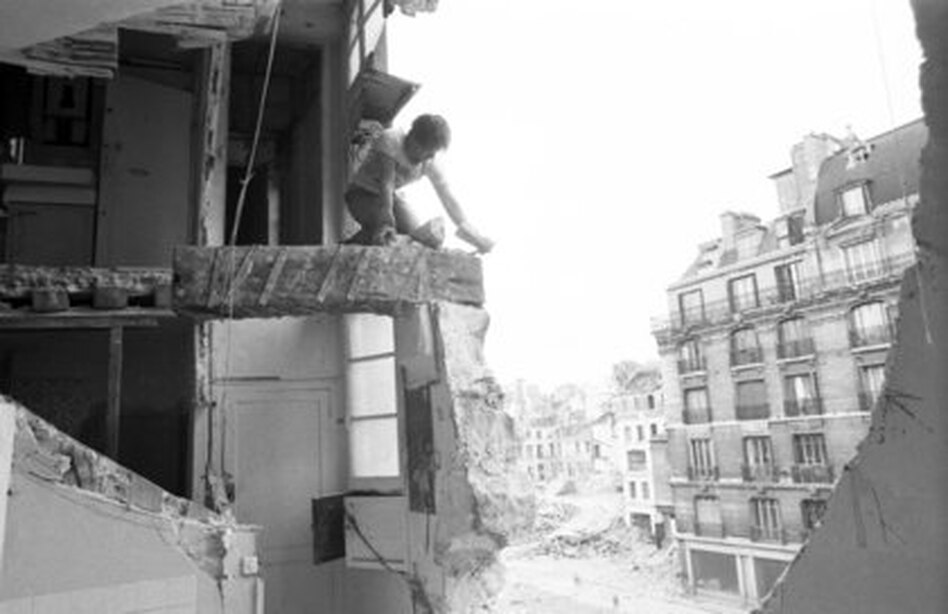
The Basel star architects Herzog & de Meuron have just squeezed a massive block into the Berlin Cultural Forum with the Berlin Modern. In the future, the museum will celebrate art for the public, but it stops short of the wide Potsdamer Straße like a frightened carriage horse at the railway barrier. A huge, public, urban square could simply be created here at the Kulturforum, the center of Berlin Art Week, in front of the Scharoun State Library. One can think a little more radically, as Gordon Matta-Clark's films were shown during this art week inside the shell of Berlin Modern, in which he mills and saws up houses and urban spaces as if they were a piece of butter.
Instead, only a few city buses pass along the wide street axis, unless the Princess of Qatar and grand patron Al-Mayasa bint Hamad bin Khalifa Al Thani rushes her fleet of limousines in front of the Neue Nationalgalerie, where she announced in the last few days that Gerhard Richter would design her own pavilion in Doha.
There was a general uproar that the Qatari wealth from oil and gas deals was also corrupting the “greatest German artist of today,” according to the Princess, as if the art world were otherwise purely based on global capital. In any case, this art week was one of the art market heavyweights and bling-bling, almost as if you were at the world's largest art fair in Basel - Ersan Mondtag demonstratively wore Gucci at the party for his performance series in the Gemäldegalerie, a Saudi Arabian delegation was there. The director of the Neue Nationalgalerie, Klaus Biesenbach, brought Maurizio Cattelan to the Neue Nationalgalerie and put Matta-Clark on huge projection surfaces, even though he preferred sawing up architecture illegally during his lifetime.
Trisha Brown's revived performance "Walking on the Wall" from 1971 also had something subversive: her performers simply walked horizontally along the glass walls of the Neue Nationalgalerie, as if gravity had been defied. Why not simply break the inertia of city planning and Berlin authorities in a very real and local way, you think, and declare Potsdamer Straße a large, car-free square.
Because public space and how we negotiate our bodies in it have come up a lot these days: Anys Reimann prefers to dunk the black woman in the dark of night in her collaged paintings in the Antonymen Salon in Charlottenburg, and Rachel Monosov asked in a performance at Künstlerhaus Bethanien what representational constraints one is exposed to in public: people were stretched on meter-long braids and rolled white flags in and out in patience-challenging slow-motion movements. And at a panel in the Hamburger Bahnhof, where the director of the Magdeburg Art Museum, Annegret Laabs, now fears a wave of cultural cuts after the AfD victory in Saxony-Anhalt, the call arose that art should, above all, be placed in the public sphere. Sophie Jung
In 1976, Gordon Matta-Clark cut vertically oriented rectangular openings through three floors of the building at New York's MoMA PS1. The work was called “Doors Floors Doors” and was part of the “Rooms” exhibition that the contemporary art institution opened at the time. So it was hardly surprising that it was Matta-Clark, of all people, whose works were shown in the shell of the Berlin Modern on the occasion of Art Week, curated personally by the director of the Neue Nationalgalerie, Klaus Biesenbach. After all, he was head of the MoMA branch for eight years from 2010.
What shocked us was the honesty. If one had expected that Matta-Clark-style intervention would take place on the construction site of the shell, one would be bitterly disappointed: what one saw were films. They are undoubtedly great, but they merely transformed the deconstruction artist's once radical works into museum-like nostalgia and longing. After an analogue time before the complete incorporation of every spark of life into global market and brand logics, which seemed to be taken to the extreme in this Art Week.
Instead of giving young positions the chance to try out something truly visionary on the construction site, the spirit of the drastic was merely invoked there. It is difficult to imagine that Matta-Clark, who died in 1978, would have agreed to this, as he once shot out the windows of the exhibition room with an air rifle as part of an exhibition with contributions from his former professors (“I hate what they stood for”).
But the presentation fits the zeitgeist. Everything is so nice and smooth here. Cynics might point out that this year it was only funded by the Economic Senate and not by the Cultural Senate, but of course the form only coincidentally matched the content. Another symptom of the present was that the counterculture usually came in bite-sized chunks. This also took the form of a patisserie at the Adlon Kempinski, where, led by the artist Sunny Pudert, what was probably the most sought-after performance of the Art Week took place. But in the iconic Royal Suite, from whose window Michael Jackson once held his baby, seats were limited. Downstairs in the lobby there were people waiting. The concentrated madness of the “Ordinary Tales of City Madness” was – as in real life – reserved for only a few.
It remained surprisingly empty on Friday night in Moabit's Arminiusmarkthalle. The Munich-based Krawallnudeln from Chicks on Speed performed a DJ set there to inaugurate the Galerie Ebensperger bar with their penchant for unusual spaces at its newest location. Between beer and neon make-up, there was at least a broad consensus in the debriefing of the gallery exhibitions on Potsdamer Straße: David Claerbout at Esther Schipper: hot. Gerhard Richter's wife Sabine Moritz at Max Hetzler: not. Hilka Dirks
You have to want to stand on your feet. The Berlin Art Week program is getting richer every year, at least since it was enriched with the full formation of the Gallery Weekend.
The new Soft Power festival – not to be confused with the already established, very good Soft Power project space – has incorporated the Art Week, including a two-and-a-half-day, around-the-clock program. The Currents design festival debuted across the city, independent of Art Week. There was also a literature festival and of course the kite festival on Tempelhofer Feld.
How complicated can you make it so that art lovers, despite the wide range of offerings on offer, end up finding themselves in the same places and essentially saying the same thing? Ersan Mondtag in the Gemäldegalerie: hui (“Were you always in king size before?”), at Dittrich & Schlechtriem ugh, because there doesn’t have to be so much copulatory fuss.
People expect great things from the new Berlin Modern museum building because they want to expect great things. What no one has forgotten, however, is the matter of the former young talent prize. In any case, Maurizio Cattelan's pigeons in the Neue Nationalgalerie are only appreciated with the addition of “yes, but”.
So everyone within the S-Bahn ring agrees. Outside the S-Bahn ring lie and lean those who have done everything right. For example, in the cooking house of the DRK Kliniken Berlin Westend, where Lu Yang cut up two well-known video works and divided them into ten screens, each for a hospital bed, for an intimate viewing situation. Or on the grounds of the Haubrok Foundation, where UdK graduate Seongwon Park lets her reductions of Lichtenberg facades float in an industrial hall.
On the steps of the Fluentum private museum in Steglitz-Zehlendorf, 120 seconds suddenly fit into a minute. There, Arash Nassiri bathes everything in blue: the magnificent architecture of his insect doll video, the uncomfortable Nazi splendor of the exhibition space.
The final boss of deceleration: the thatched house in – again – Lichtenberg. From the entrance door onwards, the imperative of silence reigns supreme. Those who don't have much to say at the end of Art Week are dozing stretched out close to each other at the feet of dried reeds and exposed concrete. Sound art makes the room vibrate, a quarter of an hour or four days later: complete relaxation. During Berlin Art Week it's best to go out and lie around. Memo for next year. Anna Meinecke
Read the full story at the source
Source: taz