
Anti-fascism taz
Survivor of the first NSU attack: He talked to the walls about what happened
On November 4, 2011, the “NSU” exposed itself after having already committed many murders. The first victim received little attention: Serkan Yıldırım. more...
Deutsch (original) ·Auto-translated to English
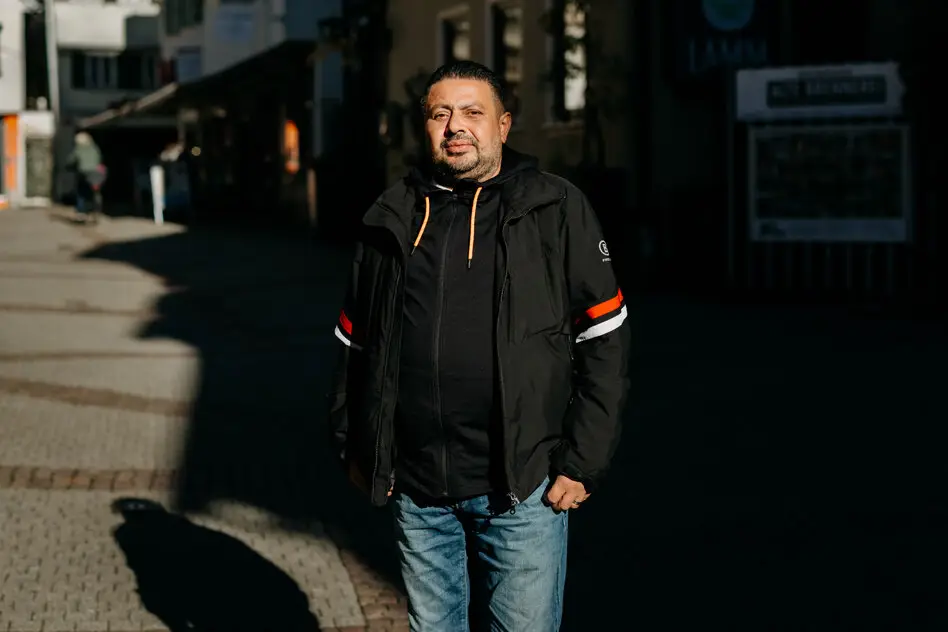
For a long time he did not know that Serkan Yıldırım was the first victim of the NSU terror. It took many years before he learned that the explosion he survived in 1999 was a right-wing extremist attack. The authorities, lawyers and journalists knew before him, while Yıldırım was left alone with his unanswered questions.
“For years I talked to the walls at home about what happened in 1999,” says Serkan Yıldırım. Shortly before the 15th anniversary of the NSU's self-exposure, he is sitting in a café at Herrenberg main station. He repeatedly reaches for a small metal box, takes out a cigarette and lights it. “Do you want to too?” he asks. He brought the cigarettes with him from his vacation in Turkey. He smiles and talks about the trip and his “four babies” who are waiting for him at home – the cats Rüzgar, Rüya, Pamuk and Gölge. “Wind, dream, cotton and shadow.” He had to fight hard for Yıldırım to be able to report on moments of security and joy in his life again today.
Yıldırım grew up in Nuremberg as the child of a single mother. His parents were workers. “With my two siblings, we had everything we needed.” He was diagnosed with leukemia as a baby and spent part of his childhood in hospitals receiving chemotherapy. It wasn't until he was nine years old that he conquered the disease.
This text first appeared in wochentaz, our weekly newspaper from the left!
Every week, wochentaz is about the world as it is – and as it could be. A left-wing weekly newspaper with a voice, attitude and the special taz view of the world. New every Saturday at the kiosk and of course by subscription.
In June 1999 he was 18. “I did it,” he thinks. He wants to start his own business, build something of his own, that was his dream. With his parents he takes over the Café Sonnenschein near Nuremberg Central Station. “It wasn’t a luxury store,” he says. “I wouldn’t have gotten rich there, but for me, at that age, it was a success.”
They celebrated the opening of Café Sonnenschein on June 22nd with many people. The next morning, Yıldırım comes back with his mother. He wants to clean up before the first guests arrive. The glasses and dishes are still around. He convinces his mother to go shopping. “Thank God,” says Yıldırım. “What would I have done if this had happened to my mother?”
In the toilet, Yıldırım finds a black flashlight about 30 centimeters long that he has never seen before. As he picks it up, the flashlight explodes. The Federal Prosecutor's Office later determined that it was a long metal tube with caps screwed onto both ends and filled with black powder. Yıldırım is lucky: the bomb was assembled incorrectly and therefore did not explode as strongly as expected. “Otherwise I wouldn’t be alive today,” he says.
The explosion throws him all the way to the door. Neighbors hear the bang and come to him. Shortly afterwards, Yıldırım loses consciousness. He spent several weeks in the hospital with serious injuries, and scars from that day remain to this day. On the evening of the attack, the Nuremberg criminal police began investigating, and the Bavarian State Criminal Police Office later took over.
During the investigation, Yıldırım experienced what many relatives of NSU victims later had to go through: a perpetrator-victim reversal. The investigation takes place in his environment and circle of acquaintances and not in the right-wing scene. Drug trafficking, prostitution and concealment fraud were mentioned as possible investigative approaches, he remembers. “That was pathetic,” says Yıldırım. He takes a drag on his cigarette. 27 years later, the anger can still be heard in his voice.
A few months after the attack, the investigation was stopped and a political background was ruled out. Just a year earlier, the police had found explosives, pipe bombs and right-wing extremist propaganda material in a garage used as a bomb workshop by the NSU trio in Jena. Then Beate Zschäpe, Uwe Böhnhardt and Uwe Mundlos went into hiding. Could the pipe bomb attack in Nuremberg have been linked to the discovery in Jena? The authorities are ruling that out today.
It is being investigated for negligent bodily harm. As if it wasn't a targeted attack. A witness from the Federal Public Prosecutor's Office in 2022 at the second NSU investigative committee in the Bavarian state parliament says that he found "negligent bodily harm not so obvious now". Another investigator also believes that the case should have been upgraded - as an attempted murder. As a result, the case was not a high priority for the police for a long time. The final report of the state parliament's second investigative committee also states that the procedure "could not have been found at all by the public prosecutor's office, for example in the event of a search for further unsolved explosives or murder attacks."
Fear shapes Yıldırım's everyday life. “I couldn’t go out on the streets anymore,” he says. For a long time he even finds it difficult to go to the toilet alone. He decides to leave Nuremberg, the city where he was born and raised and where his family and friends live.
In 2004 he moved to a more rural area near Herrenberg in Baden-Württemberg. “I had to start from scratch,” he says. Yıldırım has to file for bankruptcy. “I only had a mattress and a television in my apartment,” says the now 46-year-old. During these years he suffered from depression and anxiety. In Herrenberg he starts working again, sometimes in a kebab shop, sometimes as a temporary worker. He no longer wants his own shop. He also finds it difficult to build trust. When he met his current partner, he initially couldn't tell her about the attack. “I was afraid of losing her and scaring her too.”
In November 2011, the NSU exposed itself. In 2012, Carsten S. was arrested as a weapons supplier to the NSU trio. The following year he reported to the Higher Regional Court that he knew about a failed attack by Mundlos and Böhnhardt using a flashlight in Nuremberg. On the same day, journalists discovered: The “flashlight attack” was in Yıldırım’s Café Sunshine. The Federal Public Prosecutor's Office is also initiating further investigations against Beate Zschäpe regarding this crime.
In 2013, detectives invited Yıldırım to an appointment. It takes several hours and he has to look at several pictures from the many files. He recognizes one person straight away: Susann Eminger. He's seen her before, but doesn't know where. She and her husband André Eminger were among the closest supporters of the NSU core trio. She is also considered the closest confidant and best friend of the convicted right-wing extremist Beate Zschäpe. Y��ldırım says the officials didn't tell him who he saw in the photo at the time.
It will be years before he really realizes that he was the first victim of the NSU terror. In 2018 he received a letter from a journalist from Bayerischer Rundfunk and a lawyer who represented the co-plaintiff in the NSU trial. You find Yıldırım in Herrenberg after a very long search. “Do you know who you recognized back then?” they ask Yıldırım.
Only now does he realize that he has become a victim of right-wing extremist terror. On the one hand, he is relieved to finally know what happened back then. On the other hand, new questions arise: "Why me? What have I done?" Out of fear, he initially remains anonymous and calls himself Mehmet O. when he speaks to the media.
Yıldırım is later excluded from the NSU trial as a co-plaintiff. The reason given was “procedural economic reasons”: Beate Zschäpe had already been sentenced to life imprisonment and the particular gravity of her guilt had been established.
Most recently, the proceedings against NSU supporter Eminger took place before the Dresden Higher Regional Court. Again Yıldırım is not admitted as a co-plaintiff. This means that Yıldırım has not been able to testify at any trial to date, except for the second investigative committee in Bavaria in 2022. “I was simply pushed to the side as if I were worth nothing,” says Yıldırım. It wouldn't do him any good if people now recognized him as a victim and showed pity. “They destroyed my psyche,” says Yıldırım. He had to seek medical help himself. Apart from the 13,000 euros in compensation, he received no further support.
Yıldırım has only been making his name public since 2025. He now works as a helper in the food packaging sector. Yıldırım continues to struggle with his health because, in addition to mental problems, he also had a brain tumor twice, one is still there. Despite everything, Yıldırım says: “Çok şükür”. Thank God. Everything could have been worse. Today he tells his story in schools and that gives him courage. “Society needs to know what happened to us,” he says.
What helps him most is contact with the bereaved. A few years ago, Yıldırım met the surviving relatives of the Şimşek and Taşköprü families at an event in Nuremberg. They spontaneously decide to go to Café Sonnenschein again, together with many others. It is the first time that Serkan Yıldırım is there again. It took a lot of effort for him, but the relief was even greater.
“Everyone came along, we had a nice evening and celebrated together,” says Yıldırım. “I will never forget this evening.” The surviving families helped him to regain trust in others. But to the German state? “How can you continue to believe the state?” he asks.
A few months ago, Yıldırım got married in Turkey, he says proudly. Now he hopes to be able to move to Turkey with his wife at some point. “Maybe we’ll open a little shop there.”