
War & Militarism taz
Mining in Guinea: War for Gold in Guinea's Highlands
Guinea's military government has banned non-industrial mining. A mass exodus has begun from the regions that make a living from gold mining. more...
Deutsch (original) ·Auto-translated to English
They were war scenes. For two hours, soldiers from Guinea's army marched through the streets of Bouré Balato, devastating the small town and opening fire. Previously, angry youths had thrown stones at military vehicles. Guinea's military government reported ten dead and 13 injured after the incident on November 11th. Local sources speak of more.
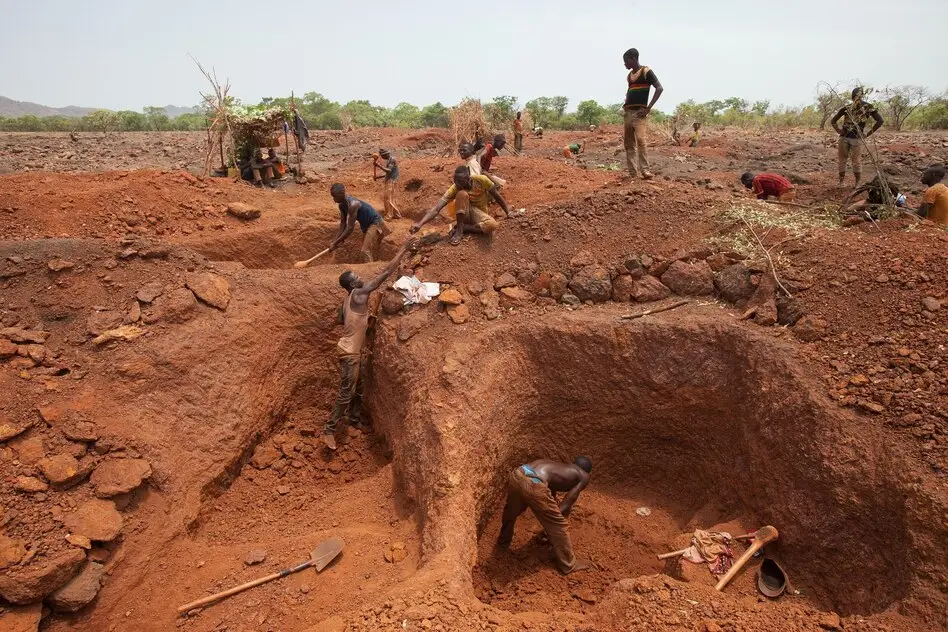
Bouré Balato is located in Guinea's northeastern highlands in the Siguiri region on the border with Mali, which has made a living from gold prospecting for centuries. On October 29, Siguiri's prefect, Colonel Radjimba Mara, banned informal gold mining, citing environmental degradation, water pollution, insecurity and disturbing the peace.
The fact that the prefect was removed from office a day later along with all 22 other prefects and sub-prefects of the region because he himself had promoted illegal mining did not change anything, on the contrary: On November 2nd, Guinea's Interior Ministry extended the ban to so-called "artisanal" small-scale mining nationwide; it applies to all watercourses, nature reserves, protected forests and settlements - a serious blow for millions of people in this desperately poor and mineral-rich country.
“The uncontrolled artisanal mining in Siguiri is causing serious damage,” the ministry said: “destruction of fields and forests through heavy equipment, massive use of dangerous chemicals (cyanide, mercury, explosives) and serious pollution of the Niger River and its tributaries.” The army was tasked with implementing the ban.
Military roadblocks were set up overnight on all major roads in the region. Gold miners from Burkina Faso, tens of thousands of whom work in Guinea, were primarily caught online after fleeing Islamist terrorist groups at home. After just two days, the Guinean authorities reported that over 8,000 Burkinabè had left the country - they were being taken to their homeland by bus through Mali.
The military governments of Mali and Burkina Faso don't like that at all. Mali's Civil Defense Ministry warned of an "influx of people of different nationalities" in Mali's capital Bamako. As of November 7, Mali reported the arrival of 160,000 people from Guinea, of whom 100,000 had reached Bamako. A week later, 73,000 of them were “evacuated” to Burkina Faso, Mali's government newspaper L'Essor quoted the government as saying last weekend. In addition to Burkina Faso and Mali, Senegal, the Ivory Coast, Togo and Benin are also countries of origin for those deported from Guinea.
Guinea's military government rejects the criticism. Foreign Minister Morissanda Kouyaté said “African solidarity” is not a legitimate reason for the destruction of natural resources. The local administration in Siguiri has stood by and done nothing for far too long. The 22 dismissed prefects and sub-prefects have been standing before Guinea's financial court since November 10th, and there have also been summary trials against thousands of arrested gold miners.
The main question in court is who delivered the heavy equipment that dredges riverbeds. The dismissed prefect of Siguiri denied the allegations against himself in court: he said he only took office in June.
Guinea is one of Africa's largest gold producers after Ghana, South Africa, Burkina Faso, Mali and Sudan, with recorded production of 69.3 tonnes last year. 20 tons came from industrial mines, 50 tons were mined by gold miners in so-called artisanal mining, in which sand is dug from river beds, chemically treated and filtered. The Niger River, which rises in Guinea's highlands and then winds its way thousands of kilometers through Mali, Niger and Nigeria in a large arc through West Africa, has been a rich source of gold in its upper reaches since the Middle Ages.
This mining has long been dominated by the Mandingo (also known as Malinké) ethnic group, who for decades built up their own alternative economic cycles in Guinea in opposition to the military dictators. Guinea's first freely elected president, Alpha Condé, who ruled from 2010, is a Mandingo. He is now sharply criticizing the crackdown on the “centuries-old” gold mining industry in Siguiri and says military ruler Mamadou Doumbouya – who overthrew Condé in 2021 and is also Mandingo – wants to drive out the local population in favor of companies and is thus pursuing “family interests”.
Since 2017, the Ghanaian-South African mining giant AngloGold-Ashanti has been the majority owner of the Siguiri industrial open-cast gold mine through its local branch SAG (Société Aurifère de Guinée). Under Doumbouya, smaller mining companies with connections to China are said to have bought land. Previously, Condé, as president, is said to have tolerated the influx of gold seekers from other African countries.
This makes Doumbouya's campaign in Siguiri a political issue, and it coincides with a large mining trade fair in the capital Conakry, at which Guinea is presenting its long-term goal of industrialization. Parallel to the nationwide ban on artisanal mining, Guinea's first gold refinery opened in Conakry.
The shadow gold economy in the Sahel is also considered a source of finance for Islamist terrorist groups. Most of Guinea's gold finds its way across the border into Mali. A new study by the Konrad Adenauer Foundation shows in detail how the Islamist rebel group JNIM (Group for the Protection of Islam and Muslims), which fights in Mali and Burkina Faso, has recently gained a foothold in the border area with Guinea.
Meanwhile, there is great need in the villages around Siguiri affected by the gold mining ban. Schools and markets remain closed, life is at a standstill. Gold was the only source of income. Now people are fleeing to the town of Siguiri in the hope of further transport, reports the online medium Guinée Matin. “I came here to be able to feed my parents in the village, but now I am desperate,” the report quotes Siguiri gold prospector Mory Savané. "I'm at the bus station empty-handed, I'm begging the bus drivers to take me with them. There's no work in Balato anymore, I'm hungry, my things are burned and I'm scared to death. My father is sick, I fed the whole family. Now I have nothing."