
Germany · taz · · 48m
Car-free Sunday in Brussels: How different the city can be
Deutsch (original) · Auto-translated to English
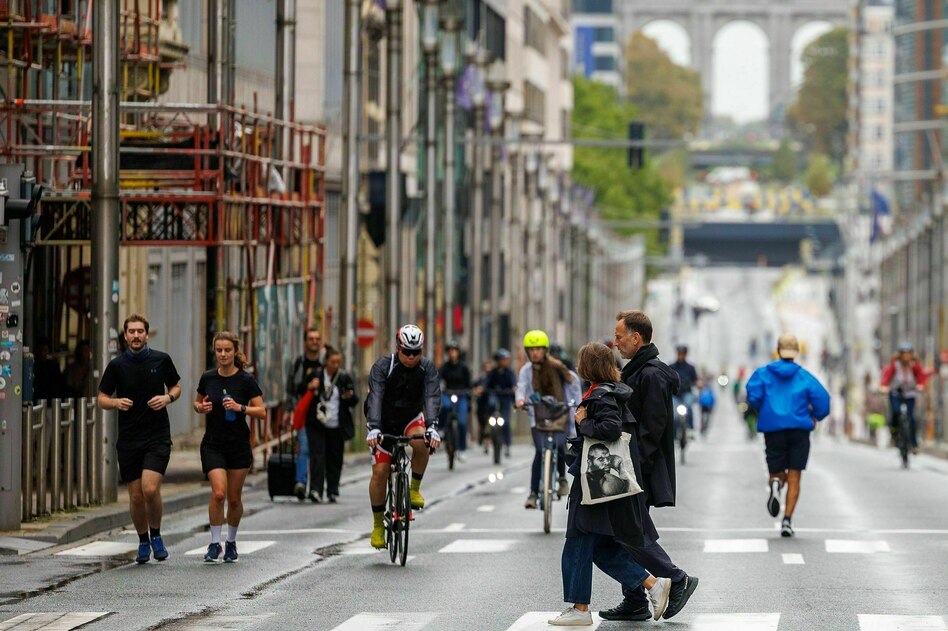
Nothing. No car. No dangerously close overtaking. How wide and comfortable roads are! And this calm. No honking. No crowding behind you. And not full throttle, because someone really wants to be the first at the next red light. For a day, Brussels is a city again, not a traffic area for the asphalt imperialists on four wheels.
Since 1999, the Brussels Capital Region has closed its streets to car traffic on one day in September (except for taxis, emergencies). This affects almost 1.3 million people plus visitors. 2,000 streets on 160 square kilometers are pedestrian zones and cycle paths. This makes Brussels the largest European city to be car-free for at least one day. The metro, buses and trams are free, and their already fast frequency is increased on most lines.
Brussels' freedom from cars is part of European Mobility Week. Elsewhere, including in the car republic of Germany, this week only means information stands, public transport advertising, discussions, film evenings about other cities, for example in Belgium.
So let's cycle off. Hundreds of people are heading down Rue de la Régence towards the monstrous Palace of Justice, whose magnificent entrance has been cleared of scaffolding this summer for the first time in over 40 years. Behind the cheer park we follow two joggers pedaling through the feeder tunnel to the motorway (which unfortunately remained one this Sunday too). Later we go up towards the Atomium. Without a backdrop of cars in front of you, Brussels' glittering landmark seems to have grown beyond its 102 meter height.
Hordes of pedestrians in a good mood roll along the boulevards. Jogging takes place in a wide formation over double tracks. Children use the streets as playgrounds (as was common in the past) and are no longer deported to protective reserves (“playgrounds”). What is particularly striking is the many small children practicing here on their tricycles, scooters and minibikes. The sheet rests on the edge. It's a kind of paradise.
In all 19 districts of Brussels you will find neighborhood festivals, street-wide flea markets, food markets, and in the city there is a much-used mobile, volunteer bike repair station, right next to it there is street salsa instead of SUVs. Meanwhile, the Bankra Bike Soundsystem, a Dutch music collective from Utrecht, cycles through the city with bass booming.
In the old stock exchange, in front of the Boulevard Anspach promenade, which was still a four-lane city highway in 2015, the world comic capital gathers for the comic strip festival with Lucky Luke, the Daltons, Spirou and the national heroes Tintin. Here children (and many adults who are young at heart) cheer when they are not cycling.
Car freedom, however, leads to new challenges: Because traffic signs and traffic lights (many of which are flashing yellow) are largely ignored, you have to constantly be on your guard in other ways, especially in the afternoon, when it gets more and more crowded.
The e-scooters, called scooters here, are annoying even on car-free Sundays. But in January there will be an end to rental scooters in Brussels: too dangerous, parked too inconsiderately. In the evening, the police reported a seriously injured child, hit by a taxi.
Apart from taxis (can't they take a break sometimes?), only a few cars roll towards you, mostly Belgian (with a special permit?), but also a visibly confused British woman and a car from Wiesbaden, whose driver tries to look as cool as possible. Did the police catch him? Dozens of other Belgian cities were also closed to cars on Sunday, such as Antwerp, Bruges and Spa.
However, banning cars for one day does not mean calm in transport policy. The new Brussels government, which only met 615 days after the election (June 2024) this spring, has not yet been able to agree on the other 364 days of the year.
The old traffic plan to promote gentle mobility (“Good Move”) with a speed limit of 30 km/h in the city (expressways 50), new cycle paths, countless speed bumps (called jams here) and concrete blocks as obstacles to speeding is too auto-harassing for most of the six coalition partners, as they complain.
Good Move became a fighting word. A new mobility plan is needed, especially the right-wing liberal MR, which also leads the Brussels government with Georges-Louis Bouchez. When the coalition agreement was signed, Bouchez celebrated “Fini, no more good moves”.
Perhaps a little hasty: The Greens under Brussels Mobility Minister Elke Van Den Brandt are fighting for as few compromises as possible. And they are playing for time. Last week the city council agenda item was postponed for the fourth time. After all, from 2027 onwards there will be a second car-free Sunday every May on the initiative of the Greens.
Read the full story at the source
Source: taz