
Germany taz
Looking for partnerships: Steinmeier and Merz travel to Asia
Federal President Steinmeier is setting off on his second state visit to China. At the same time, Chancellor Merz travels to the surrounding area of the gigantic empire. Is that a coincidence? more...
Deutsch (original) ·Auto-translated to English
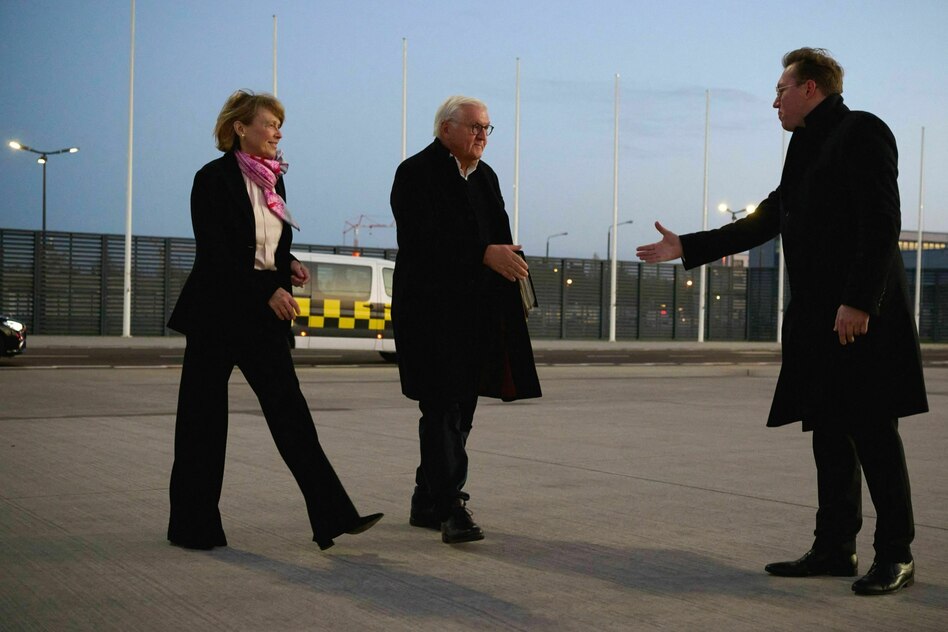
dpa | Chancellor Friedrich Merz (CDU) and Federal President Frank-Walter Steinmeier set off on a multi-day trip to Asia. In the morning Steinmeier started a four-day state visit to China. Just five hours later, Merz took off from Berlin airport and began his longest foreign trip to date as chancellor. His first stop is the rich city-state of Singapore, then he continues to Japan and South Korea.
They are two trips to very different partners. Steinmeier is visiting China, by far Germany's most important economic partner in Asia. However, the country, which is led authoritarianly by the Communist Party, is seen as a competitor and a rival to the system. The three countries that Merz is visiting, on the other hand, are among the like-minded partners on the continent. Germany is most closely connected to Japan via the G7 of democratic economic powers.
Merz only returns to Berlin late on Friday evening, followed shortly afterwards by Steinmeier. In government circles it is important that there is no direct connection between the two trips. So one doesn't happen because of the other. According to the Chancellery, the Merz trip is one “in its own right”. Nevertheless, the two sides have coordinated closely.
This is Merz's third trip to Asia as Chancellor. In January, unlike his predecessors Olaf Scholz (SPD) and Angela Merkel (CDU), he decided to visit India, the world's most populous country, before China, where he only showed up a few weeks later. A clear sign that he wants to reduce Germany's economic dependence on the great power China when it comes to exports, but especially when it comes to importing important raw materials.
This so-called diversification is now also the purpose of his third trip to Asia. It should be understood as an investment in partnerships with the states of the region and “in a shared vision of international order”.
In Singapore, in addition to his political discussions, the Chancellor will give a keynote speech on the Federal Government's Asia policy. His program includes taking part in economic conferences in Japan and South Korea. From the South Korean capital Seoul, he will also make a detour to the demilitarized zone on the border with North Korea.
Merz is accompanied by 30 top managers. Among others, the heads of Siemens, Telekom, Henkel, but also defense companies such as Airbus Defense and Space and Quantum Systems are there.
Several company agreements as well as agreements between governments are to be signed - for example on artificial intelligence, infrastructure and critical raw materials.
In addition to the economy, a second focus will be security policy - especially in Japan. Despite the great distance, the country is one of Ukraine's supporters and has the Patriot systems, which are so important for air defense.
For Steinmeier, the four-day state visit to China is the conclusion and highlight of his numerous trips to Asia in recent years. In his second term in office alone, he visited around ten Asian countries, including Singapore, Japan and South Korea, where the Chancellor is now flying.
He regularly promoted Germany and Europe as fair and reliable partners - politically and economically - and as guarantors of a rules-based international order. Steinmeier's message was that Germany and Europe would be ready if the Asian states wanted to reduce their one-sided dependencies on their large neighbor China.
Fairness in economic and trade relations will also be a central topic at Steinmeier's talks in Beijing, as will the future role of the world power China in international relations. He wants to give a keynote speech at the awarding of the honorary professorship at Peking University on Thursday, and the next day he wants to talk about it with China's President Xi Jinping.
“We don’t want a decoupling from China, we want close and resilient economic relationships, but ones that are in the interests of both sides,” says the Federal President’s Office. “That’s why imbalances have to be reduced.”
Steinmeier is concerned with systemic economic and trade issues, not with concluding contracts for German companies. That's why he's not taking a business delegation to China, but rather Peter Leibinger, the President of the Federal Association of German Industry, and Dirk Jandura, the President of the Federal Association of Wholesale, Foreign Trade and Services.
According to the information, the Federal President has coordinated closely not only with the Chancellor but also with Trade Commissioner Maroš Šefčovič. In negotiations with China's Trade Minister Wang Wentao, he had just achieved a reduction in Chinese exports of hybrid cars to Europe. Steinmeier is traveling to China “not just as a German head of state, but as a European,” the Federal President’s Office emphasized. To make this clear, he is also taking the Vice President of the European Parliament, Katarina Barley (SPD), on the trip.