
World taz
Audi boss Döllner visits Trump: Ingolstadt carmaker is planning a new SUV factory in the USA
At a US presidential election campaign event, Audi boss Döllner promises a new production facility in Georgia. German factories are on the brink. more...
Deutsch (original) ·Auto-translated to English
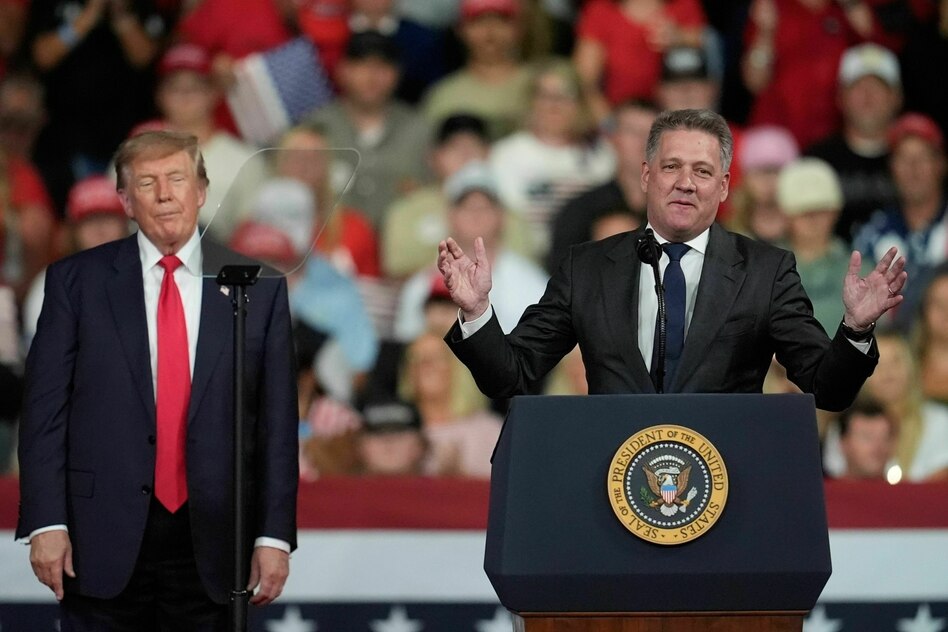
Audi boss Gernot Döllner has stepped out of line in recent years. Other car bosses often and audibly railed against the European CO2 requirements for the auto industry - but Döllner defended the climate rules, including the end of combustion engines from 2035. "I don't know of a better technology than the electric car to make progress in reducing CO2 in transport in the next few years," he told Wirtschaftswoche in the fall of 2025, when colleagues and conservative politicians were once again making a major attack on the EU requirements.
This fall, on Saturday, Döllner was kindly invited onto the stage by President Donald Trump in Perry, Georgia, USA. Trump's fans cheered, Döllner could hardly hide his joy - then he announced from the lectern, adorned with the US President's seal, that Volkswagen subsidiary Audi wanted to build its own new plant in the USA: "We plan to produce our largest and highest-quality SUVs here in Macon, Georgia."
It was a Republican campaign event; the right-wing extremist US president is canvassing for votes in the midterm elections at the beginning of November. Georgia is particularly politically competitive and could tip the scales in the struggle for a majority in the US Senate. Trump said in Perry that Audi would invest $4 billion to build the new plant. 200,000 vehicles are expected to be manufactured there every year. Audi boss Döllner explained: "This is a long-term investment. We believe in the American market."
The announcement comes at a time when signs point to crisis in the German auto industry. Large manufacturers such as Volkswagen, BMW and Mercedes-Benz want to reduce costs at German locations and cut jobs on a large scale. In the Audi parent company VW, the factories in Emden, Hanover, Zwickau and Neckarsulm are at risk, and the future of many workers is uncertain. It was only at the end of September that Volkswagen terminated 10 of the 13 existing company collective agreements; according to the IG Metall union, the salaries of around 660,000 employees worldwide were frozen until 2030.
For a long time, the transformation of the industry towards climate-friendly electromobility was slow. German manufacturers' electric car sales have recently picked up. Nevertheless, they are under pressure: Chinese competitors have established themselves in Europe with inexpensive electric and hybrid models, and the profitable batteries for German vehicles are still too rarely produced in Germany itself. The tariffs imposed by US President Trump and his anti-climate protection policies in turn made sales, especially electronic sales, more difficult on the large US market.
The fact that the VW subsidiary Audi is promising a new plant in the USA in such a situation is bad news for employees at German locations, said Ferdinand Dudenhöffer, economist and founder of the Bochum Center Automotive Research (CAR), to the taz. In addition, it is “embarrassing and strange that Döllner is allowing Trump to pull him in during the election campaign.”
Trump was able to suggest to Perry that his protectionist tariff policy was worthwhile. Audi is weak in the USA, all vehicles have to be imported at great expense from Europe or Mexico. According to Audi, the new factory in Macon will now create 4,500 jobs and production will start in the early 2030s. The combustion SUVs Q7, Q8 and Q9 are scheduled to roll off the assembly line.
In view of the tariffs, it makes economic sense to set up your own production in the USA, says Dudenhöffer. The car expert believes that it is understandable that combustion engines are being built there: “Trump has put the electric car on the hard shoulder.”
Jens Hilgenberg, head of transport policy at the Federation for the Environment and Nature Conservation (BUND), sees it differently. “The Volkswagen Group would shift climate sins abroad and at the same time abandon its employees and entire regions at home,” he said. “Money that is urgently needed to transform the company would be moved to the US.” Döllner’s commitment to climate protection now seemed “like mere lip service,” says Hilgenberg.
And Isabel Cademartori, transport policy spokeswoman for the SPD parliamentary group, is also angry. Workers in Germany have to worry about the future of their jobs - at the same time, Audi is campaigning aggressively for an autocrat who wants to “bring jobs to the USA at the expense of Europe through a trade war”. “This will massively damage both Germany as a business location and our own brand,” believes Cademartori.
Before construction of the plant in Macon can begin, the Volkswagen Group's supervisory board must give its approval. The state of Lower Saxony and IG Metall, both of which sit on the supervisory board, continue to demand secure prospects for employees in Germany.