
World taz
Asean summit in Manila: Hardly any agreement against China's AI supremacy
Trump's short visit to the summit of Southeast Asian states in the Philippines caused a stir. Left-wing groups protest against a US initiative. more...
Deutsch (original) ·Auto-translated to English
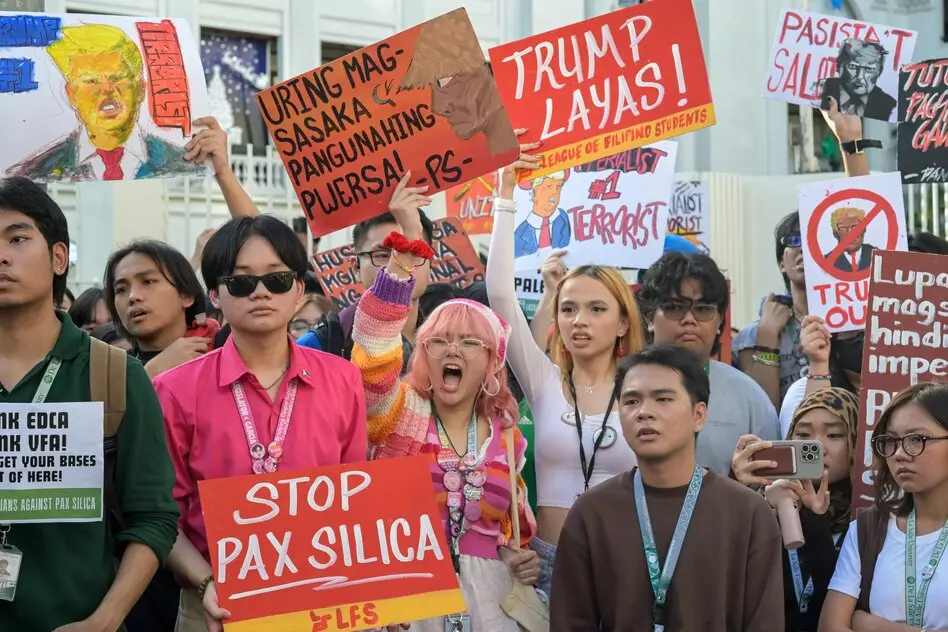
At the summit of the Southeast Asian alliance Asean in Manila, the guest who caused the biggest protests was the one who took part the least: Donald Trump. After landing in the Philippine capital on Tuesday, the US President flew straight to his hotel in a helicopter. There he received the heads of government of India, Japan and Australia for a meeting of the informal Quad alliance.
In the so-called quadrilateral security dialogue, the four members see themselves as a security policy alliance in the Indo-Pacific and thus as a counterweight to China and its growing power in the region. The short Quad meeting in Manila, at which Trump primarily praised India's Prime Minister Narendra Modi ("a very strong guy") and fawned over Japan's Prime Minister Takaichi ("she's maybe even stronger"), was at best symbolic, lasting only an hour. Apart from that, it was the first summit since 2024. Plans for a joint military exercise were discussed.
While Trump was still attending the final dinner of the heads of state and government of the 11 Asean members and their high-ranking guests from Brazil, China, Russia, South Korea and the other Quad members, left-wing groups had been demonstrating in the center of Manila for three days against the US President ("Not welcome here") and his government's policies.
The US initiative Pax Silica was at the center of the protests. It is intended to broaden supply chains for silicon, semiconductors and other key technologies as well as key raw materials and to secure the USA's lead over China in artificial intelligence (AI). Pax Silica has 26 members, including the EU and Germany.
The Philippines, the only member from Southeast Asia alongside Singapore, joined in April. There is now a first major project in the Tarlac province north of Manila. A 1,620-hectare industrial park for the production of semiconductors, microchips and AI technologies is to be built there in New Clark City.
The former US colony of the Philippines has large deposits of copper and nickel, minerals that are urgently needed. For the industrial park, the details of which have not yet been clarified, more than 200 farmers will give up their land and an indigenous ethnic group will give up a traditional burial site. Tarlac was home to Clark Air Base, the largest US military airport outside the USA until 1991.
The counter-project to Pax Silica is China's World Artificial Intelligence Cooperation Organization (Waico), based in Shanghai. In the organization, which was founded in July 2026 and currently has 37 member states, China is trying to unite friendly states and countries in the Global South around Beijing's ideas and standards for AI. Waico includes seven countries from Southeast Asia; Singapore is the only country that is also part of Pax Silica.
So far, the states of Southeast Asia have tried to resist pressure from Washington and Beijing to choose one of the two sides. Trump has caused a lot of trouble with his tariff policy. And the day before his arrival in Manila, the US Department of Commerce had imposed new export restrictions in the wake of the Nvidia scandal. In the future, US companies will have to apply for licenses to export high-performance chips to Singapore, Malaysia, Thailand, Indonesia (and Brazil).
During discussions that began on Sunday, the Asean states somewhat relaxed the sanctions imposed against Myanmar following the military coup there. The coup leader and current President Min Aung Hlaing is still not allowed to attend the summit. There is still no solution to the question of a code of conduct on the South China Sea. This should actually be available by the end of the year - and defuse the tensions between China on the one hand and, above all, the Philippines and Vietnam on the other.