
Germany · taz · 6h
Army clothing for women in Ukraine: “Women are not little men”
Deutsch (original) · Auto-translated to English
It was right at the beginning of the Russian full-scale invasion: at the command “Air alert!”, the Ukrainian soldier Nataliya Lischschyshena jumped from a truck. The standard protective vest weighing 18 kilos hit her chest painfully. But she knew that her life was in danger and ignored the pain. The “air alarm” order was sounded frequently that day.
When she took off her protective vest in the evening, Nataliya noticed large bruises on her upper body. Then her unit was moved, the war continued, the bruises disappeared and Nataliya didn't think much about it. Until a few years later she was diagnosed with a pre-cancerous condition, which led to both of her breasts having to be amputated.
Nataliya Lizhyshena was one of the first female soldiers in Ukraine to document that she suffered health problems as a result of wearing a regular army bulletproof vest.
The protective clothing that Nataliya wore, called the “standard vest,” can actually be described as male. Because they were made for men's bodies. And although almost 75,000 women serve in the Ukrainian Armed Forces (ZSU) today, they still have no anatomically adapted protective vests, no uniforms of their own, not even women's underwear.
has been reporting for Western media on events on the front in Ukraine and humanitarian issues in the context of war for over ten years. She specializes in on-site reports and stories about children suffering from the consequences of hostilities.
In July this year, the Ukrainian Defense Ministry announced that female soldiers in ZSU combat units were equipped with protective vests specifically designed for female anatomy for the first time since the start of the war in eastern Ukraine in 2014. However, this first delivery only included 2,000 pieces. They were the first such vests since the war in eastern Ukraine began in 2014.
"That's just a drop in the ocean. I have a question for the state: What is more expensive - an anatomically adapted protective vest or rehabilitation and prosthetic care after an injury?" asks 45-year-old Nataliya Lischshyschena rhetorically. Nataliya is now retired. Due to her health condition, she can no longer work and now has disabled status.
"I found out about my illness by chance. When I was examined for lung problems, the doctor also referred me to a breast specialist. I was diagnosed with milk duct papillomas with bloody nipple discharge (Mintz's disease). Without surgery and removal of the mammary glands, the tumor could have developed into a malignant one," says Nataliya, who is now actively campaigning for human rights.
Several Ukrainian doctors believe that Nataliya's illness could have been caused, among other things, by wearing an unfitting men's protective vest.
"Women have breasts. But for some reason this is not taken into account when it comes to uniforms and protection. Women are not small men. That's why giving a woman a body armor, a helmet and a man-sized uniform is not a solution," explains Nataliya.
The former soldier is now campaigning for a state program to provide free breast prostheses for those soldiers and veterans who have had to have their breasts amputated.
"Such an operation costs 7,000 euros. That's a lot of money that veterans like me simply don't have. I could finance the prostheses with the help of donations, but I don't want to do that on principle. I also want to help the other women to ensure that there is a state program for them in Ukraine," says Nataliya.
Khrystyna, nom de guerre “Kudryawa” (the curly one), lieutenant colonel in the National Guard of Ukraine, has one of her rare days off today. She uses it to stop by the Kyiv office of the non-profit organization Zemljatschki (German: Compatriots). The Ukrainian volunteer organization supplies female soldiers with uniforms and equipment.
Khrystyna tries on the uniform, it fits perfectly. Comfortable, functional, the right size and, as a little “women’s bonus”, embroidery on the collar. It is a uniform of the Zemlyachki organization, the army does not issue such uniforms.
The large-scale Russian war of aggression against Ukraine began with the invasion on February 24, 2022. The annexation of Crimea took place in March 2014, and shortly afterwards the conflict broke out in the eastern Ukrainian regions.
Khrystyna has been in the armed forces since 2013. During this time she has observed how the role of women in war and attitudes towards it have changed. At the beginning of the full-scale Russian invasion, she was in eastern Ukraine. The commander tried to send them into the hinterland. But Khrystyna insisted on her right to remain where she could be used most effectively and sensibly.
Until 2013, women in the military were the exception rather than the rule. Back then, women were either paramedics or worked in administration. After 2014, this changed thanks to the women who joined the defense of Ukraine after the Revolution of Dignity, Euromaidan, says Khrystyna.
"They were practically already deployed in the attack, in reconnaissance or in the infantry, but were listed in the documents as seamstresses or clerks. And thanks to their commitment, around 70 combat positions for women in the armed forces were finally officially created in Ukraine," says the lieutenant colonel, who took part in heavy fighting in the Luhansk and Donetsk regions as well as in Hostomel near Kyiv.
The difficult conditions at the front were made even more difficult for Khrystyna by the lack of suitable uniforms and equipment.
"I remember one time when we got underwear. They were these big, olive-green men's army underpants that slide down under the uniform, and men's T-shirts. I took two pairs of these underpants. I don't even know why. I just wrapped my favorite book of poetry in them, because you really can't wear them," says Khrystyna, laughing.
But she doesn't want to joke about protective vests and helmets. Because if they don't fit properly, it can quickly become dangerous in war. "Providing women with appropriate equipment is not a priority. For us in Ukraine, air defense systems are a priority," she says.
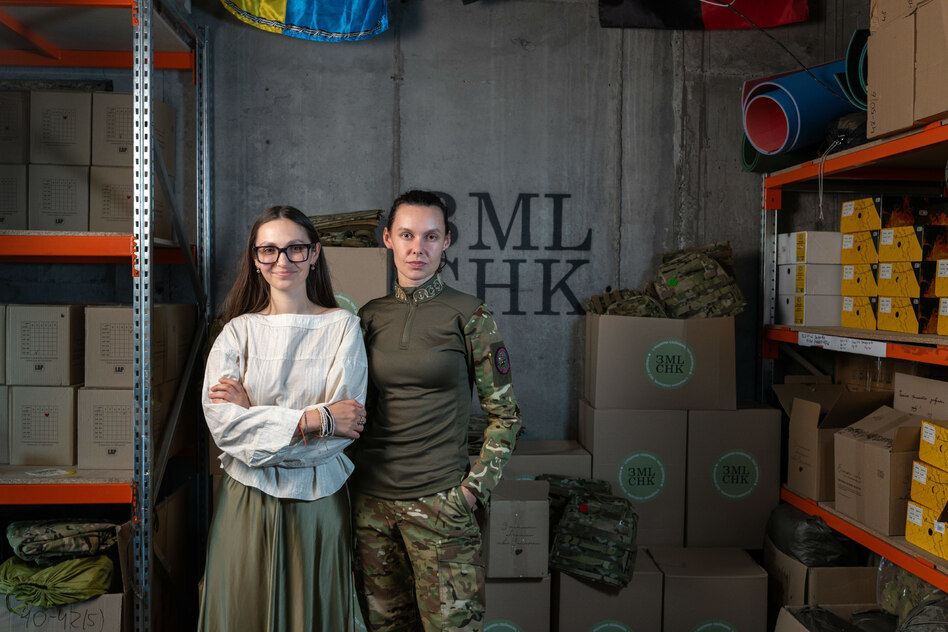
27-year-old Khrystyna Delin, who co-founded Zemlyachki, carefully packs a women's uniform, a sleeping bag, a book, a first aid kit and hand cream into a box on which she writes in marker: "We are proud of you." Since the start of the all-out war, the organization has processed over 31,000 such requests from women in the ZSU.
"When you go to the gym, you put on comfortable clothes so that you can do the exercises properly. And just like that, the uniform for female soldiers has to fit like a second skin. You have to feel comfortable in it to be able to fight," says Delin. “But the women were given uniforms in sizes L and XL, which they tied together themselves with strings or sewed tighter,” she says as she walks through the organization’s storage rooms, which are financed with the help of donations.
Everywhere there are boxes stacked high with things that soldiers order every day. 95 percent of inquiries concern uniforms, then anatomically fitting protective vests and underwear. Last year the number of women in the ZSU increased by almost 7,000 compared to the previous year.
Both Nataliya and Khrystyna “Kudryawa” say that the situation regarding the inclusion of women in the army is finally moving beyond the impasse. And in her opinion, it will be up to Ukraine to pave this path for women.
"No other country offers a contemporary solution for the gender-equal integration of women in the army. We don't even have a model to follow. We are currently one of the few countries that has such extensive experience with modern combat operations and, accordingly, with the search for solutions on the battlefield - both in terms of uniforms and weapons," says Captain Khrystyna Boitschuk, who currently works in the reconnaissance service. “We of all people will have to change this patriarchal system,” she is convinced.
Meanwhile, Khrystyna Delin is packing a few more boxes in the Zemlachki warehouse. Tomorrow the uniforms will be sent to women at the front - and a few more female soldiers will receive their “second female skin”.
Read the full story at the source →
Source: taz