
World taz
Argentina and the EU-Mercosur agreement: How much is environmental protection worth to Europe?
Brussels is caught in a rhetorical labyrinth: while the EU adorns itself with green speeches, it turns a blind eye to “Chainsaw” Javier Milei. more...
Deutsch (original) ·Auto-translated to English
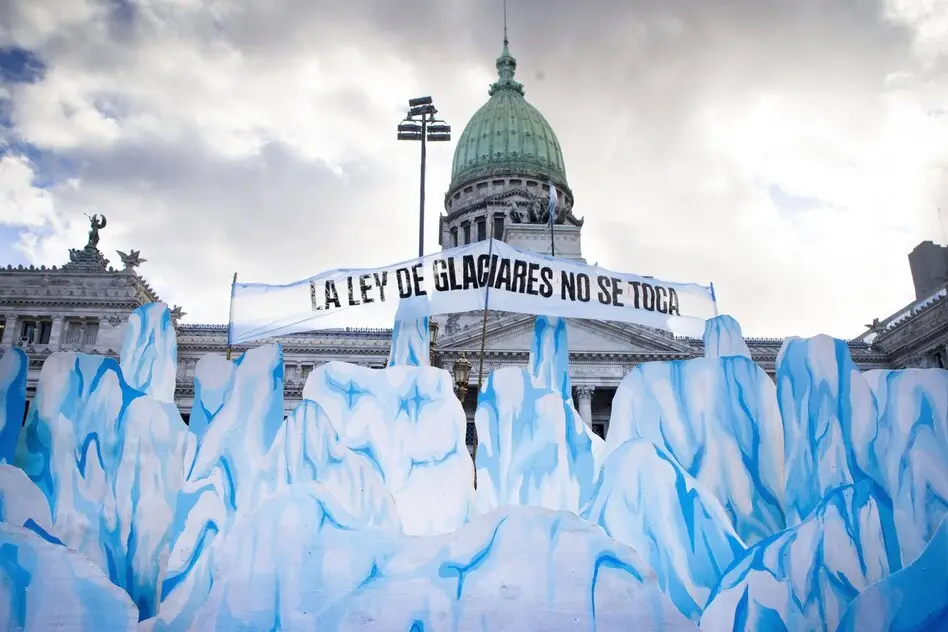
On February 26, as the first rays of sunlight hit the Congress dome directly, a dozen men and women bypassed the site's security and climbed over the bars that separate the palace from the street. At that hour it was already 25 degrees in Buenos Aires, an unusual – if increasingly less rare – heat for a summer that only had its last few weeks left.
After gaining entry, visitors pulled down their pants and sat on dummy toilets with a "Don't shit on the glaciers" sign directed at lawmakers. Inside the building, the meeting room was prepared for the vote on the reform of Argentina's glacier protection regime, one of numerous deregulation measures in the "chainsaw" plan.
15 journalists from 12 Latin American countries are taking part in the “Euromérica” workshop organized by the taz panter foundation. It's about the opportunities and challenges of the EU-Mercosur agreement and Latin American-European relations. A supplement will appear in the taz on December 5th, and there will be a public talk in the taz canteen on December 9th. All texts can be found here.
The scene took place in Buenos Aires, but the discussion did not end on the steps of Congress. More than 11,000 kilometers away in Brussels, the European Union is trying to make its environmental standards an increasingly important part of its trade policy. The problem is that one of its new trading partners, Javier Milei's Argentina, is doing the opposite and is reviewing, relaxing or outright eliminating some of the regulations that have shaped the country's environmental policies for years.
This tension has taken on a particular dimension since May 1, when the agreement's trade provisions came into force. Days earlier, the Argentine Congress had passed the reform of the glacier law, and almost six months later the activists - members of the Greenpeace organization - were not acquitted by the judiciary and a confiscation of assets was ordered. “Our activity should not be a crime,” says activist Cynthia Moreno Gallo. “We didn’t attack anyone, we didn’t damage the facilities and we didn’t hurt anyone.”
The discussion is not insignificant for a country that wants to attract investment in the lithium and copper sectors. Both minerals occupy a central place in international strategies for the energy transition and are at the same time raw materials whose mining takes place in areas where water is one of the most important points of conflict in the area of environmental protection.
For the EU, environmental requirements are a central part of its trade policy. The anti-deforestation regulation and the CO₂ border adjustment mechanism are intended to prevent imports from running counter to their climate commitments.
Argentina's regression also affects the state's ability to maintain environmental measures. The draft budget for 2027 envisages a real decrease of 10.84 percent compared to 2026 and 84.3 percent compared to 2023 for the Environment Secretariat. Officials at the National Institute of Agricultural Technology (INTA) and the National Weather Service also denounced restrictions on the public use of the term “climate change.”
Argentina is a long, very long country. South of the Chaco region lies the city of Buenos Aires and even further south is the Patagonian forest. When Hernán Ñanco starts a working day, he doesn't always know which fire he'll be fighting. But he is sure that first it is necessary to check which vehicles are ready for use and whether there is enough equipment for all his colleagues. Kutral, his friends call him. This means “fire” in the Mapuche language. He's 28 years old and has been fighting wildfires for a decade.
In Argentina, his working conditions have recently deteriorated. In 2025, the government dissolved the National Fund for Forest Fire Management through Decree 463/2025. The fund ensured targeted financing to prevent and combat fires, raised through contributions from the insurance sector. “If a young man has to mend his shirt or sew his pants while he is in the middle of the fire front, there are problems,” said Ñanco.
Support the taz panter foundation and its international projects with a donation. Learn more
The Mercosur-EU agreement is not limited to reducing tariffs. It also contains explicit environmental principles. Some of these prohibit lowering standards to attract investment or reduce production costs.
Javier Milei's statements against the international climate agenda and his threat to withdraw Argentina from the Paris Agreement sparked internal discussions in Brussels. When asked by taz, European officials acknowledged that various governments had expressed their concerns. However, they stressed that Argentina remains a member of the Paris Agreement and that this membership maintains the legal obligation.
For the EU, international obligations remain in force as long as Argentina is a party to the Paris Agreement, regardless of what its government says. When it comes to domestic environmental policies, Europeans insist they cannot intervene. The question that no one dares to answer, privately or publicly, is: Is Europe prepared to turn a blind eye to the environmental regression in Argentina?
France, which has traditionally been cautious about the agreement, finds arguments in Milei's policies to demand safeguard clauses and protect its farmers. Germany and the industrial wing of Europe, on the other hand, are pushing for accelerated implementation in order to secure strategic raw materials and new markets.
The dilemma is thus sealed. Giving in to trade pragmatism would undermine the EU's credibility as an environmental power. Stopping the agreement, which has been negotiated for a quarter of a century, would also have political costs. The future of the treaty will show whether Brussels prioritizes the durability of its climate commitments or the strategic interest in deepening trade with Latin America in the face of China's advances.
Cecilia Camarano is an Argentine journalist. She works for the daily newspaper Ámbito Financiero as a political editor.