
Germany · taz · · 2h
Anti-Semitism during protests: Demos exacerbate the threat to Jewish people
Deutsch (original) · Auto-translated to English
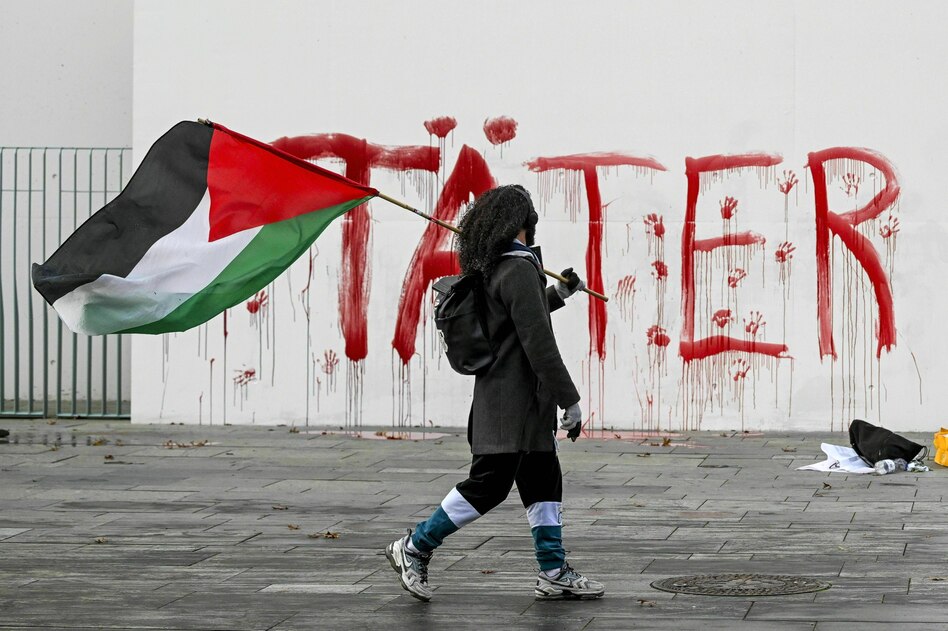
The tone at demonstrations is becoming more tense. And political violence is increasingly seen as justified. This is the result of a study on anti-Semitic protest mobilization since October 7, 2023.
The organization Democ e. V. investigated rallies at which anti-Semitic incidents occurred. She also analyzed actors and networks that have mobilized for such demonstrations over the past year and a half and the narratives behind these protests. The study makers see a connection between the protest dynamics and an increased threat to Jewish people and institutions, on the streets and also on the Internet.
The study shows how the demos push the boundaries of what can be said. Anti-Semitic narratives and interpretations have now become established in the protest milieus examined. Violence is being reinterpreted as legitimate resistance, the Israeli state is being delegitimized and demonized, and Zionism is increasingly being used as a negative term. The study also lists discourses against Germany's historical responsibility after the Shoah and conspiracy-ideological narratives. The study makers emphasize that it is expressly not about demonstrations in solidarity with Palestine as such, but about demonstrations with anti-Semitic statements.
“Despite the falling number of participants, the networks are becoming more established,” writes Democ. These networks succeeded in “shaping forms of action and narratives over longer periods of time”. As an example, the study cites the PFLP, the Popular Front for the Liberation of Palestine, which was involved in the massacre on October 7th. The PFLP mobilizes for protests through support structures and close activists - for example through the United Palestinian National Committee (VPNK), in which actors close to the PFLP and Hamas work together. The EU has classified the PFLP as a terrorist organization.
In Berlin, Ibrahim Ibrahim, a representative of the VPNK and activist close to the PFLP, appeared as a speaker at an Amnesty International event and at a party organized by Die Linke Neukölln. Such appearances “increased connectivity” and “access to younger activist milieus.” In this way, anti-Semitic and anti-Israel narratives would also be carried into parts of the climate protests and the feminist movement.
For its study, the organization has documented and evaluated rallies, speeches at rallies and demonstrations, slogans and banners since October 7, 2023. It also relies on findings from around 3,000 events recorded by the Anti-Semitism Research and Information Center (Rias).
One finding: “There were hardly any demonstrations in which very problematic actors or organizations did not call for them or were significantly involved in the organization and structure,” says Linus Kebba Pook, managing director of Democ. People who wanted to join a demonstration, for example to show their concern for the situation in Gaza, to express their criticism of Israel's conduct of the war or to protest against the actions of the federal government, in the vast majority of cases ended up at events organized by “problematic actors”.
“These actors such as Young Struggle. Zora, the now banned Samidoun or Masar Badil are problematic because they are groups that explicitly stand for an escalation of the conflict,” says Pook. "They don't stand for coexistence and peace. On the contrary: they are interested in driving escalation forward, as that is the only way to liberation," he says.
Pook reports on a large demonstration at the Brandenburg Gate last summer, during which a small group gathered at Moritzplatz in Berlin-Kreuzberg. “It was explicitly stated there that the participants in the big demonstration were betraying their own cause because they were standing up for peace,” says Kebba Pook. Similarly, the Masar Badil group denounces condemnation of violence as a “betrayal of the Palestinian cause.”
“A certain radicalism also has a great appeal for some who go to the demos,” explains Pook. At the same time, according to his observations, organizers or alliances would not take decisive action against actors who are close to problematic groups because they see them as representatives of the Palestinian movement, for example, and do not want to deny their legitimacy.
“What’s important is that even a protest with legitimate political demands – such as positions critical of Israel – can help create a climate in which people feel emboldened to commit anti-Semitic crimes,” says Pook. “Anti-Semitic actors act more decisively when they believe there is a social majority behind them,” says the study. “In right-wing demonstrations, it is very clear to many people that this connection can result in racist crimes,” says Pook. “When it comes to anti-Semitism, such a connection seems more difficult to understand for many,” he says.
The study recommends clearly excluding extremist actors and taking harsh repression against those who legitimize violence. “The Left Party should also clearly define itself when such actors seek its proximity,” says Pook. It is important to seek dialogue with young people, many of whom have become politicized over the issues of Israel/Palestine since 2023. “Here we would advise educational work with the aim of conveying an understanding of the conflict and the fight against anti-Semitism,” says the Democ managing director.
Read the full story at the source
Source: taz