
World · taz · · 3h
Rush to Ceuta: New branches for her grave
Deutsch (original) · Auto-translated to English
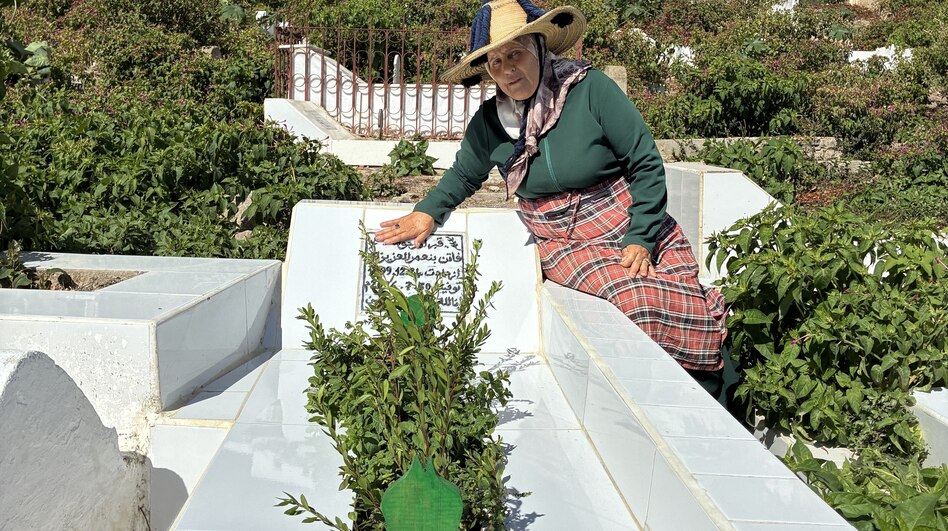
There are no flowers here. Nothing should distract from praying for the dead. Instead there are green myrtle branches. Its small leaves are reminiscent of laurel, the branches are simple, like the thousands of graves in the main cemetery of Tétouan in northern Morocco. They lie close together on the slope at the foot of Jebel Dersa, the city's local mountain.
The Myrtle Branches is the business of Jamila Ben Omar El Aziz. There is a large pile on a tarpaulin in front of her feet. There are a dozen 5-liter water bottles next to it. On her head, Jamila wears the Chachiya Jeblia, the large straw hat worn by the women of the Rif Mountains. Dark wool bands run in a star shape from the head to the wide brim. So on this Friday morning she stands at the southern main entrance to the cemetery and waits. Every now and then people come by. They hug Jamila silently. Then they move on. Almost everyone in town knows her story.
Jamila had said she didn't want to leave that morning. On Fridays, before prayer, most people visit their dead. Jamila didn't want to miss it. When customers are there, she pours water over the white tiles of the grave enclosure to wash away the dust that blows in from the nearby coastal plain. Then she takes the dried myrtle branches from the graves, puts fresh ones in them and receives a few dirhams as a reward.
But there is so little going on that she finally leaves the branches and goes through the gate to the street. “Come on,” is all she says.
The main street that leads past the cemetery towards the old town is named after Mohammed Ameziane. In 1912 he led the second major uprising of the Amazigh, the Rif Berbers, in Tétouan. They wanted to drive out the Spanish colonial rulers. But Spain stayed. It's still there in Tetouan. Especially in the heads.
Jamila walks along Avenue Mohammed Ameziane out of town. It is only a few meters to a roundabout planted with bushes where shared taxis are waiting. She crosses a zebra crossing and walks past Café al Mers, where smoking men sit on plastic chairs. Then she stands in front of a house entrance and unlocks a black painted metal door. She climbs the narrow steps, panting; her apartment is on the first floor. Tiles on the floor and wall, with silk-look wallpaper above. Light bulbs without shades hang on cables from the ceiling. There is no furniture apart from a black faux leather sofa. There are stacked mattresses on one side of the room. Pictures on the walls show three young men and two young women.
Jamila sits down on the faux leather sofa. She points to the walls. She did everything here herself. Now that the apartment is so nice, the landlord wants more money. As if for punishment. She could hardly pay it.
It points towards the roundabout. On that day, six weeks ago, there was something in the air. Everyone was talking about it. The street was full of young people who wanted to go to Ceuta, the nearby Spanish enclave. Jamila talked to her son about it. Montaser, 31, lived with her; he was unemployed, like so many people here. She points to a photo of a young man with a side parting, a thin mustache, and a buttoned-up shirt with a stand-up collar.
The border is open, she tells him on that July 30th.
Jamila's eldest son went to Spain a long time ago. He left his family behind in Tétouan. He now lives in Avila, near Madrid. Montaser also wants to go there. Now the opportunity may present itself.
Her daughters overhear the conversation. Faten is 26 years old, Amira is 15. Until that Thursday, they lived with their brothers Jawal and Montaser and their mother Jamila in the apartment with the mosaic tiles, which today looks as if it had been cleared out.
If everyone goes, then we go too, say the two young women.
“Not you,” says Jamila. “Your brother yes, but not you.”
It's no use. Faten calls a friend. The four of them set off: Montaser, Faten, their friend and Amira, the youngest daughter. The shared taxis that usually start here at the roundabout are long gone, so many people are heading towards Ceuta. Courier drivers offer the route on the backs of their vans. The journey takes 40 minutes, past the airport, past holiday resorts along the coast, which even now, at the end of summer, are covered in amazing greenery, past the small marina of Marina Smir. The group then reaches Fnideq, the last town before the border.
Montaser continues alone to the border facilities, which will soon be open, for whatever reason.
Faten, her friend and Amira go to the beach.
The family often went to the beach, says Jamila. The sea is not far from Tétouan. Her children could swim well, she says.
On the border of Morocco and Spain, a concrete wall has been built far into the sea. Large boulders lie around its base. If you want to swim to Ceuta, you have to go around it. Thousands of people go into the water that day. Faten reaches a rock. Amira doesn't get any further. Faten goes back into the sea and wants to help her, Amira reports later. Then Amira no longer sees her. She reaches the beach on the Spanish side alone.
The Moroccan police recovered 11 bodies that day. According to NGOs, a total of over 140 people are said to have died that day while trying to cross the border.
On the morning of July 31st, Jamila asks her sister, Faten's aunt, to identify a female corpse in the Tétouan mortuary.
Faten was 12 years old when his father died. Shortly afterwards the girl leaves school. She has to make money. “She has been working with me at the cemetery ever since,” says Jamila. “We’ve been together our whole lives.”
When she's not at the cemetery with her, Faten plays soccer. “She always walked around in a soccer jersey, even in the cemetery.” First she played on the street, then in youth teams, and for several years in the regional women's league for Club Moghreb Atlético Tétouan. “That was her dream,” says Jamila.
She has to buy the shoes herself. Her mother always comes with her to the home games; the away games in the north of Morocco - in Tangier, Chefchaouen, Aslihah - are too far for her.
Faten later moves to the Ittihad Tanger club. Every Sunday she now takes the bus to training in Tangier, 60 kilometers away, 1.5 hours there, 1.5 hours back. Jamila rarely goes to the games anymore.
Faten is known as a footballer in Tétouan. Why did she want to leave? "She didn't have a job. There's nothing here," says Jamila. The two earned 20 euros a day at the cemetery, 30 euros on good days. Sometimes the club gave some money for football victories. She gave that to her mother.
“The young generation thinks they can find wealth in Spain that they can’t get here,” says Jamila.
This text first appeared in wochentaz, our weekly newspaper from the left!
Every week, wochentaz is about the world as it is – and as it could be. A left-wing weekly newspaper with a voice, attitude and the special taz view of the world. New every Saturday at the kiosk and of course by subscription.
For many young Moroccans, Spain seems like the answer to their problems: youth unemployment in Morocco is 38 percent, and almost 80 percent of those under 30 work in the informal sector, i.e. without social security and usually without registration. On average, they earn around 230 euros per month. Inflation has totaled almost 13 percent since 2022. A small elite in particular benefits from the enormous income, for example from tourism - no African country has more visitors - and the billions from the sale of raw materials. The government is investing in prestige buildings for the World Cup in 2030. Over 250,000 young people are said to have taken part in the Gen Z protests in the country in 2025. The state responded with violence, thousands of arrests and trials.
The Spain that many young Moroccans want to go to today for these reasons is very closely intertwined with their own country. Spain's south in particular, Andalusia, was under Muslim rule for around 800 years. Many of the rulers and troops came from what is now Morocco. Fighters from what is now Spain destroyed Tétouan in 1399. The city was rebuilt by people who fled what is now Andalusia when Moorish rule there ended in 1492. In the following centuries, more and more people from what is now Spain came to Tétouan - and at the same time Spain conquered more and more areas in northern Morocco. In 1860 Tétouan became Spanish for the first time, then in 1912 it became the capital of the Protectorate of Spanish Morocco.
A nationalist military culture emerged in Spanish Morocco, and many of the officers here saw themselves as the “saviors of Spain”. They later brought the violence with which they enforced colonial rule with them into the Spanish Civil War. From Tétouan they overthrew the democratic Second Spanish Republic.
At the same time, the Spanish built the Ensanche district, today's center of Tétouan. If you walk from there to the old town, the Medina, the wide streets slowly become narrower and more crowded, and the houses are lower. A real border is hardly visible. Spanish traces can be found everywhere in the city. In 1913 the Spanish opened the Saniat Rmel stadium. The former Spanish club Atlético Tetuán played here. After Spanish Morocco gained independence in 1956, the club became today's Moghreb Atlético Tétouan - in which Faten El Azizi's former team also plays. It's a 20-minute walk from her apartment to the stadium.
Hardly anyone speaks French, the second official Moroccan language, in Tétouan. If people know a few words of another language besides Arabic, it is Spanish, which is also taught in school.
The Strait of Gibraltar, which separates Africa and Europe here at the narrowest point of the Mediterranean, has always been less a geographical barrier than a connection. It was used for conquest and subjugation as well as for exchange and trade. This created a space that was probably shaped more strongly by the superimposition than by the demarcation.
Anyone who approaches the northern tip of Africa from the sea today will see the Spanish flag from afar. It towers over everything in the port of Ceuta, as if it had to prove that this place is Spanish and nothing else.
Faten El Azizi and her siblings were three of around 70,000 people who pushed into Ceuta at the end of July, unhindered by the Moroccan soldiers who would otherwise have fought them off with armed force on any other day. Like most of them, Faten's sister Amira returned to her mother in Tétouan. According to official information, around 13,000 migrants are still in Ceuta as of mid-September. Almost everyone is Moroccan. Faten's brother Montaser is one of them. He hopes for a right of residence. There is little evidence that he will get it.
“Invasion”, “avalanche” – these are the words used to describe people like him in Ceuta. People don't just say it at the bar counter. The city government has made it an official formula. Hardly any statement can do without the vocabulary.
At the same time, on the other side of the border, in Morocco, the addition of “occupied,” which used to be only used discreetly, can be heard more and more frequently when talking about the Spanish enclaves of Ceuta and Melilla. From the perspective of many Moroccans, the area should belong to Morocco.
This is one of the reasons why there is a pogrom atmosphere in the air in Ceuta. It's not just about the Africans who live on the beach. Their presence is being negotiated as a question of Ceuta's existence. Many people see the migrants as the vanguard of an army of conquest - if they are not already one themselves.
This is also how the driver who steers his taxi in Ceuta towards the border sees it. You don't have to ask him, he starts the topic on his own. Things can no longer go on like this with migrants, he says. School started today, but it wasn't a normal start to school. The migrants would break into the school buildings, leave behind feces and harass girls. So be it, no doubt about it, he hears it everywhere.
Someone waves to him from the side of the road. The driver slams on the brakes and shouts to the man through the open side window in Arabic, without an accent. The answer also comes in Arabic. He says he was born in Morocco, his wife is Muslim, but was born in Ceuta. He has lived here for many years. Like half of Ceuta's residents, the taxi driver is Muslim. "I'm Spanish. The country gave me my laws, my rights."
He then says that the migrants would pull their notes out of thick wads of money if they paid him for a taxi ride.
The matter is fishy. The left-wing Prime Minister Pedro Sánchez allowed himself to be bought by Morocco in order to cede Ceuta. The migrants are the tool for this.
The confrontation is only a matter of time, he says. "A lot of people are selling their homes here, did you know that? They're getting out while they can." If there is a war, “then I will fight on the side of the Spanish army.”
Hardly anyone could embody the simultaneous existence of Spain and Africa in this region more than this family man. But he sounds as if he is looking forward to the fight to defend Ceuta as strictly and purely Spanish and nothing else.
There are only two land borders between Africa and Europe: one is in Melilla, the other here, in Ceuta. From the direction of Spain it is difficult to see how huge and sophisticated the facilities are. If you want to cross, you have to go through the two customs houses, then a 400-meter-long, walled corridor leads through a bare, heavily guarded strip. It is intended to make it impossible to even approach the high border fences. Even at the end of the wall, on the Moroccan side, the defenses continue: a fence on the seashore, water cannons, soldiers, police, personnel carriers, barriers, kilometer after kilometer along the beach where Faten El Azizi and her sister went into the water.
The border should draw a clear line between Europe and Africa. Anyone who violates this rule without permission cannot be sure that they will not be shot at. This has happened several times in the past. Morocco collects hundreds of millions of euros for security. The EU should now “provide another 115 million euros in the short term” so that a day like July 30th does not happen again.
Invasion, defense - these are the terms used to think and talk about this point of contact between Africa and Europe, where the strict separation of the two continents appears all the more artificial the closer you look. And sometimes the close connections open doors that hardly anyone dares hope for.
Ittihad Tanger, Faten El Azizi's soccer club, was invited to a friendly match, says her mother. In Spain. Anyone who had a visa was allowed to go there. Faten didn't have one. That's what she told her. “She was crying,” Jamila says.
Faten didn't tell her mother that she applied for a visa at the Spanish Consulate General in Tangier. She gave her brother in Ávila near Madrid as her destination. She gave his phone number as the contact.
The fact that many international media reported on Faten El Aziz's death has primarily to do with the existentially tragic circumstance that her visa application was approved and this became known immediately after her death. It was reported in the newspapers that the mother received a call from the consulate on the day of the funeral and was told that the passport with the visa could be picked up.
Jamila describes it a little differently: The consulate called the brother, who then informed the mother.
Either way: As a young, unmarried woman without children, property or a permanent job, Faten actually had no good prospects for a visa. The consulate doesn't say why she got one, even when asked.
Later in the morning, Jamila Ben Omar El Aziz stands again at the south gate of the cemetery and waits for customers.
“Do you want to see it?” she asks at some point.
Then she starts running along the main path, up the slope. Miracle flowers grow between the graves. Their purple flowers hang on the bushes like small, bright trumpets.
It's windy. Jamila continues walking up the hill, across the forecourt of a small chapel. A few workers are sitting in the shade and they greet her. A guard joins her and runs after her through a second plateau full of graves. The plot that Jamila is walking towards is just before the wall, at the northern end of the cemetery.
The grave is 42 days old. It doesn't stand out among all the other, older ones that look exactly the same.
Jamila sits on the edge with the white tiles. The myrtle branches on the grave still look fresh. Jamila takes it in her hand anyway, turns it over and then throws it on the floor. She puts new branches on the grave. Faten's name and the date of his death are engraved in black letters on a tile. She strokes the tile as if it were her daughter's cheek. Then she cries.
Read the full story at the source
Source: taz