
Politics · taz · · 2h
Hearing on the AfD ban procedure: Agenda item: AfD ban
Deutsch (original) · Auto-translated to English
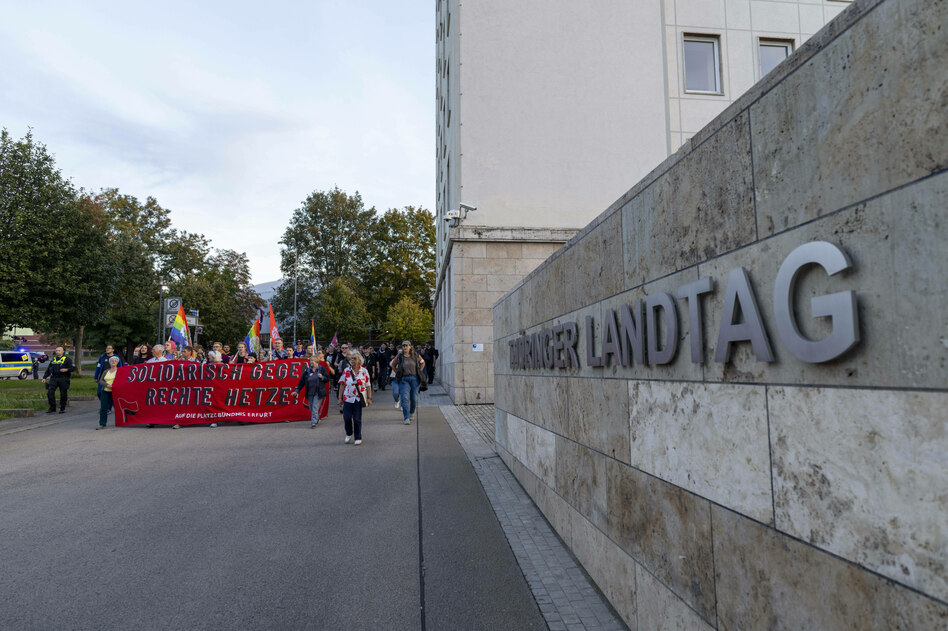
After the hearing, the lawyer Chan-jo Jun stands in the room in front of the plenary hall of the Thuringian state parliament and takes a quick breather. The members of the Justice Committee questioned him as a legal expert for around an hour and a half. The public hearing took place on Wednesday afternoon in the large plenary hall. The visitors' gallery was full. The topic: a possible party ban procedure against the AfD.
Jun says afterwards with a smile that he was surprised at how detailed the questions were. And something else surprised him: “That the AfD MPs seemed so desperate that the path to the rule of law that I wanted to outline for them represented such a big dilemma for them.” Right at the beginning he declared that the AfD would only avoid a ban in such a process if it changed radically. To be more precise: it must seriously and noticeably distance itself from anti-constitutional positions.
It is the first time that a committee has publicly addressed the question of banning the AfD party. In total, the MPs invited eight experts. Jun was the first to answer the questions. Then lawyer Christian Conrad, who has represented the AfD for years, spoke. In the evening, the actor Hape Kerkeling and the former CDU politician and head of the Federal Office for the Protection of the Constitution Hans-Georg Maaßen were among others on the list. (You can access the live stream of the Thuringian State Parliament here)
The hearing was set up following a request from the Left party. Last year in May, she submitted a draft resolution that the state government should advocate in the Bundesrat for “the initiation of a ban procedure in accordance with Article 21 Paragraph 2 of the Basic Law” against the AfD.
The reason was the classification of the AfD as “certainly right-wing extremist” by the Federal Office for the Protection of the Constitution at the beginning of May 2025. The AfD sued against this in an urgent application to the Cologne Administrative Court and, after ten months of preliminary examination, was proven right in February. There is no “certainty” that the AfD federal party is against the free democratic basic order. However, a “strong suspicion” of a “certain extremist effort” is proven by numerous statements.
Before the hearing, Katharina König-Preuss, domestic politician for the Left Party in Thuringia, explained that the aim was to “objectify the debate”. A ban procedure should not be anticipated. Instead, it is about “responsibly examining the legal requirements and social consequences”.
The AfD held a short press conference in the state parliament before the hearing. There, the justice policy spokesman for the Thuringian AfD parliamentary group, Sascha Schlösser, thanked the Left “for this magnificent stage”. He explained that a process would strengthen the AfD. A few hours later in the plenary hall, he asked the legal expert Jun. Did he know that if the AfD Schlösser were banned, he would lose his mandate in the Thuringian state parliament even if he left the party during the proceedings?
Jun said he was aware of the harsh consequences for MPs. But that's exactly why he believes the party has to decide on a direction. As an AfD member, Schlösser ultimately has control over how the party develops. It is necessary to distance oneself from people who represent or promote anti-constitutional positions. As an example, he cited a “remigration concept” that envisages excluding or deporting German citizens. Then it is also possible that the AfD will survive a ban procedure.
A little later, the lawyer Conrad was the second expert to warn that the public debate about a ban alone could deter voters. At a certain point, the police can carry out searches on the party in question. That's why it would be damaging for the party even if the ban process was ultimately unsuccessful. He rejects a process that is conducted according to the motto “the path is the destination” and does not want any party to be examined.
But what if the AfD survives a ban even though it is actually unconstitutional? Jun said after the hearing that he didn't think this scenario was likely. Either the AfD will be banned, or it will change in such a way that it becomes de-radicalized and democratized. “The case law of the Federal Constitutional Court is clear on this.”
He cannot predict how the AfD will develop. But he was certain, the lawyer explained during the hearing, that the evidence of unconstitutionality was enough to initiate ban proceedings.
Read the full story at the source
Source: taz