
Politics taz
AfD and the election in Serbia: Krah's lawsuit for Belgrade
With Vučić's deselection, Europe's extreme right is losing its second model within six months. An AfD post shows how much this hurts. more...
Deutsch (original) ·Auto-translated to English
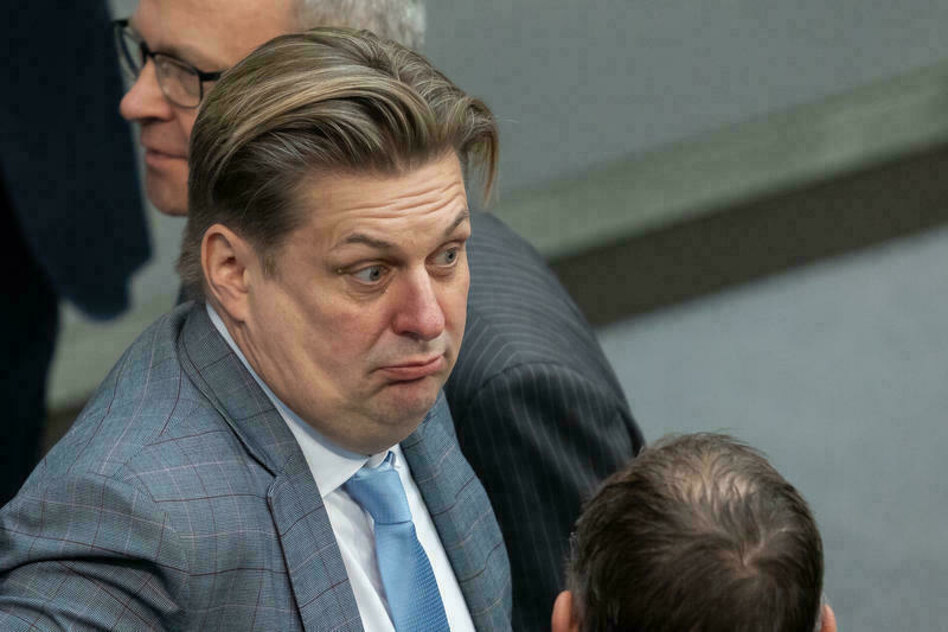
“After Hungary, we also lost Serbia.” This is not a quote from the Kremlin, but one from AfD member of the Bundestag Maximilian Krah. While half of Europe celebrated Aleksandar Vučić's fall on Sunday, Krah spoke on X of “not a good day”. The right needs to reposition itself, its previous concept is no longer convincing.
As a reminder, Vučić has dominated Serbian politics since 2012 – as deputy prime minister, prime minister and most recently as president – and converted the country into a hybrid regime. In the Freedom House Index, Serbia fell from 78 points (2016) to 53 points out of 100. Since 2019 it has only been considered “partially free”. The Vučić years were characterized by corruption, a lack of the rule of law and a foreign policy bias towards Moscow.
However, Krah’s “we” is not a slip-up. When Hungary's long-term Prime Minister Viktor Orbán was voted out of office in April, he reported by video from Budapest on the evening of the election. “It’s bad for us, we have to admit that,” he said there. The party leadership, on the other hand, remained taciturn; Alice Weidel only let her spokesman regret the loss of an “important partner”. So far she has remained completely silent about Serbia.
In the first few years after its founding in 2013, the AfD was hardly interested in Serbia. And if so, then for Vučić’s opponents. In 2017, the then party leader Jörg Meuthen received Boško Obradović from the right-wing Dveri Movement, who was running against Vučić for the presidency.
The AfD changed sides in 2019 at the latest. In October 2019, her foreign policy spokesman Armin-Paul Hampel declared Kosovo's independence to be illegitimate when speaking to Vučić's party deputy Marko Đurić. Further examples: After the 2023 Serbian parliamentary election, which was overshadowed by manipulation, AfD MP Harald Weyel blamed the opposition for the violence. In October 2024, co-party leader Tino Chrupalla praised Serbia's “active border protection” and met then Family Minister Milica Đurđević Stamenkovski. In return, the Saxon AfD invited her to speak at its election campaign finale at the beginning of 2025.
The Austrian FPÖ, probably the AfD's closest sister party, has long been openly at Vučić's side. Even under long-time party leader Heinz-Christian Strache, Kosovo was considered part of Serbia. Harald Vilimsky, head of the FPÖ delegation in the EU Parliament, advocated in 2024 that of the entire Western Balkans, only Serbia should be admitted to the EU. Vučić repaid this loyalty with a medal in 2025.
However, proximity to Vučić was never a privilege of the right wing. His party SNS is affiliated with the EVP, the party family of the CDU and CSU. Angela Merkel met him 16 times in nine years and praised the “very trusting” relationship. There were no serious consequences in view of the dismantling of the rule of law; calm in the Balkans apparently counted more than democracy.
Krah's tweet probably reveals honest melancholy. For years, Orbán and Vučić have provided proof that the media, judiciary and elections can be controlled without completely breaking with the EU. The AfD's foreign policy promise - sovereignty, hard borders, rapprochement with Russia - could be demonstrated almost as a prototype in Budapest and Belgrade. Within just over six months, the AfD has lost both role models.
Krah's call for a reorganization is also a self-diagnosis against his will. Anyone who mourns two semi-autocrats who were voted out of office as part of their own “we” is revealing how they want to govern themselves. In doing so, Krah has once again distorted his party.