
War & Militarism taz
+++ News in the Ukraine War +++: USA approves sale of 500 Patriot missiles to Ukraine
Ukraine is set to get Patriots for $2 billion, paid for by Germany, Canada, Norway and the EU. But there is no delivery date yet. more...
Deutsch (original) ·Auto-translated to English
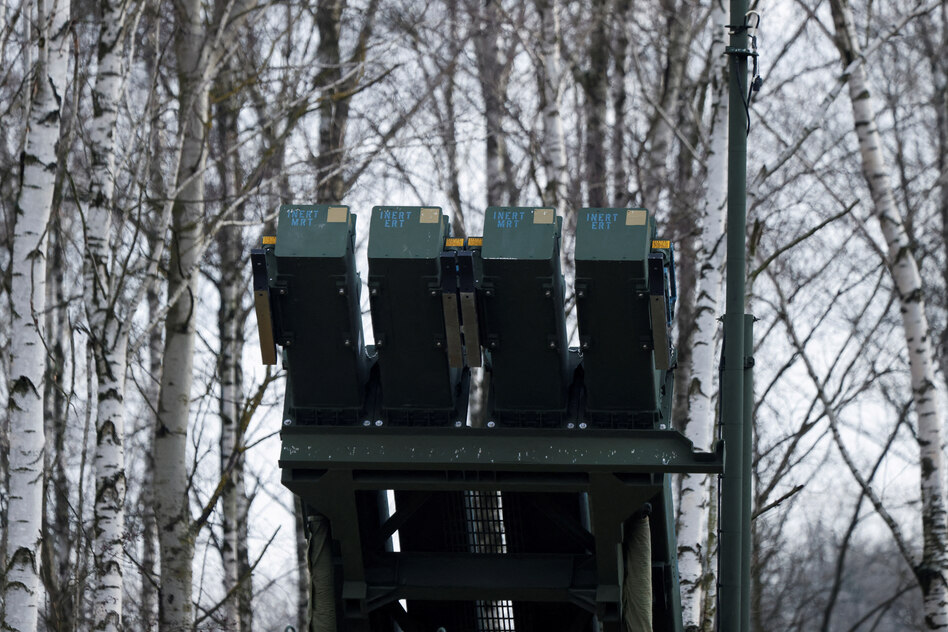
The US administration of President Donald Trump has given the green light to sell 500 Patriot interceptor missiles to Ukraine. "The proposed sale will improve Ukraine's ability to address current and future threats by strengthening its integrated air and missile defense capabilities," the US State Department said in Washington on Friday. Ukrainian President Volodymyr Zelenskyj welcomed the decision, but warned that deliveries would not begin for a few years.
According to US information, the planned sale is worth two billion dollars (almost 1.8 billion euros) and is still being examined by the US Congress. Washington did not give a delivery date. The US also pursued its own interests with the deal, as the State Department explained: “This proposed sale will support the foreign policy and national security objectives of the United States by improving the security of a partner country that is an important pillar of political and economic stability in Europe.”
Zelenskyj spoke on Friday evening in the online service X about a “strong decision by the US State Department”. However, deliveries could only begin “in a few years”. “We ask our American partners to find a solution for the time when there is real danger and PAC-3 interceptor missiles are needed,” Zelensky said. He suggested that the United States and European allies first hand over missiles from their stockpiles to Ukraine and later replace them with the newly ordered weapons.
The Patriot interceptor missiles are particularly important for Ukraine to deter Russian ballistic missiles. Kyiv has been complaining about dwindling supplies for weeks. On Wednesday, Zelensky said his country would receive an average of only twelve Patriot missiles per month in 2026. There is also a “significant shortage” of interceptor missiles for the Norwegian Nasams system. According to the US State Department, the new purchase will be paid for with contributions from Germany, Canada and Norway as well as with Ukrainian funds from a loan from the European Union. “No US resources will be used,” said Washington.
Since Trump took office in early 2025, the US has stopped direct military aid to Ukraine. However, through the so-called Purl mechanism, NATO states and other allies can buy weapons packages worth $500 million each from the USA for Kiev. Germany has already participated in three such packages and in June pledged an additional $200 million for a weapons package and an additional $200 million for Patriot interceptor missiles.
On October 20, Zelensky had already accused the USA of delaying the delivery of missiles that European partners had “already paid for” via Purl. The signature of US Defense Secretary Pete Hegseth is still missing for a delivery. According to him, European states that wanted to sell Patriot missiles from their stocks were also waiting for approval from Washington. "The missiles are ready for use. They could already be in Ukraine," Zelensky said at the time. “But unfortunately the (afp)
According to Russian military information, the people rescued from the front-line town of Oleshky, which was occupied by Moscow's troops, were flown out of the Black Sea city of Anapa. The Defense Ministry announced this morning that they would be taken to Gomel in Belarus in Russian military aircraft together with the Ukrainian human rights representative Dmytro Lubinets. From there they travel on to Ukraine.
There was no concrete information on the number of people rescued during the evacuation from Oleschky the day before. According to reports, more than 200 people left the city in the Russian-annexed Kherson region towards Ukraine. Dozens of people had decided to leave for areas controlled by Russia. According to Russian and Ukrainian information, people had the choice of leaving the country or staying in the rubble town of Oleschky. Dozens of refugees were temporarily accommodated in Simferopol on the Russian-annexed Black Sea peninsula of Crimea before continuing their journey.
More than 1,000 people could still live in the city, which is isolated from the outside world. Before the war, Oleschky had around 24,000 inhabitants. The region, which is extremely mined and has many anti-tank barriers, is sealed off from the Russian military. Ukrainian drone attacks in the area are considered particularly dangerous. The Ukrainian representative Lubinets and his Russian colleague Jana Lantratova personally accompanied the evacuation on Friday. They thanked US First Lady Melania Trump for brokering a ceasefire lasting several days and held out the prospect of possible further humanitarian actions for people in need in frontline cities. The ceasefire for the Kherson region, which is partly controlled by Russia and partly by Ukraine, ends on Sunday evening. (dpa)
According to authorities, two people were killed in a Ukrainian drone attack in the Russian border region of Bryansk. The regional administration said five other people were injured when the drone hit a residential building in the town of Klimowo. The Russian military shot down 29 Ukrainian drones over the region in the past 24 hours. (rtr)
A good six weeks before the G20 summit of the major industrialized and emerging countries, there is no sign of an end to the ice age between European member states and Russia. According to Russian Foreign Minister Sergei Lavrov, there is no easing in relations between Moscow and Washington. "In practice, there has so far been no real progress in relations with the USA. There should be no illusions about the diesel deal," said Lavrov on the sidelines of the G20 foreign ministers' meeting in Atlanta, Georgia. At the beginning of October, US President Donald Trump and Kremlin chief Vladimir Putin agreed on diesel deliveries from Russia to the US, for which Washington temporarily suspended existing sanctions against Moscow. The deal triggered sharp international criticism - from the EU, Ukraine, the federal government and also from parts of the US Congress.
Lavrov criticized Washington for saying that the fundamental questions were not being resolved, that sanctions were continuing, that all previous US sanctions imposed by then-President Joe Biden would be continued, and that additional sanctions would be imposed on the oil giants Lukoil and Rosneft. With a view to the consultations between Ukraine, the USA and Russia that were planned in mid-November in Abu Dhabi, the capital of the United Arab Emirates, following Kremlin hints, on a continuation of the talks on a possible peace solution that had been interrupted for months, Lavrov criticized the Europeans: “They are trying to interfere in the peace negotiation process in Ukraine.”
At the same time, Lavrov sharply criticized his German colleague Johann Wadephul (CDU), whom he accused of “family photo diplomacy”. “If the most important thing for them is how they look in a family photo and who is standing next to them, then that says it all,” he complained. US Secretary of State Marco Rubio canceled the usual “family photo” of all participants in the group after there had apparently been sharp criticism of it, especially from European member states. Among other things, according to a report by Polish radio, Polish Foreign Minister Radoslaw Sikorski, who was invited by Rubio as the only guest to the G20 round, spoke out against such a photo with Lavrov. However, Sikorski said he wasn't the only one. Wadephul had already said shortly before the start of the G20 consultations: “In any case, there will be no family photo in which our European partners are together with Mr. Lavrov.” On ZDF in the evening, the Federal Foreign Minister said that the term “family photo” evoked “the feeling of unity, that we belong to each other. And we really are not such a family with Russia at this point in time.”
The deliberations in Atlanta were controversial with some participants, but the tone was objective and did justice to the seriousness of the situation, Wadephul added. “Everyone notices, everyone knows that the world is in an extraordinarily critical situation” and that it is the task of the G20 to “try everything to defuse conflicts and crises.” Unlike Putin, Lavrov has recently been a regular guest at G20 meetings. Russia is still officially a member of the group, but Putin last physically attended a summit in 2019. The G20 group includes 19 countries as well as the European Union and the African Union. (dpa)
Russia's Foreign Minister Sergei Lavrov has described his government's stance on the Ukraine conflict as unchanged. Ukrainian President Volodymyr Zelensky's statements about attacks on Russian targets are not helpful in preparing for new talks, Lavrov said on the sidelines of a G20 meeting in Atlanta, according to Russian news agencies. In addition, fundamental problems in relations with the USA remain unresolved, as sanctions against Moscow remain in force and weapons continue to be supplied to Kiev.
Both Russia and Ukraine had agreed to further trilateral talks with the USA. Zelensky said this week that he hoped for a trilateral meeting of negotiators from November 6 to 10 in Abu Dhabi. Kyiv also wants Europe to be included in the peace talks.
Lavrov said Russia's position "has remained unchanged since the start of the special military operation." Moscow cannot accept that Ukraine is a “military threat to the legitimate security interests of the Russian Federation.” As an example of continued U.S. support, he pointed to Friday's State Department announcement that it had approved the sale of 500 Patriot PAC-3 missiles to Ukraine. At the G20 meeting, the foreign ministers decided not to take the traditional group photo. Some made it clear that they refused to be photographed with Lavrov. (rtr)
UN Human Rights Commissioner Volker Türk has described the closure of the Russian newspaper Novaya Gazeta as a “devastating blow” to independent media in the country. Türk said on Friday that he was “deeply concerned” and “dismayed” that the newspaper would be “forced” to stop work. Independent journalism in Russia has been subject to increasing “restrictions and pressure” for many years. Since Russia's invasion of Ukraine, the restrictions have been “significantly intensified”.
On Friday, editor-in-chief Sergei Sokolov announced that the newspaper was ceasing its work completely due to pressure from the Russian authorities. She has to leave her premises from November 9th. The newspaper's founder and Nobel Peace Prize winner Dmitry Muratov described the closure as part of Moscow's "gigantic military operation" in Ukraine. Media rights organizations reacted to the move with dismay. (afp)
Ukrainian President Volodymyr Zelensky has said he will hold “important” talks in Turkey as part of diplomatic efforts after more than four and a half years of war with Russia. In his evening video address, Zelensky indicated that the talks were linked to the resumption of negotiations next month aimed at resolving the conflict. "Important negotiations will take place in Turkey. We are also working to exhaust all available diplomatic options," Zelensky said. “We expect that in November we will be able to move on to the formats that have been discussed for so long.”
Turkish President Recep Tayyip Erdogan's communications chief said on Platform X that Zelensky would meet Erdogan in Istanbul on Saturday. The Ukrainian president expressed hope this week that a trilateral meeting of negotiators from Ukraine, Russia and the United States could take place in Abu Dhabi between November 6th and 10th. He would also like Europe to be included in the talks. Turkey, in turn, has repeatedly offered its support in brokering talks to end the war. (rtr)
Russian forces have again attacked the Ukrainian capital, according to Kiev Mayor Vitali Klitschko. The goal was the infrastructure, Klitschko said on Telegram. The energy supplier DTEK also explained that there was a partial power outage in four districts of the city. (rtr)
Russian Foreign Minister Sergei Lavrov said he had a “pleasant” conversation with his US counterpart Marco Rubio on the sidelines of the G20 foreign ministers meeting in the United States. “We had a pleasant conversation, albeit a short one, because, for understandable reasons, he has many responsibilities as a host,” Lavrov told reporters on Friday. Rubio invited Lavrov to the meeting in Atlanta, Georgia. The background to the meeting between the two foreign ministers is US President Donald Trump's rapprochement with Russian President Vladimir Putin. (afp)
According to government information from Kiev, the Russian armed forces are continuing their attacks against the Ukrainian energy sector unabated. "Unfortunately, there are hits on the energy infrastructure every day, a lot of damage; the Russian operation against our electricity generation, against our networks and against the electricity connections continues," said President Volodymyr Zelensky in his evening video address. In many places, emergency services are on duty to restore supplies.
Nevertheless, further Russian attacks repeatedly caused work interruptions and new power outages. “The Russians have not taken a single step to de-escalate the energy sector,” Zelensky said.
Meanwhile, Ukraine is expanding its capabilities for long-range attacks with its combat drones. “Russian facilities on the line from the Yamal Peninsula deep into Western Siberia are now within range of our long-range drones,” Zelenskyj reported on Facebook. At the same time, he announced the expansion of these ranged combat units. “Ukrainian long-range combat capabilities are among the real guarantors of our independence in this war, and they will remain our long-term security guarantee after the war.” (dpa)
Canada wants to contribute to the costs of a 90 billion euro loan from the European Union for Ukraine. Ottawa announced this after the two-day EU-Canada summit in Montreal on Friday. Specific details about the investment were not initially disclosed. The move is a symbol of the ever closer rapprochement between Canada and the EU. Both sides signed several agreements on Friday to deepen their cooperation in strategic areas such as raw materials and artificial intelligence.
Brussels has granted Ukraine a loan of 90 billion euros for 2026 and 2027. This is intended to enable Kiev to close budget holes and buy weapons - preferably in Europe. The loan is financed through a loan that the EU secures through its budget. The interest amounting to three to four billion euros per year should also be paid from the EU budget. Ottawa could contribute to these costs and in return be included in the group of countries that should be given priority when awarding Ukrainian defense contracts. Great Britain made a similar agreement with the EU regarding the billion-dollar loan. (afp)