
War & Militarism taz
+++ News in the Ukraine War +++: Ukraine support divides Germany
The question of support divides Germany more than any other issue. Merz urges EU partners to participate more in Ukraine financing. more...
Deutsch (original) ·Auto-translated to English
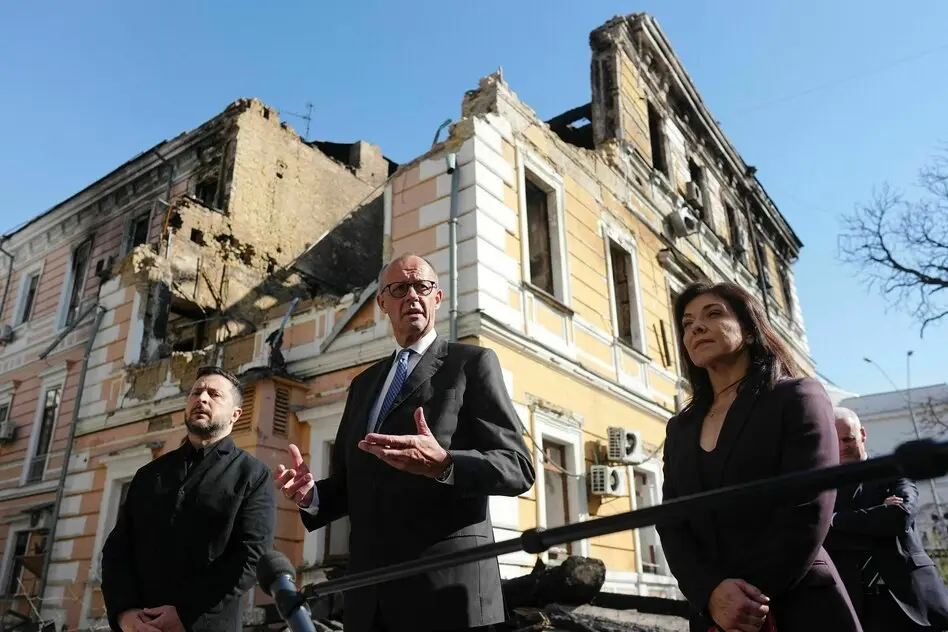
The question of support for Ukraine divides people in Germany more than any other issue. This emerges from the polarization barometer for the current year, which the Mercator Forum Migration and Democracy at the Technical University of Dresden published on Tuesday. According to this, almost 54 percent of those surveyed want Germany to continue supporting Ukraine in its defense in the Russian war of aggression. Around 29 percent, however, called for rapprochement with Russia.
At the same time, according to the study, positions on the fringes have hardened: around 17 percent have chosen the highest value on a scale from 0 (distancing themselves from Russia) to 10 (coming closer to Russia) and thus the greatest possible rapprochement with Russia. In the barometer for 2025 it was just under 14 percent.
Compared to the previous year, the question of support for Ukraine has replaced the immigration debate as the most charged topic. There, 47 percent now believed that immigrants would also have to adopt German culture and way of life - 7 percentage points more than in 2025. At that time, according to the study, the prevailing opinion was that language acquisition and compliance with the law were enough.
The dispute over rainbow flags in public spaces was the only one of 15 social issues examined that had significantly lost its intensity - both in terms of camp formation and in emotional perception. While a relative majority rejected the flags in 2025, supporters (31 percent) and opponents (almost 30 percent) were now almost evenly matched.
Overall, however, the feeling of a general social division remains widespread in Germany. 83 percent of those surveyed expressed this view, around two percent more than in the previous year. This perception is particularly pronounced among people who identify themselves politically on the right or are close to the AfD. East Germans also reported more often that they perceived a division.
The Mercator Forum Migration and Democracy, together with the market research institute YouGov, surveyed a total of 2,785 people in Germany on 15 social topics in March 2026. According to the information, it was a panel survey; So the same people were surveyed as in 2025. (kna)
Britain wants additional channels of communication with Russia, particularly at the military level. This is intended to reduce the risk of misjudgments, Defense Minister Wes Streeting told the Financial Times newspaper. The British Embassy in Moscow is an important channel, but he would very much welcome further direct contacts. Relations between Moscow and most European capitals, including London, have been on hold since Russia's invasion of Ukraine in February 2022. (rtr)
Chancellor Friedrich Merz (CDU) is calling on all EU states, without exception, to make a “fair contribution” to closing the billion-dollar gap in Ukraine financing. In a letter to EU Council President António Costa, he indirectly threatened a blockade on other financial issues if there was no common commitment to aid to Ukraine.
Such a commitment is “an essential prerequisite for solving this problem and for discussing further questions, especially those with financial implications,” says the Chancellor’s letter, which is available to the German Press Agency. It's about 45 billion euros that will be missing for Ukraine next year.
In the letter, Merz also calls for a solution supported by all member states to be found for solid financing of Ukraine, which is attacked by Russia, over several years as part of the negotiations on the EU budget for the years 2028 to 2034. The EU wants to reach an agreement on the entire financial framework by the end of the year.
“Supporting Ukraine is a question of our indivisible European security, and this must also apply to the burden-sharing of support,” the Chancellor wrote in his letter to Costa. He is calling on the EU Council President to put the issue “as a priority” on the agenda of the informal EU summit in Dublin on Friday.
The EU Commission had previously put the financial gap next year at 70 billion euros, of which the European Union should cover 45 billion euros. The EU had already approved 90 billion euros for Ukraine last year for the years 2026 and 2027.
But this sum is no longer enough. Ukrainian President Volodymyr Zelenskyj had already demanded an additional 70 billion euros from his allies in October in order to be able to defend themselves against the Russian attackers. The heads of state and government then called on the EU Commission to make a proposal to cover the additional financing needs.
But there is resistance from several member states. The Bulgarian Prime Minister Rumen Radev and the Slovakian Prime Minister Robert Fico have already announced that they no longer want to participate in any new EU financial aid for Ukraine. Hungary and the Czech Republic are also considered shaky candidates.
The Hungarian Prime Minister Peter Magyar will be received by Federal Chancellor Friedrich Merz in the Chancellery today. Aid to Ukraine is likely to play an important role in this. Germany is by far Ukraine's most important donor in the EU. This is also where the Chancellor's urging to spread the burden more broadly comes from. (dpa)
The agreement with the USA on diesel deliveries is already having an effect and is lowering prices, writes Russian Foreign Minister Sergei Lavrov in an article for the Moscow daily newspaper Kommersant. US President Donald Trump announced the agreement on October 9th.
It envisages Russia initially supplying 300,000 tons of diesel to the US and global markets to reduce fuel prices ahead of the US midterm elections. The US government temporarily suspended its sanctions against Russian fuel. Lavrov further writes that Ukraine is ignoring Trump's calls to stop attacks on Russian energy facilities. Meanwhile, Russian media reported renewed fuel shortages in at least half a dozen Russian regions. The reason for this is Ukrainian attacks on at least eight large oil refineries in the past two weeks. (rtr)
Russian and Ukrainian representatives want to meet in Abu Dhabi for US-mediated talks. These are the first direct negotiations since February. Representatives from the EU, Germany and France are sending representatives to the talks. However, Russia has said it will not accept European representatives at the talks.
From Kiev it was said that the Ukrainian delegation would separately inform its European allies about the progress of the talks. “We are doing everything to ensure that Europe is involved in the diplomatic process,” said the head of the Ukrainian delegation, Rustem Umyerov, on Monday. The Russian delegation includes, among others, Kremlin advisor Vladimir Medinsky and Deputy Foreign Minister Sergei Ryabkov. (rtr)
According to authorities, two people were killed in a Ukrainian drone attack in the Russian border region of Belgorod. A drone attacked a car in the Borissowka district. Two men inside were killed, the regional civil defense team said. The information cannot be independently verified.
Russia has been waging a destructive war of aggression on Ukraine for more than four and a half years. Ukraine is increasingly defending itself with drone attacks in the Russian hinterland. Belgorod Oblast is one of the most war-affected regions in Russia. Nevertheless, the number of civilian casualties and the extent of destruction in Ukraine are significantly greater than in Russia. (dpa)
According to the International Atomic Energy Agency (IAEA), an employee was killed in a drone attack on the Russian-occupied Zaporizhia nuclear power plant in southeastern Ukraine. In addition, another employee was killed on Monday in another drone attack at a thermal power plant near the nuclear power plant, as the IAEA announced in the online service X. The organization did not provide any information about who carried out the attacks.
IAEA Director Rafael Grossi strongly condemned the attacks. This would “violate indispensable pillars of nuclear safety,” he explained. Employees at nuclear facilities must be able to “carry out their work without undue stress or fear,” emphasized the IAEA. At the end of October, the organization had already reported a death in the Zaporizhzhia nuclear power plant due to a drone attack. (afp)