
War & Militarism taz
“Because peace is sugar” at the DSH: Karadings doesn’t want to go to war
Anita Vulesica turns an anarchic anti-war novel by Georges Perec into an exuberant evening at the theater in Hamburg. more...
Deutsch (original) ·Auto-translated to English
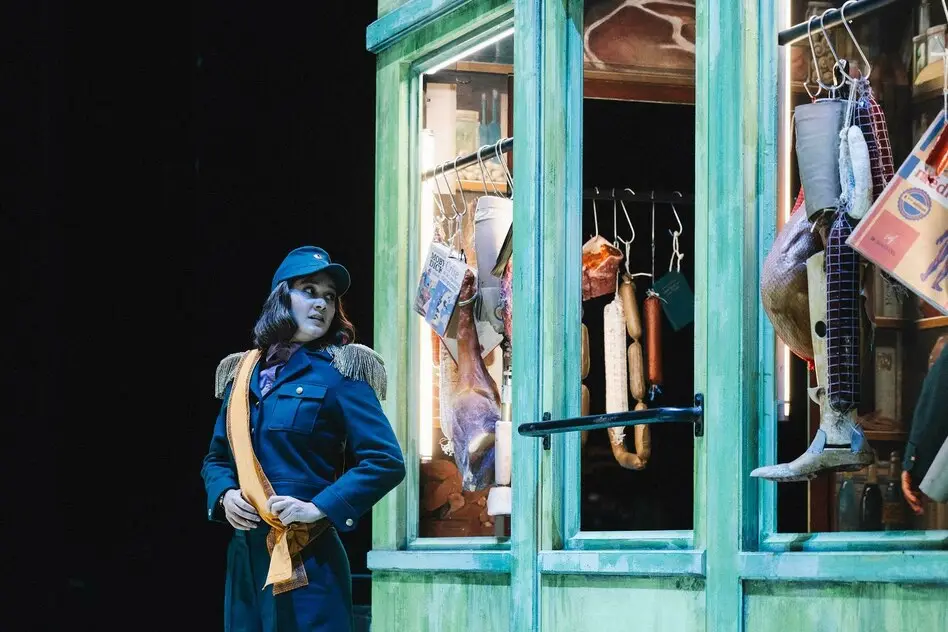
No, he's not fit to be a hero, this Karadings. Not the classic one, which has since fallen into disrepute. But actually he's not entirely to the taste of these birds surrounding tables in Paris, whose help he now needs, this, well, what was his name: Kara-wutz? Kara-kuh? - There are 72 name variations of the competence model Kara-n, which means that the main character, embodied at the Deutsches Schauspielhaus by Christoph Jöde, has 72 name variations in the text of “Because peace is sugar” - this Karading is supposed to go to war.
It is important to defend the proud French nation, if not the Christian West. In Algeria. But Karamanlis (or something like that) doesn't want to. He would rather stay in Paris, where the girl he was fooled by lives. His friend Henri Pollak (Katrija Lehmann), a non-commissioned officer by day, a bohemian by night, and his friends are supposed to help, just as the literary original would have it: Georges Perec's short novel with the awkward title "What kind of little moped with a chrome-plated handlebar is there in the yard?" was published in France in 1966.
In any case, Pollak Henri is the owner of the small moped of the title (with chrome-plated handlebars!) and, as an orphan, is exempt from working in the rebellious colony. He and his associates (Moritz Grove, Henni Jörissen and Matti Krause) discuss how they can help Karathustra out of trouble: “Break my foot,” Karamalis demands at one point, “so that I can never use it for mystical purposes again” (or at least stay in the hospital until peace is signed).
Other options for disqualification are also discussed. None of these are without problems. A broken arm is supposed to save the Karakorum from having to be shipped out, despite all the risk that the injury could permanently “mess up his bones, tendons and joints, fibers, ligaments, fat, lean and the whole magic.”
From the fictitious fall down the metro station steps, as Karaschrei is supposed to tell it, you end up with a supposed suicide attempt: That will bring the psychoanalytic company into action, long enough until peace is signed.
It's sugar, they all agree on that. With his motives, Karadings is just like us. But when the first efforts to save him are completed and Karakiri is not on the list, so he is spared the front line for the time being, and the working-class child Karadigma, on top of that, cares much less about politics and socialism than Pollak Henri and his academically educated friends, they are really angry: "So we had toiled away and run into expenses, but puff cake," Perec lets the comrades complain about caramel, and: “Of course it stinked to us.”
The story “Quel petit vélo à guidon chromé au fond de la cour”, i.e. “What kind of little moped with a chrome-plated handlebar is there in the yard?” was Perec's second published book in 1966. So again, it is not a text that Anita Vulesica stages that was genuinely written for the stage. Her highly acclaimed “Machine” production was based on a radio play by Perec almost exactly two years ago; one that never existed in France, in French.
Once again the director turns the material into a dense, fast-paced, yes: sometimes exuberant evening of theater including a brass band, sometimes amplified with techno (music: Camill Jammal), dance performances by Jöde and a flying moped (with chrome-plated handlebars!).
Perec's play with form is a fitting addition to Perec's theatre. The son of Jews who had immigrated from Poland - his father was fatally injured in the war in 1940, his mother was deported to Auschwitz and murdered in 1943 - he studied sociology, earned his croissants among the files of a scientific institute, and repeatedly subjected his writing to rules that were not dictated by the content.
Repetition and variation, similarity and deviation structure and generate the material. The text is often constructed strictly mathematically, for example with the help of Euler squares, to have a musical effect. Traces of this increasingly sophisticated poetics can also be found in the wilder “Moped” story: Perec has appended to it a “list of rhetorical phrases and figures of speech and, more precisely, of the metaboles and parataxes that the author thought he had identified in the text he had just read,” ranging from “abbreviation” to “pseudoepigraph, of course, etc. etc. etc.”
That sounds so cheerful. Nevertheless: love, death, war and its absence - these are huge ingredients, which elsewhere groan with meaning, with which Perec creates his cybernetic picaresque pieces. From which Vulesica and a good-humored ensemble once again primarily (not to be confused with: only) work out everything that is comedic.
A German edition of the “Moped” booklet reached the audience in the GDR in 1967 before the Federal Republic edition - possibly because people in Berlin (East) appreciated the level of criticism of colonialism. In the probably authoritative translation by Eugen Helmlé, first published in Hof in 1970, it is still available today. Was the choice of material really an “excavation” of something that had been overlooked, as some theater reviews now suggest?
Admittedly, to make it part of, let's say, a school teaching canon of the well-intentioned, among the kind of books that a democratically purified society is so happy to give to its young people (and which then regularly fill city theater stages): the book is probably too anarchic for that. Perhaps the motives of the – spoiler: ultimately failing – military power destroyers are not sufficiently presentable. And yet that is precisely why it fits into the game plans in our changing times.
In 1966, the real war of the Great Nation in Algeria was just a few years ago. And in any case, the questions back then are not simply the same as those that will concern a young man affected by the draft today, whether in France, Germany or, let's say, the Ukraine. Or are they very much so?
Clearly: If a colonial power takes military action against the population of its colony, then non-participation and refusal can be justified more easily and morally more cleanly than today against an aggressor Russia or Hamas. You can then find that this Hamburg production is cheating around the actually delicate updates, the translation to where the nitty-gritty is really at stake.
This criticism would have confused Perec with a military strategist or the play with training material. Vulesica and her team tease out something different (and with suspicious, yes: enjoyable results): Colorful, loud, lively and always funny, this party on life shows what, God knows, threatens to end up under the chains - whenever only the logic of the military is taken into account.