
World taz
+++ News in the Iran War +++: Pakistan wants to mediate between the USA and Iran again
As the US moves its third aircraft carrier to the Gulf, Tehran is ruling out new inspections of Iranian nuclear facilities before the war ends. more...
Deutsch (original) ·Auto-translated to English
Pakistan wants to continue mediating between Iran and the USA. Prime Minister Shehbaz Sharif and army chief Field Marshal Asim Munir are in close contact with regional countries and international partners to facilitate peaceful solutions, Foreign Minister Ishaq Dar said on Monday at a meeting of the Economic Cooperation Organization (ECO) in Islamabad, which was also attended by Iranian Foreign Minister Abbas Araghchi. Dar stressed that peace and stability are essential for economic development. Pakistan is “deeply concerned about conflict and instability” in the region.
“Their consequences extend beyond national borders, disrupting trade routes, energy supplies, investments and the economic projects of our peoples,” he said. “Peace and development reinforce each other.” Pakistan hosted a first round of direct talks between the US and Iran in April. “Pakistan will continue these diplomatic efforts in support of dialogue, de-escalation and lasting regional stability,” Dar said. (ap)
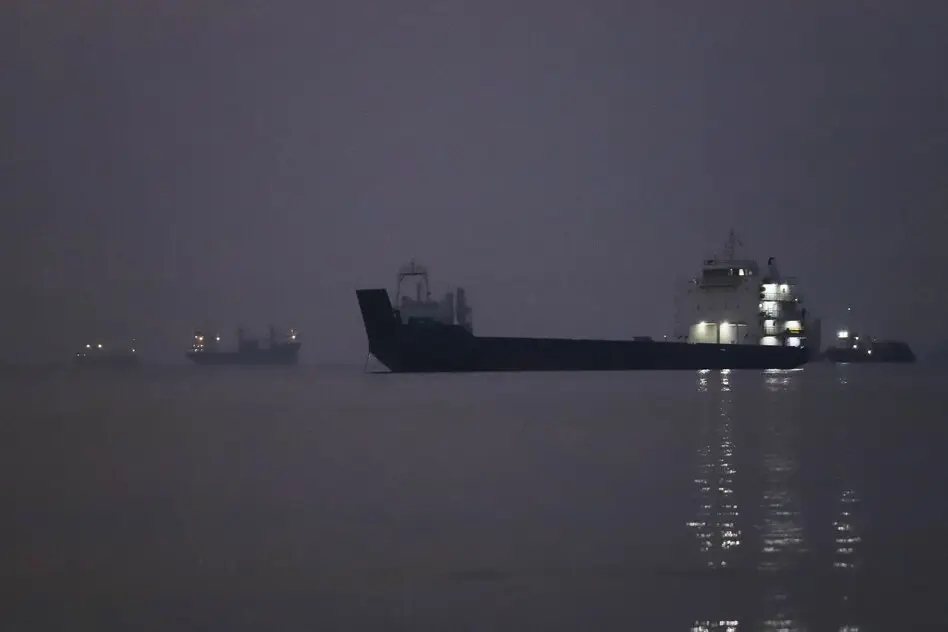
According to a report by Iranian state television, three oil tankers caught fire in the Strait of Hormuz on Monday night and early Monday morning after hitting sea mines. As the Iranian Revolutionary Guard Navy announced, six oil tankers have been damaged by mines since Sunday; There was also environmental pollution on the coasts along the strait. Shipping companies were warned in the report that a U.S.-protected route in the strait remained dangerous due to mines. No information was given about possible victims or which flag the tankers were flying.
Separately, the British Navy's maritime trade watchdog (UKMTO) said an unknown missile hit a tanker that was about to transit the Strait of Hormuz. The attack caused a fire in the ship's engine room. Nothing was known about possible victims. The strategically important waterway, through which about a fifth of the world's crude oil and large quantities of liquefied natural gas and fertilizer are shipped in peacetime, has become the focal point of the conflict between the United States and Iran. (ap)
Iranian Foreign Minister Abbas Araghchi has blamed the US and Israel for insecurity in the Persian Gulf and the Strait of Hormuz. The US is violating international law and the UN Charter with “aggression, threats, targeted assassinations, economic coercion and blockades,” Araghchi said at a meeting of the Organization for Economic Cooperation (ECO) in Islamabad on Monday, according to the Iranian state news agency Irna. Araghchi emphasized that Iran, on the other hand, has always adhered to international law and the peaceful resolution of disputes. “Over the past two years, Iran has remained committed to diplomatic engagement and peaceful solutions,” Araghchi said.
After the American-Israeli attacks began at the end of February, Iran practically blocked the Strait of Hormuz, through which around a fifth of the world's crude oil is shipped, as well as large quantities of liquefied natural gas and fertilizer. He is now allowing some ships to pass through again, but is claiming control and has, at least in some cases, demanded money for passage. The USA, in turn, is blocking Iranian ports. Maritime law experts view Iran's control claims and toll demands as a violation of international law. According to the United Nations Treaty on the Law of the Sea, countries must allow innocent passage through their territorial waters. The ECO includes Afghanistan, Iran, Pakistan, Turkey and several former Soviet republics. (dpa)
The third US aircraft carrier, the USS Theodore Roosevelt, has arrived in the Gulf region. The New York Times and the news portal Axios reported this on Sunday. The US appears to be preparing to resume large-scale attacks against Iran after talks to end the war stalled, experts say. The USA and Israel started the Iran war with air strikes at the end of February. Since then, Tehran has regularly attacked targets in the Gulf states and US facilities in the region. After a period of relative calm, the Iranian Revolutionary Guards said they had attacked targets in Bahrain several times in recent days. (afp)
According to a human rights organization in Bahrain, 64 Shiite clerics have been sentenced to life imprisonment for suspected terrorist crimes. Five others were sentenced to 15 years in prison, the Bahrain Institute for Rights and Democracy said on Monday. 56 of the defendants are in custody, while 13 clergy were convicted in absentia. According to the institute, the mass trial against the clergy was overshadowed by allegations of torture and violations of constitutional procedural principles.
They were convicted, among other things, of founding a terrorist organization with the aim of overthrowing the government. They were also found guilty of propagating the Iranian model of rule as an Islamic Republic. One of the defendants was also accused of spying for Iran, according to the human rights group. In the conflict between the USA and Iran, Bahrain and other allies of Washington in the Persian Gulf have repeatedly been the target of Iranian attacks - most recently at the weekend. (ap)
The US ambassador to the UN, Mike Waltz, has called on the pro-Iranian Hezbollah militia in Lebanon to “voluntarily” disarm. “No country can have two armies,” Waltz said Monday during a visit to Lebanon. "I hope and pray that Hezbollah disarms. They should do so voluntarily," he added. Waltz also stressed that “Lebanon’s sovereignty must be fully restored.” “The instrument for this will be the Lebanese armed forces,” said the US ambassador.
Hezbollah dragged Lebanon into the Iran war with attacks on Israel in March. Israel responded with air strikes and a ground offensive. In the meantime, the governments of Israel and Lebanon agreed on a framework agreement that, among other things, provides for the disarmament of Hezbollah and a withdrawal of the Israeli army from the south of Lebanon. Hezbollah rejects talks with Israel and disarmament. (afp)
The major Hamburg shipping company Hapag-Lloyd is sending more container ships through the Suez Canal and the Red Sea. The largest German container shipping company in terms of capacity announced this in a message to customers. Trips through the Red Sea collapsed after the Gaza War began in October 2023 because the Yemeni Houthi militia, which was hostile to Israel, attacked ships. Shipping companies decided to send ships to Asia instead of going through the Red Sea around the southern tip of Africa. Hapag-Lloyd is in an alliance with the Danish shipping company Maersk, the second largest shipping company in the world by capacity. The announcement therefore affects ships from both companies.
Hapag-Lloyd CEO Rolf Habben Jansen announced in August that he wanted to restart trips through the Red Sea. The situation is slightly better than at the beginning of the year, he said. It had been “a long time since there was an incident with a container ship”. Around two weeks ago, the Hamburg shipping company announced that the Germany-India service IOS was sailing through the Red Sea again. A spokeswoman for Hapag-Lloyd said the shipping company is continually assessing the security situation. “We will continue to monitor developments closely and adapt our network should circumstances change.” Alliance partner Maersk from Copenhagen has been using the Red Sea for transport for longer than Hapag-Lloyd. The return was initiated before the start of the Iran war, which began at the end of February, a company spokesman said upon request. (dpa)
The government in Tehran has ruled out inspections of Iranian nuclear facilities by the International Atomic Energy Agency (IAEA) before an end to the Iran war. “We will not grant the IAEA access to the facilities until Iran’s conditions are met and the war is permanently ended,” Iran’s Deputy Foreign Minister Kasem Gharibabadi said in a television interview on Sunday evening. A corresponding request from the UN agency was “presumably aimed at assessing the effectiveness of American weapons,” Gharibabadi added. Last week, the IAEA urged Iran's leadership to allow inspections of nuclear facilities in the country. In September, IAEA inspectors were able to visit the Iranian nuclear facility in Bushehr. However, they were not given access to other facilities.
Following the attacks by Israel and the US on several Iranian nuclear facilities, the IAEA has no longer had access to key nuclear facilities in the country since June 2025. Nuclear facilities were also hit during the Iran War that began at the end of February. The authority therefore repeatedly called for unrestricted access to the affected sites to be granted again. Western states have been accusing Iran of seeking nuclear weapons for years. Tehran denies this and assures that it only operates its nuclear program for civilian use. (afp)
According to the Foreign Ministry, the upcoming summit meeting of the presidents of China, Russia and the USA in Beijing will be about “world peace”. Thursday's talks in Shenzhen, China, would be of "groundbreaking significance," a Chinese Foreign Ministry spokeswoman said on Monday. China's President Xi Jinping will hold talks with Russian President Vladimir Putin and US President Donald Trump in "in-depth discussions on maintaining world peace and promoting strategic stability in relations between major powers," a Chinese Foreign Ministry spokeswoman said. Shortly before, Beijing had confirmed the planned summit meeting after Washington and Moscow.
The historic tripartite summit is scheduled to take place on Thursday on the sidelines of the Asia-Pacific Economic Cooperation (APEC) summit. The White House had already announced the date on Friday, and on Saturday the Kremlin confirmed Putin's participation. Trump wants to talk about nuclear disarmament and the Iran war at the summit. According to US government officials, the war in Ukraine should not be discussed. During his trip to China at the end of October, Federal President Frank-Walter Steinmeier said that Xi had reacted irritably when he asked him about possible Ukraine talks at the three-party summit. The Chinese president emphasized that “this is a European conflict in which the Europeans must have a seat at the table.” On denuclearization, China insists that the United States and Russia must first dismantle their own nuclear arsenals before agreeing to negotiations over its own stockpiles. (afp)
In view of tightened sanctions, the US government estimates that the Iranian economy is facing one of the “fastest collapses in history”. He assumes that Iran's economic output will shrink by 25 percent between March 2026 and March 2027, US Treasury Secretary Scott Bessent told Fox News on Sunday. “This is the greatest economic isolation ever imposed on a single country in the history of the world,” he said.
Bessent also confirmed media reports that he had left his private residence because of alleged threats from Iran. The threat level was too high to stay there, he said, without providing further details about his new whereabouts. Bessent had increased economic pressure against Tehran in recent months on the orders of US President Donald Trump. The USA imposed sanctions on Tehran's supporters, including banks, individuals and companies as well as airlines. (dpa)
A supertanker carrying more than two million barrels of oil sank in the Strait of Hormuz, according to the Iranian Revolutionary Guard. The ship had previously hit a mine and caught fire, the Revolutionary Guards said on Sunday. Another ship was also hit by a mine. There was no independent confirmation of the information. Since the Iran War began at the end of February with US and Israeli attacks on the country, Iran has blocked shipping through the strategically important Strait of Hormuz. Tehran insists that ships can only travel through the strait on routes permitted by Iran. Ships are regularly attacked.
The US had therefore blocked Iranian ports and tried to help ships transit the Strait of Hormuz. Before the war, a fifth of the world's oil transport passed through this strait. According to the Iranian Revolutionary Guard, the two ships were hit by mines in the southern part of the Strait of Hormuz. There were “large explosions and fires,” the Revolutionary Guards said, according to state television.
One of the two tankers “sank in the southern waters of the Persian Gulf.” The names or origin of the ships were not mentioned. A British maritime control agency reported on Sunday that there were reports from Indian shipping authorities of an attack on a tanker in the Gulf; But it was unclear whether it was the same ship about which the Revolutionary Guards made their statement. Britain's shipping authority UKMTO said the damage and environmental impact of the incident was unclear but that the crew was safe. (afp)